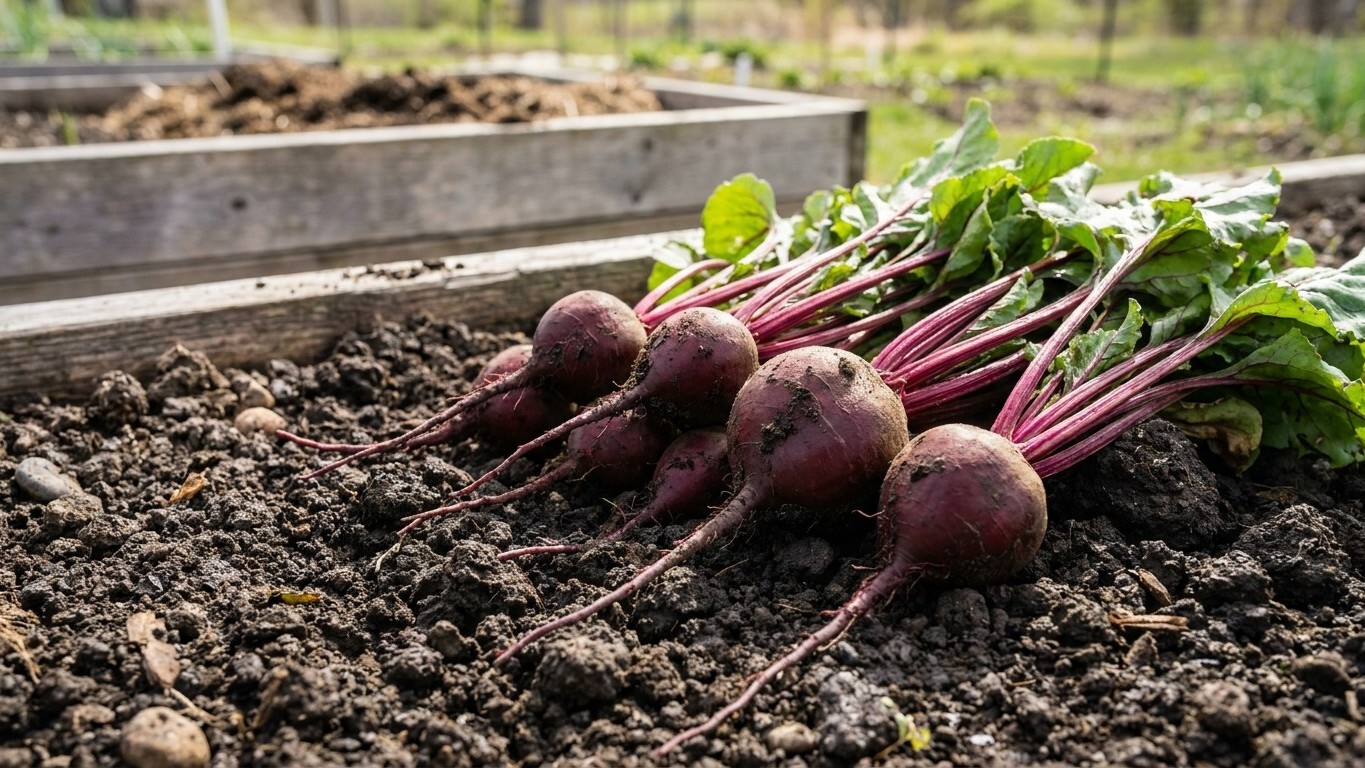

In Pennsylvania, what eats into a beet crop is mostly what the soil and weather hand out. Thirst in the first six weeks sends plants to flower. Heat above 85 F, combined with thirst, turns roots woody. In storage, too much cold brings black spot and rot. That makes two failures in the garden and one in the cellar. Insect pests are not covered by the sources behind this page, so they are left out here.
The short answer
The state’s reference soil is the Hazleton series, an Inceptisol, meaning a young soil that has not yet developed strong horizons. USDA records its surface layer as loam to silt: 46 percent sand, 12 percent clay and 42 percent silt. Organic matter is about 3.0 percent, the surface pH is about 4.6 (strongly acid), and the drainage class is well drained. These are representative values for the mapped surface horizon of the series, not a measurement of a worked garden bed.
Utah State University Extension describes the beet’s ideal as deep, sandy, well-drained soil rich in organic matter. Hazleton meets that picture partway. It drains well and carries little clay, which is good news for a root that has to swell without hitting a wall. But it is not sandy in the textbook sense, with silt close behind sand, and 3.0 percent organic matter is modest. The same extension source caps compost at no more than 1 inch of composted organic matter per 100 sq ft, so the fix for modest organic matter is not to bury the bed.
Good drainage cuts both ways. Ground that sheds water also dries fast, and that matters because water stress in the first six weeks is what triggers premature flowering. A free-draining bed forgives a wet April and punishes a dry one.
Treat all of this as a starting point. Pennsylvania spans hundreds of soil series, and your garden may look nothing like Hazleton. River bottoms, ridge-top hill country and any lot a builder has scraped or filled will behave differently. The pH of 4.6 is a figure for the series, not for your yard. A soil test gives you your own number, and Beet Soil in Pennsylvania: What the Root Will Meet goes deeper on what the root finds underground. For the whole growing picture, start with Growing Beets in Pennsylvania.
Then there is the heat. Philadelphia serves as the reference city here, and the count of days a year it passes 90 F is not a figure published for this page, so I won’t guess one. What matters more is that the Utah State threshold sits lower: heat above 85 F combined with water stress is what makes the root woody. A tally of 90 F days would understate the exposure. Woodiness is a late failure, tied to hot weather as the roots size up. It is a different problem from bolting, which happens early. Keeping them apart is the point of the next section.
The six weeks that decide it here
Philadelphia’s last spring frost falls between March 29 and April 6, according to NOAA NCEI U.S. Climate Normals (the 32 F freeze probabilities, 30 to 70 percent band). Sowing two to three weeks ahead of that puts seed in the ground from about March 8 to March 23. The first six weeks then run from roughly April 19 to May 4, depending on the day you started. That stretch is when the plant decides whether to make a root or a flower stalk.
What does a Pennsylvania spring do in those weeks? It swings. Cold snaps, soaking rain and a run of warm, dry days can all show up inside a single month, and the sources behind this page carry no rainfall figures to pin it down further. So the bolting risk does not sit at a fixed date. It sits in whichever dry stretch lands inside your six weeks. On a well-drained loam like Hazleton, a week without rain can leave the top few inches parched sooner than it would on heavy ground. A rain gauge or a finger pushed into the soil tells you more than the calendar does.
The timing is easy to misjudge in the other direction too. Beets are sown in place, so the 60 to 80 days to harvest run from seeding, not from any transplant. A seeding between March 8 and March 23 points to harvest from early May to mid-June. That is mostly ahead of the hottest part of summer, in the mild corner at least, so the heat-and-thirst woodiness is less likely to catch a spring crop in Philadelphia than a later sowing. For a full sowing calendar, see When to Sow Beets in Pennsylvania.
Philadelphia is the mildest corner of the state, though. The northern tier and the Alleghenies run two to four weeks later in spring. Counting from the same rule, their six weeks slide into May, and their roots reach size later, closer to the warm months. Anyone gardening up there should shift the whole calendar by the same two to four weeks rather than borrowing Philadelphia’s dates.
What goes wrong here
- Bolting after early thirst. Water stress in the first six weeks sends the plant to flower instead of building a root. Remedy: keep the seedbed evenly moist from sowing through week six, and check it after every dry spell, especially in well-drained ground that dries fast.
- Woody roots from heat. Heat above 85 F combined with water stress makes the root tough and woody. This is a separate failure from bolting, and a bed watered carefully in April can still suffer in July. Remedy: sow early enough that roots size up before the hot weather, and water steadily when the thermometer climbs.
- Over-amended beds. Piling on compost to fix 3.0 percent organic matter overshoots the extension advice. Remedy: work in no more than 1 inch of composted organic matter per 100 sq ft.
- Assuming the state soil is yours. Hazleton’s strongly acid surface is a series average. Scraped, filled or bottomland ground can differ completely. Remedy: take a soil test and read your own pH and texture.
- Storing too cold. Colder is not better for beets, which runs against every other root crop. USDA Agricultural Handbook 66 says more black spot and rot occur at 32 to 34 F than at slightly higher temperatures. Remedy: aim for 33 to 36 F for topped roots at 98 percent relative humidity, and keep pits and cellars between 31 F and 41 F.
- Keeping small roots. Large roots keep much better because they lose water and shrivel more slowly. Remedy: eat the small ones first and save the big ones for storage.
- Leaving the tops on. Bunched beets with leaves last about 10 to 14 days at 32 F and above 98 percent humidity, and no longer. Remedy: top them before storing, or plan to eat them within that window.
Common questions
Is the Hazleton soil what I have in my garden?
Possibly, but do not count on it. USDA lists Hazleton as the representative soil of Pennsylvania, yet the state has hundreds of soil series. Use it as a guide to what the region’s ground tends to do (drain well, run acid) and test your own bed for the real numbers.
Is a bolted beet the same as a woody one?
No. Bolting is premature flowering caused by water stress in the first six weeks. Woodiness is a tough root caused by heat above 85 F together with water stress, and it comes later. Watering well in spring does not protect against the summer problem, and the reverse is also true.
How cold should I store beets?
Topped roots do best at 33 to 36 F and 98 percent relative humidity. At 32 to 34 F, USDA Handbook 66 reports more black spot and rot than at somewhat higher temperatures. Pits and cellars should stay between 31 F and 41 F. Choose large roots for storage, because small ones shrivel faster.
How long from seeding to harvest, and can I transplant?
Beets are sown in place, and the 60 to 80 days to harvest are counted from seeding. A mid-March sowing in Philadelphia therefore points to a harvest from early May to mid-June, with later dates in the northern tier and the Alleghenies.