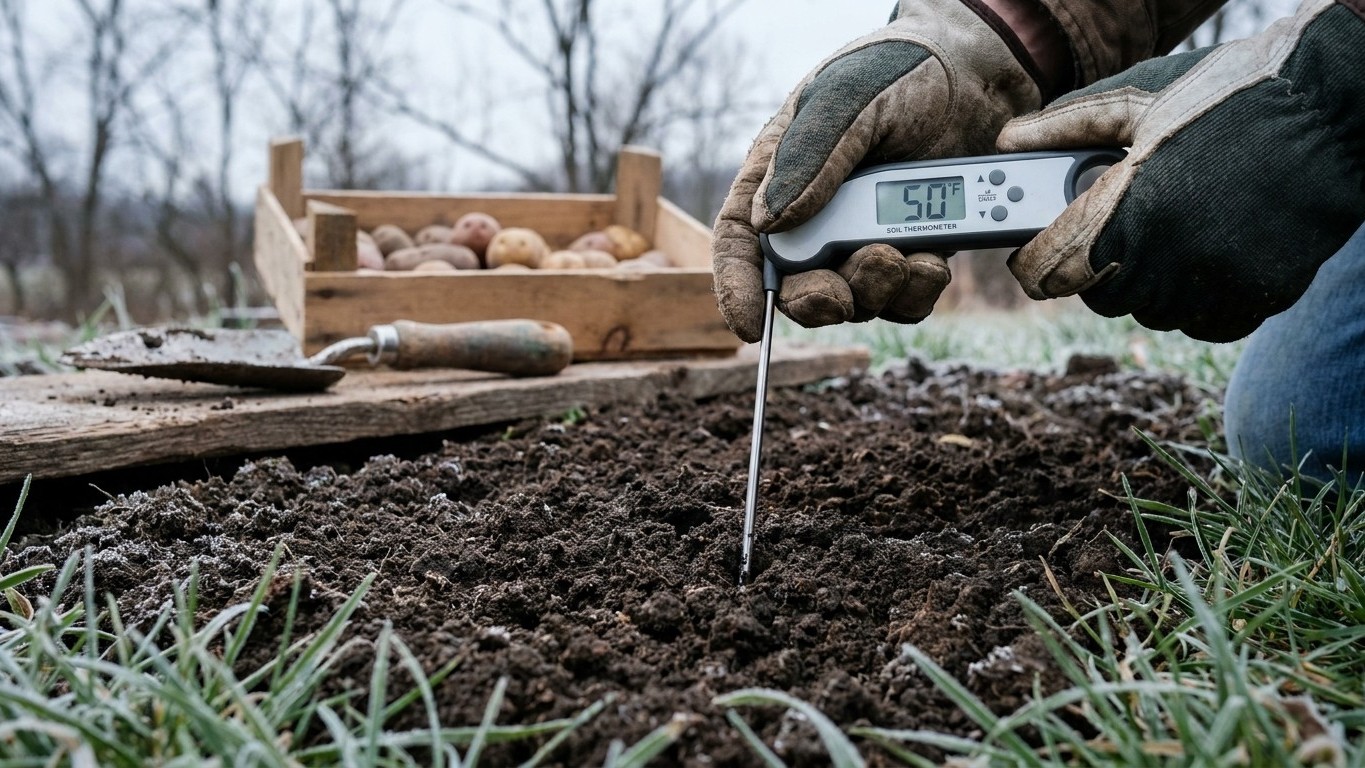

Plant potatoes in Pennsylvania 14 to 21 days before your last spring frost date, once the soil hits 50°F. For Philadelphia, that frost date runs March 29 to April 6, per NOAA NCEI’s 1991-2020 climate normals. Count backward from there. Everywhere else in the state, the calendar shifts later, sometimes by a full month.
The short answer
The number that matters is 50°F soil temperature, not a date on a wall calendar. Both Utah State University Extension and the University of Maine Cooperative Extension agree on this: potatoes go in the ground 14 to 21 days ahead of the last frost, timed so the soil has already warmed to that 50°F mark by planting day. For a gardener working off the Philadelphia frost window of March 29 to April 6 (NOAA NCEI), that puts the planting target somewhere in mid-to-late March, soil temperature permitting.
That last clause carries weight. Soil temperature does not move in lockstep with air temperature, and it does not care what the frost date says. A cold, wet spring can hold soil below 50°F well past the point when the frost date has already come and gone. A dry, sunny stretch can push soil past 50°F earlier than the date would suggest. The frost date is a planning anchor, not a planting trigger.
Philadelphia sits at the mild end of Pennsylvania’s climate range. The NOAA NCEI window of March 29 to April 6 reflects a 30 to 70 percent probability band for a 32°F freeze at that reference station, and it is the earliest such window found anywhere in the state. Move north or up into the mountains and the frost risk lingers longer into spring, which means the whole planting sequence, soil warming included, gets pushed back with it.
So the short answer has two parts. First, the mechanism: 50°F soil, 14 to 21 days ahead of last frost, sourced to Utah State and Maine Extension. Second, the local anchor: Philadelphia’s frost window from NOAA NCEI, which only applies cleanly to that reference city and its immediate surroundings. Everywhere else needs its own adjustment, and that adjustment is the subject of the next section.
What actually decides it
Two separate physical limits govern a Pennsylvania potato crop, and neither of them is the calendar. One sets how early you can plant. The other sets how late your soil can stay productive before it works against you.
The 50°F floor
Seed potatoes will sit in cold, wet soil and rot before they sprout. Utah State University Extension and the University of Maine Cooperative Extension both anchor planting timing to a 50°F soil temperature, not an air temperature or a fixed date. This is why the 14-to-21-day window before last frost exists at all: it is an estimate of how long it typically takes soil to climb through the final stretch to 50°F as spring advances, not a rule with its own independent logic. In a slow, wet spring, soil can lag behind that estimate by a week or more. A soil thermometer pushed a few inches into a garden bed settles the question faster than any calendar math.
The 90°F ceiling
The upper limit is less intuitive and, frankly, the more consequential of the two for how a Pennsylvania gardener should plan the whole season. Once soil temperatures climb above 90°F, tuber set and tuber fill both shut down. This isn’t a stress the plant can water its way through. A wilted potato plant responds to irrigation; a potato plant sitting in 90°F-plus soil does not resume normal tuber growth just because the hose comes out.
That ceiling is what actually decides the whole growing strategy in any given corner of Pennsylvania. In a location that racks up a lot of 90°F-plus days, the practical answer isn’t to baby a crop through midsummer heat. It’s to plant as early as the 50°F floor allows and treat the harvest as a spring crop, timed to finish sizing before the hottest stretch of soil temperatures arrives. Where summers run cooler, that pressure eases, and the planting window has more slack on the back end.
Why the frost date itself moves so much across the state
Philadelphia’s March 29 to April 6 window, from NOAA NCEI, is the mildest frost timing found in Pennsylvania. It reflects the moderating effect of the urban corridor and the lower elevation of the southeastern part of the state. Move toward the northern tier or up into the Allegheny Plateau and elevation and latitude both work against an early spring, pushing the last-frost probability window two to four weeks later than Philadelphia’s. That shift changes everything downstream: when soil crosses 50°F, when the 14-to-21-day planting window opens, and how much runway exists before soil temperatures start climbing toward that 90°F ceiling in summer.
| Region reference point | Relative frost timing | Practical effect on planting |
|---|---|---|
| Philadelphia | Earliest in the state (NOAA NCEI window: March 29 to April 6) | Soil reaches 50°F soonest; earliest planting window in Pennsylvania |
| Northern tier | Two to four weeks later than Philadelphia | Soil warms later; planting window shifts correspondingly later |
| Allegheny Plateau / mountains | Two to four weeks later than Philadelphia | Shorter gap before summer heat risk; early varieties favored |
How to do it
- Find your local last-frost timing. Philadelphia’s reference window from NOAA NCEI is March 29 to April 6; adjust two to four weeks later for the northern tier or the mountains.
- Push a soil thermometer 3 to 4 inches into the planting bed on a dry day and track it over a week or two as spring advances, rather than relying on a single reading.
- Wait until the soil holds steady at 50°F. This typically lines up with 14 to 21 days before the local last-frost date, per Utah State University Extension and the University of Maine Cooperative Extension.
- Buy certified seed potatoes rather than saving tubers from a grocery bin or an unverified source. Uncertified seed carries a real risk of virus that can undercut the whole crop before it starts.
- Choose a season class, early, mid-season, or late, based on what the local frost-free stretch and summer heat pattern can support, and on what the potato is meant for, baking or boiling, since that use is what the Extension sources actually publish about a variety.
- Cut larger seed potatoes into pieces with at least one eye each, and let the cut surfaces callus for a day or two before planting, to reduce rot risk in cool soil.
- Plant into the 50°F soil at the depth and spacing recommended for the chosen variety’s season class, and hill soil around the emerging stems as they grow.
- In regions with a high count of 90°F soil days, plan the harvest as a spring-timed crop that finishes sizing before peak summer heat, rather than pushing maturity into the hottest weeks.
What goes wrong
- Planting by the calendar instead of the soil. A grower plants on the frost date itself, ignoring that the soil hasn’t reached 50°F yet in a cold spring. Remedy: check soil temperature directly with a thermometer before planting, regardless of what the date says.
- Using uncertified seed potatoes. Tubers saved from a previous harvest or bought from a grocery store often carry virus that certified seed is bred to avoid. Remedy: buy certified seed potatoes each season rather than reusing or repurposing uncertified stock.
- Trying to push a crop through peak summer heat. In parts of Pennsylvania with a high count of 90°F soil days, a late-planted or late-maturing crop stalls out during tuber fill and never recovers, no matter how much it’s watered. Remedy: plant early enough, and choose a season class suited to finishing before the hottest stretch, rather than trying to water through the heat.
- Applying Philadelphia’s frost timing to the whole state. A gardener in the northern tier or the Alleghenies plants on the Philadelphia schedule and loses seed potatoes to a late frost that Philadelphia never experiences. Remedy: adjust the reference window two to four weeks later for those regions before counting back the 14-to-21-day planting gap.
- Planting seed pieces that never had time to callus. Freshly cut seed potatoes placed straight into cool, damp soil rot before they sprout. Remedy: let cut pieces sit a day or two in a cool, dry spot to form a callus over the cut surface before planting.
Common questions
Can I plant potatoes before the last frost date in Pennsylvania?
Yes, and that’s actually the point. Potatoes are planted 14 to 21 days before the last frost date, once soil reaches 50°F, per Utah State University Extension and the University of Maine Cooperative Extension. Frost on the surface doesn’t damage seed pieces buried underground.
Does the Philadelphia frost date apply to the rest of Pennsylvania?
No. The NOAA NCEI window of March 29 to April 6 is specific to the Philadelphia reference station. The northern tier and the Allegheny Plateau run two to four weeks later, which shifts the whole planting sequence back correspondingly.
What happens if I plant potatoes too late in a hot part of the state?
Soil temperatures above 90°F inhibit tuber set and tuber fill, according to Utah State University Extension. Watering does not reverse this. In areas with many 90°F soil days, plant early enough that the crop finishes sizing before that heat arrives.
Why does certified seed matter so much?
Uncertified seed potatoes, including tubers saved from a previous crop or bought for eating, commonly carry virus. Certified seed is tested and grown specifically to avoid that risk, which is worth the extra step every season.
If you follow the almanac, here is when to plant potatoes by the moon. It is a tradition, not a proven method.