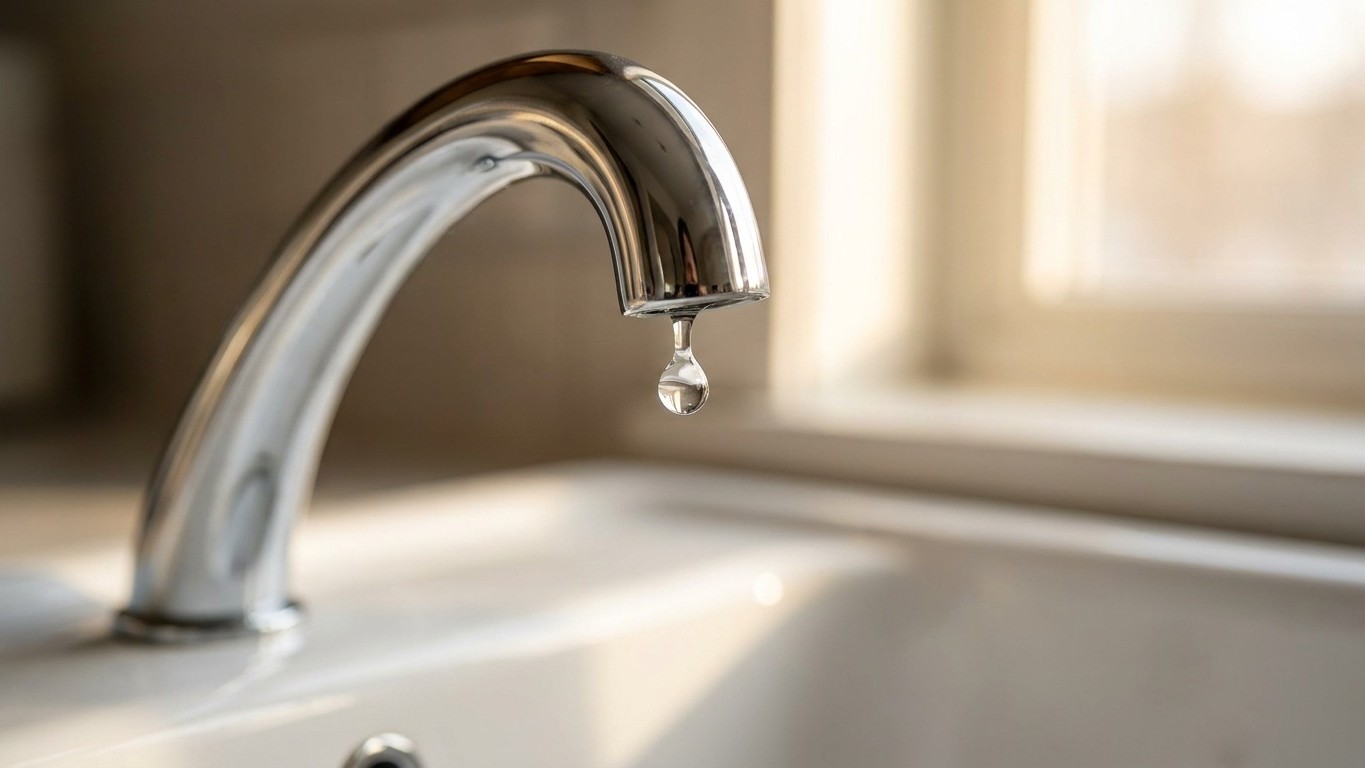

A dripping faucet almost always comes down to one worn part inside the fixture, usually a rubber washer, a cartridge, or an O-ring that no longer seals tight against water pressure. The fix is often a $5 part and twenty minutes with basic tools. But the real question isn’t just what’s broken, it’s how much that slow drip is quietly adding to your water bill, and at what point the problem stops being a DIY job.
What is actually happening
Every faucet holds back water pressure with a seal of some kind. When you shut the handle, that seal presses against a valve seat and stops the flow completely, at least when everything’s new. Over months and years, that seal wears down. Rubber hardens and cracks. Metal seats get pitted from mineral deposits in hard water. Ceramic discs get scratched by grit that slips past a failing filter. Once that seal can’t close all the way, water finds a microscopic path through, and gravity does the rest, one drop at a time.
The type of faucet you have determines which part is doing the sealing. Compression faucets, the older style with separate hot and cold handles that you have to turn several full rotations to shut off, rely on a rubber washer pressed against a valve seat. That washer is the most common failure point in older homes, and it’s also the cheapest and easiest to replace. Cartridge faucets, common in single-handle kitchen and bathroom fixtures installed over the last few decades, use a cylindrical cartridge with internal seals that wear as a unit. Ball-type faucets use a rotating ball with springs and rubber seats. Ceramic disc faucets, often found in higher-end single-handle fixtures, use two hard discs that slide against each other; they’re more drip-resistant but not immune, especially if debris scratches the disc surface.
Understanding which mechanism you’re dealing with matters more than any specific repair step, because it tells you what’s actually failing and why. A washer problem shows up as a drip that gets worse the harder you have to crank the handle to stop it, since you’re compensating for a seal that no longer holds on its own. A cartridge or ceramic disc problem often shows up as a drip that starts suddenly, sometimes right after the faucet was installed or serviced, because a scratch or a piece of grit got trapped where it shouldn’t be. Knowing this before you open anything up means you’re not guessing at what to buy or replace, you’re matching the fix to the actual point of failure inside your specific fixture.
What to check, in order
Work through these checks from cheapest and most likely to more involved, before assuming you need a full parts replacement.
- Check where the drip is coming from. Turn the faucet fully off and watch closely for thirty seconds. A drip from the spout tip usually points to a washer or cartridge issue inside the faucet body. A drip or puddle around the base of the handle, or dampness under the sink where the supply lines connect, points somewhere else entirely, often a loose connection rather than a worn internal seal.
- Feel for looseness in the handle. Wiggle the handle gently. If it moves more than it should, or feels loose compared to when the faucet was new, an internal part may have shifted or a retaining piece may have backed out. This often means the fix is a tightening job, not a full replacement.
- Look at the water itself. Is it clear, or does it carry small grit and mineral flakes? Cloudy or gritty water dripping from the spout suggests sediment has worked its way into the seal surface, which is common in homes on well water or with older galvanized supply lines.
- Run hot and cold separately. If the drip only happens on one side, that narrows the problem to the corresponding valve or cartridge, rather than a shared component. If it drips on both sides equally, especially on a single-handle faucet, the shared cartridge or ball assembly is the likely culprit.
- Check how long it’s been since the faucet was serviced. If you’ve lived in the home for years and never touched the fixture, general wear across multiple parts is likely, and a full internal rebuild may make more sense than replacing one piece and finding the drip continues from somewhere else nearby.
Each of these checks costs nothing but a few minutes, and together they tell you. Skipping straight to disassembly without this diagnostic pass often means reassembling twice.
What it costs to leave it
A single drip a second sounds like nothing. It isn’t. According to the U.S. EPA WaterSense program, “A leaky faucet that drips at the rate of one drip per second can waste more than 3,000 gallons per year.” That’s roughly the amount of water it takes to fill a small backyard pool, dripping away unnoticed under a sink for twelve months.
Scaled up across the country, the numbers get harder to ignore. The EPA notes that “Household leaks can waste nearly 1 trillion gallons of water annually nationwide,” and that “The average household’s leaks can account for more than 9,300 gallons of water wasted every year.” A dripping faucet is rarely the only leak in a home, either. The agency found that “nine percent of homes have leaks that waste 50 gallons or more per day,” which usually means more than one fixture or fitting has failed at once, not just a single faucet.
None of these figures tell you what your specific faucet is costing you. They’re national averages from a conservation campaign, useful for understanding scale, not for estimating your own water bill. Your meter is the only honest measurement of what a leak in your home is actually costing, and this site’s guide on how to spot a hidden water leak using your meter walks through how to read it before and after you shut off every fixture, so you can isolate what’s really running.
What the EPA figures do make clear is that fixing a drip pays off. “Fixing easily corrected household water leaks can save homeowners about 10 percent on their water bills,” the agency reports. For a household paying a typical monthly water bill, that’s a meaningful chunk of change for a repair that, in many cases, costs less than a dinner out.
When to stop and call a plumber
Most dripping faucet repairs are well within reach of anyone comfortable with a wrench and a screwdriver. But there’s a clear line where the job stops being a weekend project and starts being a call to a licensed plumber.
If the leak is coming from anywhere behind a wall, whether that’s a supply line you can hear but not see, or dampness showing up on drywall near a bathroom or kitchen, stop. Opening a wall to chase a leak without knowing exactly what’s routed back there can turn a small repair into a much bigger one. The same goes for anything involving the main water supply line into the house, rather than an isolated fixture. A problem at that level affects everything downstream, and a mistake there can mean flooding the whole house rather than one sink cabinet.
Any leak connected to a gas water heater also belongs to a professional. Water and gas lines running close together raise the stakes considerably, and a DIY fix that goes wrong near a gas appliance is not a risk worth taking to save a service call.
And if a leak, whatever the source, has already left standing water, soaked wood, swollen drywall, or a damp smell that’s been there for more than a day, that’s no longer just a plumbing fix. Wet structure invites mold and rot, and it needs assessment beyond just stopping the drip.
Before any of that, though, the single most useful thing you can do is know where your shut-off is., being able to stop the water fast, before you even diagnose the problem, is what keeps a slow drip from becoming a flooded cabinet or a soaked subfloor. This site’s guide to finding and using your home’s shut-off valve is worth reading before you ever need it in a hurry, not after.
Common questions
Can a dripping faucet fix itself over time?
No. Worn washers, cartridges, and seals don’t repair themselves. The drip typically gets worse as the seal degrades further, not better.
Is a dripping faucet always a sign of a bigger plumbing problem?
Usually not. Most drips are an isolated worn part inside that one fixture. It only signals a broader issue if you’re seeing similar drips from multiple faucets at once, or if you notice dampness beyond the fixture itself.
Does a dripping hot water faucet cost more than a dripping cold one?
Yes, because you’re also paying to heat the water that’s being wasted, on top of the water cost itself. A hot water drip is generally worth fixing sooner for that reason.
How do I know if the drip is from the faucet or the supply line underneath?
Dry the area completely, then watch closely with the faucet off. Water appearing at the spout points to the faucet itself. Water appearing lower down, near the connections under the sink, points to the supply line or fitting instead.