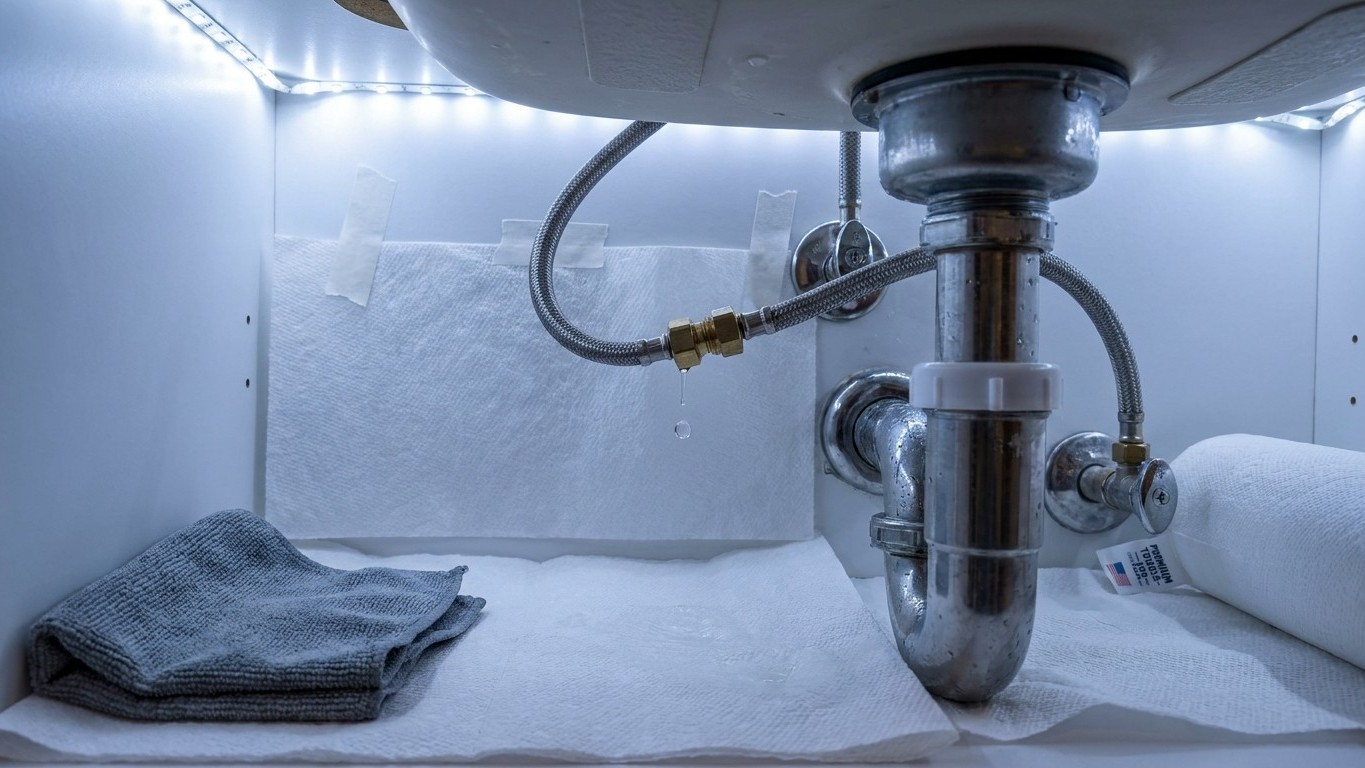

Dry out the cabinet completely, lay down a few paper towels or a dry rag along the back wall and floor, then run the faucet and fill the sink. Watch three spots at once: where the supply lines connect, where the trap and drain pipes join, and the underside of the sink basin itself. Whichever spot gets wet first is where the leak starts, not necessarily where the water ends up pooling.
What is actually happening

Water doesn’t fall straight down and stay put. It runs downhill along whatever surface it touches, which in a sink cabinet means it travels the length of a pipe, drips off a fitting, or slides down the back wall before it finally lands somewhere and soaks in. That’s why the wet spot you find when you open the cabinet door is so often several inches away from the actual failure point. A drip starting at a supply line connection can travel down the pipe and land near the drain, making it look like the trap is the culprit when it isn’t.
This is why drying everything out first matters more than any other step. A puddle tells you where water ended up, not where it started. Once the cabinet is dry, you need to create the leak again under controlled conditions and watch it happen in real time, because the order in which things get wet is the actual diagnostic information.
Three general zones account for almost every leak under a sink. The supply lines are the smaller lines that bring water in, along with the shutoff valves themselves. The drain assembly is everything from the sink basin down through the trap and out to the wall, including every slip-joint connection along the way. The sink itself, meaning the seal between the basin and the countertop or the gasket around a basket strainer, is the third zone, and it’s the one people check last even though it fails constantly, especially on older strainers where the putty has hardened and shrunk.
Each zone fails differently. Supply line leaks tend to be slow and constant, showing up whether or not you’ve run the faucet, because they’re under pressure all the time. Drain and trap leaks only show up when water is actively flowing, and often stop within a minute or two once the water clears the pipe. Basin and strainer leaks behave like drain leaks but only appear when the sink is holding standing water, rather than when water is just passing through. Matching the timing of the leak to these three patterns narrows the search before you even touch a wrench.
What to check, in order
Work from the checks that cost nothing and take thirty seconds toward the ones that require tools, and stop as soon as one of them gives you an answer. There’s no reason to disconnect a trap if a loose compression nut was the whole problem.
- Look at the shutoff valves and supply line connections first. Feel around the nuts where the supply lines meet the valve and where they meet the faucet underneath. Dampness or a mineral crust here means the connection has been slowly weeping, often for a long time before anyone noticed. This is the cheapest possible finding, usually meaning a fitting just needs to be snugged up.
- Run the faucet with the cabinet dry and watch the trap assembly. The P-trap has at least two slip-joint nuts, one where it meets the tailpiece coming down from the sink and one where it meets the drain pipe going into the wall. If water beads up or drips from either joint only while water is running, the nut is loose or the washer inside it has hardened and lost its seal.
- Check the garbage disposal connection, if there is one. The gasket between the disposal and the sink flange, and the point where the disposal’s discharge pipe meets the trap, are common failure points that get overlooked because people assume disposal leaks are electrical problems, not plumbing ones.
- Fill the sink and let it stand, then check the strainer and basin seal. If nothing leaked while water was running but the cabinet gets wet once the sink is full, the leak is in the basket strainer gasket or the plumber’s putty seal under the basin, not in the drain line at all.
- Check the dishwasher air gap or drain hose, if one runs through the cabinet. These are often mistaken for sink leaks because they sit in the same space, but they only leak during a dishwasher cycle, which is an easy way to rule them out or confirm them.
Each result points somewhere specific. A dry trap with a wet supply connection means a fitting problem, not a drain problem. A dry supply line with a wet trap only during running water means a washer or nut issue at the slip joint. A leak that only shows up with standing water means the basin seal, and no amount of tightening the trap will fix that.
What it costs to leave it
It’s tempting to let a slow drip wait until the weekend, especially if it’s small enough that you only notice it once a week. Nationally, the numbers on unaddressed leaks are bigger than most people expect. According to the U.S. EPA WaterSense program, “Household leaks can waste nearly 1 trillion gallons of water annually nationwide,” and “The average household’s leaks can account for more than 9,300 gallons of water wasted every year.” The program also notes that “nine percent of homes have leaks that waste 50 gallons or more per day,” which is the kind of leak that’s often invisible until a water bill jumps.
Those figures describe the country as a whole, not your kitchen, so treat that number as scale rather than a personal estimate. For comparison, EPA WaterSense notes that “A leaky faucet that drips at the rate of one drip per second can waste more than 3,000 gallons per year,” which gives a sense of how a leak that looks trivial in the moment adds up over months. The agency also points out that “An old or worn flapper can cause your toilet to flush on its own or silently leak thousands of gallons a year,” a reminder that fixtures elsewhere in the house often waste more than the visible drip under the sink ever does.
The only number that actually matters for your household is the one on your own water meter, and this site has a separate page walking through how to read a meter to catch a hidden leak, including ones you can’t see or hear. That’s the measurement worth trusting over any national average. What the EPA does confirm broadly is the payoff for acting: “Fixing easily corrected household water leaks can save homeowners about 10 percent on their water bills,” which at least sets an expectation for what fixing this leak is realistically worth.
When to stop and call a plumber
Most under-sink leaks are within reach of a homeowner with a flashlight, a dry rag, and an adjustable wrench. Some aren’t, and the line between the two isn’t about skill so much as about where the water is going.
If the leak is coming from inside a wall rather than from a visible fitting in the cabinet, stop. Water that’s already traveled behind drywall is doing damage you can’t see, and opening that wall without knowing exactly what you’re dealing with usually makes the repair bigger, not smaller. The same goes for anything involving the main water supply line coming into the house, as opposed to the small lines feeding the faucet. Main line work involves pressure and shutoff points that affect the whole house, and a mistake there isn’t a wet cabinet, it’s no water at all until someone fixes it.
A gas water heater anywhere near the affected plumbing is its own category entirely. Water and gas lines sharing a confined space is not a do-it-yourself situation, and any leak, drip, or standing water near a gas appliance calls for a licensed plumber before anything else gets touched.
The last consideration is what the leak has already touched. If the cabinet floor is soft, if the particleboard under the sink has swelled, or if nearby drywall has started to bubble or discolor, the leak has been going on longer than you realized and has already wetted structure, not just surfaces. At that point the fix isn’t just stopping the drip, it’s dealing with what the water has already done, which is a different job and often a bigger one. Before doing anything else in a situation like this, the priority is knowing how to shut off water to the fixture, or to the house, fast. This site has a separate page on locating and using shutoff valves that’s worth reading before an emergency, not during one, since fumbling for a valve while water is actively running is how a small leak turns into a bigger repair bill in a matter of minutes.
Common questions
Why does the leak only show up sometimes?
Leaks tied to running water, like a loose trap connection, only appear while water is actively flowing through the drain, then stop within a minute once the pipe clears. Leaks tied to standing water, like a strainer gasket, only show up when the sink is full. If a leak seems random, note whether it happens during use, right after use, or only with a full sink, since that timing points to a specific zone.
Can I tighten a slip-joint nut too much?
Yes. These nuts seal against a rubber or nylon washer, and overtightening can crack the nut or distort the washer, causing a leak where there wasn’t one before. Hand-tight plus a small turn with a wrench is usually enough; if it’s still leaking, the washer likely needs replacing rather than the nut needing more torque.
Is a small drip really worth fixing right away?
A slow drip under a sink is unlikely to flood anything overnight, but it’s also the kind of leak that sits unnoticed for months, quietly damaging cabinet flooring and wasting water the whole time. Given how much a small, ongoing leak can add up to over a year, there’s little reason to leave it once you’ve found the source.
What if I dry everything and nothing leaks at all?
Some leaks are intermittent enough that they only show up under specific conditions, such as after the dishwasher runs or when the disposal is used. Repeat the test while running each fixture connected to that cabinet individually, rather than just the faucet, since the source might not be the faucet or drain at all.