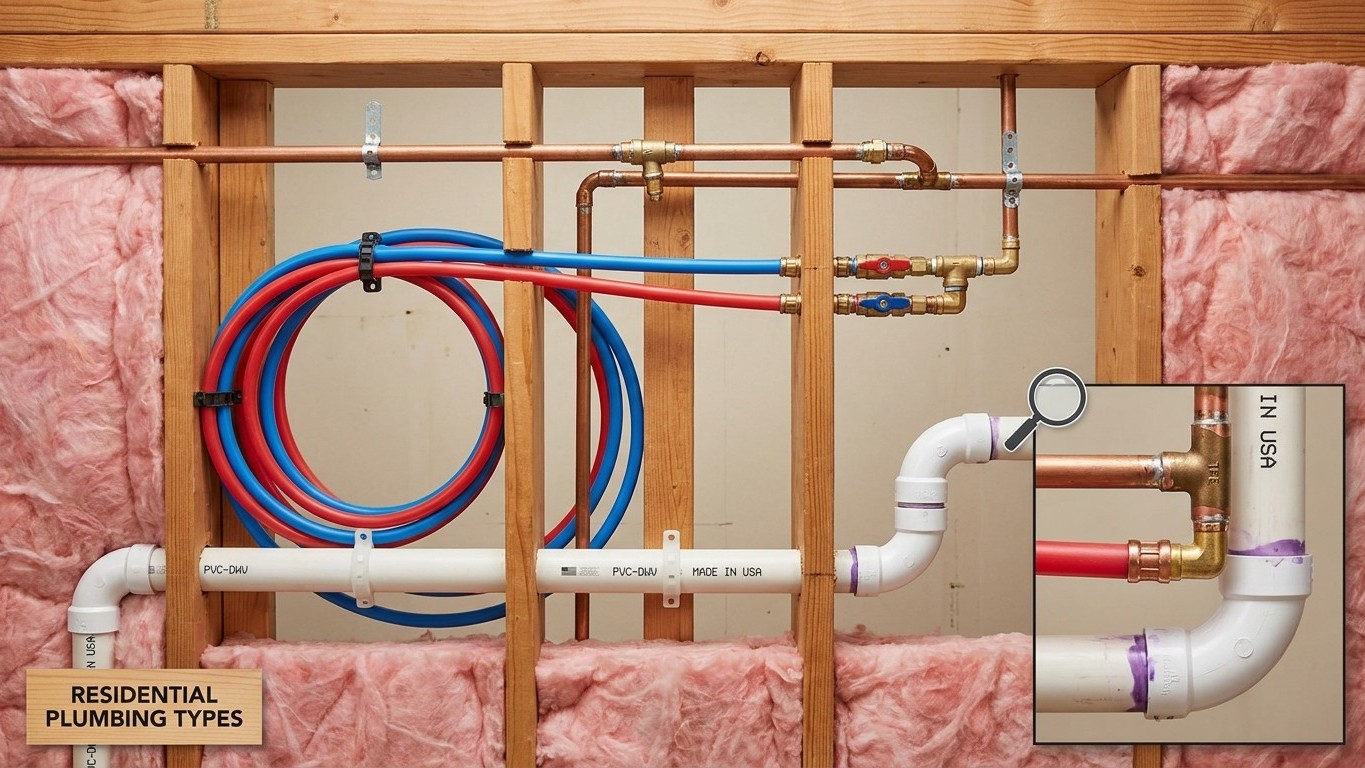

Copper, PEX and PVC each fail differently, and each one hides in a different part of the house. Copper shows up as rigid reddish metal in older supply lines. PEX is the flexible red, blue or white tubing running through most homes built or repiped since the early 2000s. PVC and its cousin CPVC are the rigid white or cream plastic pipes usually carrying drain waste or, in some regions, hot water. Knowing which one is behind your wall tells you what a fix will cost and whether you can do it yourself.
What is actually happening

Water expands by roughly nine percent when it freezes, and what happens next depends entirely on what’s holding it. Copper is rigid and unforgiving. When ice forms inside a copper line, the pipe has nowhere to give, so the wall of the tube splits, usually along a seam near a joint. That’s why a burst copper pipe often shows a clean crack rather than a pinhole, and why the damage tends to appear at an elbow or a soldered fitting rather than in the middle of a straight run.
PEX behaves differently because it’s flexible. The tubing can stretch slightly as ice expands inside it, which is one reason PEX has become the default choice for new construction and repipe jobs across the country. It doesn’t corrode the way copper can, and it tolerates minor movement without cracking. That flexibility isn’t unlimited, though. A hard freeze that holds for hours can still split PEX, particularly at a rigid fitting where the tubing connects to a valve or a manifold.
PVC and CPVC sit somewhere in between. Both are rigid plastics, but they’re more brittle than copper and more prone to stress cracking as they age, especially where sunlight or repeated temperature swings have made the material chalky or discolored. CPVC, the version rated for hot water, is often confused with plain PVC because they look nearly identical. The giveaway is usually color: PVC is typically white or gray, CPVC tends to be a cream or tan shade, and PEX comes in solid colors that make it easy to trace a line from a fixture back to its source.
Here’s the practical part. If you can see a section of pipe, whether under a sink, in a crawlspace or along a basement ceiling, you can usually identify the material just by looking and touching. Rigid and metallic means copper. Rigid and plastic means PVC or CPVC. Flexible and colored means PEX. That single observation tells you a lot before you ever call anyone: copper repairs typically involve soldering or a mechanical fitting, PEX repairs use crimp or push-fit connections, and PVC repairs use solvent cement. Each system has its own tools and its own learning curve, and mixing them incorrectly is a common cause of slow leaks that show up months later.
What to check, in order
Start with the cheapest look before you touch a tool. Work through these steps in sequence, since each one narrows down what you’re dealing with without spending money.
- Look at an exposed section of pipe. Under a sink, in a basement, or in a crawlspace, note the color and rigidity. This alone usually identifies copper, PEX or PVC/CPVC and tells you which repair method applies before you go any further.
- Press on the pipe gently. Copper and PVC won’t give at all. PEX has a small amount of flex. If you’re unsure whether a plastic-looking line is PVC or a rigid CPVC line, this quick check combined with color usually settles it.
- Check joints and fittings for staining. Greenish or bluish crust on copper indicates a slow corrosion leak at that joint. Chalky white residue on a PVC fitting suggests the solvent weld has started to fail. Either finding tells you exactly where a small leak is starting, before it becomes a big one.
- Check your water meter with everything off. Turn off every fixture and appliance that uses water, then watch the meter for movement over ten or fifteen minutes. Any movement means water is going somewhere in the system, even if you can’t see it yet.
- Look at pipe age against your home’s history. A home built or renovated in the last two decades likely has PEX. A home with its original plumbing from the 1960s through the 1980s is more likely to have copper. This won’t confirm anything on its own, but it sets expectations for what you’ll find when you open a wall or cabinet.
None of these steps require cutting into anything. They’re observational, and together they usually answer two questions: what material am I working with, and is there already a leak I haven’t noticed. If the meter test in step four shows movement with everything off, that’s the moment to stop guessing and start tracking it down systematically.
What it costs to leave it
A slow leak rarely announces itself. It shows up as a slightly higher water bill, a faint mineral stain, or nothing at all until the damage is already done. On a national scale, the numbers are hard to ignore. According to U.S. EPA WaterSense, “Household leaks can waste nearly 1 trillion gallons of water annually nationwide,” and “The average household’s leaks can account for more than 9,300 gallons of water wasted every year.” That’s the scale of the problem across the country, not a prediction about what’s happening in your own pipes.
The same EPA data points to how uneven the problem is. WaterSense notes that “nine percent of homes have leaks that waste 50 gallons or more per day,” which means most homes have small or no leaks while a minority carry a disproportionate share of the waste. A single dripping faucet fits into this picture too: “A leaky faucet that drips at the rate of one drip per second can waste more than 3,000 gallons per year,” and “A showerhead leaking at 10 drips per minute wastes more than 500 gallons per year.” Neither of those numbers tells you what your own faucet or showerhead is doing, but they show how quickly small, easy-to-ignore drips add up over twelve months.
Toilets deserve their own mention here. WaterSense warns that “An old or worn flapper can cause your toilet to flush on its own or silently leak thousands of gallons a year,” often without any sound or visible sign at all. That’s a leak that can run for months behind a closed lid, adding to a bill that quietly climbs while nothing looks wrong.
The upside is that these losses are usually cheap to fix once found. WaterSense states that “Fixing easily corrected household water leaks can save homeowners about 10 percent on their water bills.” But every one of these figures is a national average, built from millions of households, not a diagnosis of your own home. The only measurement that actually applies to your situation is your own meter, read with everything off, over time. If you haven’t done that yet, this site’s guide to finding hidden leaks walks through exactly how.
When to stop and call a plumber
Everything above works for what you can see and touch. There’s a clear line where DIY checking should stop and a licensed plumber should take over.
The first line is anything behind a finished wall. If you suspect a leak inside a wall cavity, whether from a stain, a soft spot, or a musty smell, don’t cut into drywall to chase it yourself unless you already know exactly what you’re doing. Water that’s reached framing can also mean mold starting within 24 to 48 hours, and a professional has moisture meters and thermal tools that find the source without guesswork or unnecessary demolition.
The second line is your main supply line, the pipe that brings water into the house before it splits off to any fixture. A failure here affects your entire water supply, often requires shutting off water at the street, and typically involves permits or utility coordination that a homeowner can’t handle alone.
The third line is anything touching a gas water heater. Combustion appliances involve venting, gas lines and pressure relief valves that are not a place for trial and error. A misdiagnosed leak near a gas water heater is a safety issue, not just a plumbing inconvenience, and it belongs to a licensed technician every time.
The fourth line is simple: any leak that has already wetted structure, meaning wood framing, subfloor, drywall or insulation. Once water has soaked into building material, the job is no longer just about stopping the leak. It’s about drying, assessing damage and preventing mold, and that’s a job for someone with the equipment to verify the structure is actually dry, not just surface-dry.
Everything covered earlier, identifying pipe material, checking joints, reading a meter, sits safely on the homeowner side of that line. The moment a leak moves behind a wall, into the main line, near a gas appliance, or into structural material, it moves into professional territory.
Common questions
Can copper, PEX and PVC be connected to each other?
Yes, with the right transition fitting rated for that specific combination. Direct copper-to-PVC contact isn’t ideal without a proper fitting, since the materials expand differently and can loosen over time. This is exactly the kind of connection where local code and the specific fittings on hand matter more than a general rule.
Which pipe material lasts the longest?
Copper has the longest documented track record, often performing well for many decades, though it can corrode in certain water conditions. PEX is newer, so its long-term performance data covers a shorter span, but it resists the corrosion issues that affect copper. PVC and CPVC vary more with sun exposure and temperature cycling.
How can I tell if my house has PEX without opening a wall?
Check under sinks, near the water heater, or in a basement or crawlspace where supply lines are visible. PEX is flexible and comes in solid red, blue or white colors, which makes it easy to distinguish from rigid copper or plastic PVC at a glance.
Does pipe material affect water quality?
It can, depending on water chemistry and pipe age. Older copper systems have occasionally raised questions about metal leaching in specific water conditions, while PEX and PVC don’t corrode the same way. A local water test is the only way to know what’s actually happening in your specific home.