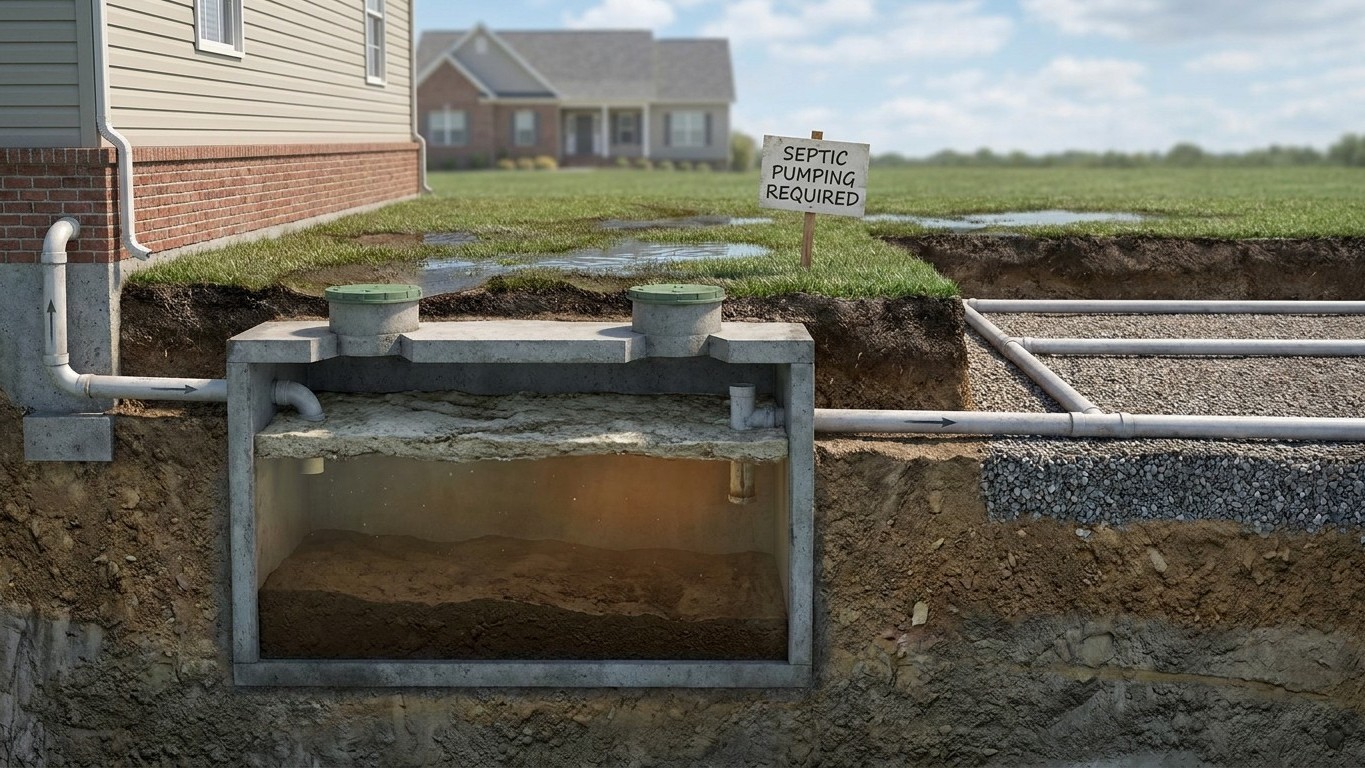

A typical household septic tank needs pumping every three to five years, though the real interval depends on tank size, number of people in the home, and how much wastewater goes down the drains. The clearest sign it’s overdue isn’t a full tank alarm, it’s slow drains, gurgling pipes, sewage odor near the tank lid, or soggy patches over the drain field.
What is actually happening

A septic tank works by holding wastewater still long enough for gravity to do its job. Solids sink to the bottom as sludge, grease and lighter material float to the top as scum, and the clarified liquid in between, called effluent, flows out to the drain field. Bacteria in the tank break down some of that sludge over time, but not all of it, and not fast enough to keep the tank from filling.
The thing to understand here is that solids carried into the drain field clog it permanently, and a drain field cannot be unclogged. As sludge and scum layers build up in the tank, the buffer zone between them shrinks. Once that space gets too small, incoming wastewater doesn’t have enough still time to separate properly. Solids and grease start riding along with the effluent, out through the outlet pipe, and into the drain field lines.
Once in the field, those particles coat the soil and gravel around the distribution pipes, along with a layer of bacterial slime called a biomat. A healthy biomat is actually normal and helps treat the effluent. But when it gets overloaded with solids that should have stayed in the tank, it thickens past the point where water can pass through the soil at all. That’s a mechanical dead end. Soil pores packed with solids and biofilm don’t clear themselves, and there’s no pump, no additive, no method that reverses it. The only remedy at that point is excavating and replacing the drain field, which typically costs several times more than a routine pump-out.
This is why the pumping schedule matters more than most homeowners assume. It isn’t really about keeping the tank from overflowing into the yard, it’s about keeping the tank’s settling zone big enough that solids never reach the field in the first place. A tank pumped on schedule protects a component that, once damaged, generally can’t be repaired, only replaced.
What accelerates the timeline is hydraulic load, meaning the total volume of water pushed through the system. A larger household, frequent garbage disposal use, or water-using appliances running more than usual all shorten the interval between pump-outs. So does anything sending extra water into the system that shouldn’t be there, including plumbing leaks inside the house that quietly add gallons to the tank every day without anyone noticing.
What to check, in order
Before assuming a septic tank needs pumping, work through these checks from cheapest and most likely to more involved. Each one tells you something specific about where the system stands.
- Pull your pump-out records. If it’s been longer than the standard three-to-five-year window for your household size, that alone is reason enough to schedule service, regardless of other symptoms.
- Watch how drains empty. Sinks, tubs, and toilets that drain slower than usual, especially the lowest fixtures in the house, suggest the tank is nearing capacity and effluent has less room to flow out.
- Sniff around the tank lid and yard. A sewage smell near the tank access point or anywhere in the yard usually means gases are escaping because the tank is full or the field is saturated.
- Look at the drain field itself. Standing water, spongy ground, or patches of grass that are noticeably greener or lusher than the rest of the lawn point to effluent surfacing where it shouldn’t.
- Listen for gurgling in the pipes. Air trapped by water backing up in the line often makes a gurgling sound in drains or toilets, a sign the system is struggling to move water forward.
- Check your water use patterns. A recent spike in daily water use, even without an obvious cause, can mean a leak is adding volume to the tank faster than the system was designed to handle.
None of these checks require chemicals or special tools, just attention to how the house is behaving. If two or more of them line up, that’s a strong signal the tank needs service soon rather than at the next convenient date.
What it costs to leave it
Delaying a pump-out doesn’t just risk the tank, it risks the far more expensive drain field, and household leaks make that risk worse by adding water the system was never sized for. According to the U.S. EPA WaterSense program, “household leaks can waste nearly 1 trillion gallons of water annually nationwide,” and “the average household’s leaks can account for more than 9,300 gallons of water wasted every year.” Every one of those gallons that comes from a home on a septic system passes through that tank and field.
The same source notes that “nine percent of homes have leaks that waste 50 gallons or more per day.” A leak at that scale, sustained for weeks or months, adds meaningfully to the hydraulic load a septic system handles, shrinking the settling time in the tank and pushing solids toward the drain field sooner than the pumping schedule assumes. EPA WaterSense also points out that “a leaky faucet that drips at the rate of one drip per second can waste more than 3,000 gallons per year,” that “a showerhead leaking at 10 drips per minute wastes more than 500 gallons per year,” and that “an old or worn flapper can cause your toilet to flush on its own or silently leak thousands of gallons a year.”
Those figures are national aggregates from a water-conservation campaign, not a prediction for any single home. They exist to show scale, not to tell you what your household is losing. Your water meter is the only measurement that actually belongs to you, and this site has a page walking through how to read your meter to catch a hidden leak before it adds unnecessary volume to your septic system.
The practical upside works in your favor too. EPA WaterSense estimates that “fixing easily corrected household water leaks can save homeowners about 10 percent on their water bills,” and for a home on a septic system, less water going down the drain also means less strain on the tank between pump-outs. Fixing a running toilet or a dripping fixture is one of the few maintenance jobs that pays off twice, once on the utility bill and once by protecting the drain field.
When to stop and call a plumber
Septic tank pumping itself is a job for a licensed septic service, not a DIY project, and that’s true even before you get to the plumbing inside the house. But the checks above sometimes uncover something beyond a full tank, and that’s where the line matters for anyone handling their own plumbing.
Stop and call a licensed plumber for anything happening behind a wall, anything involving the main water supply line, anything connected to a gas water heater, or any leak that has already wetted structure like drywall, subfloor, or framing. Water damage in those spots moves fast and stays hidden, which is exactly why it does the most damage before anyone notices. If a leak or backup has reached that point, the first move isn’t a repair, it’s finding your main shut-off valve and stopping the water before it does more.
The same caution applies on the septic side. Sewage backing up into tubs or floor drains, effluent pooling visibly in the yard, or a strong sewage smell inside the house are signs the system is past the point where a homeowner should keep troubleshooting alone. Those symptoms can mean a tank that’s full past capacity, a blocked outlet line, or a drain field that’s already failing, and pushing more water through the system while diagnosing it can make a repairable problem worse.
None of this is meant to alarm anyone over a slow drain or a slightly damp patch of lawn. Most septic issues, caught early, are a scheduling problem, not an emergency. But the difference between a routine pump-out and a drain field replacement often comes down to how quickly a homeowner recognizes when a symptom has crossed from “worth checking” to “worth calling a professional today.”
Common questions
How often should a septic tank be pumped?
Most households need a pump-out every three to five years, though the exact interval depends on tank size, the number of people in the home, and daily water use. A septic professional can measure the sludge and scum layers at each visit and tell you where you actually stand.
What are the clearest signs a septic tank is overdue for pumping?
Slow drains throughout the house, gurgling pipes, sewage odor near the tank or yard, and soggy or unusually green patches over the drain field are the most reliable indicators. Any two of these together are worth acting on.
Can household leaks affect how often a septic tank needs pumping?
Yes. Leaks add extra water volume to the system every day, which shortens the settling time in the tank and pushes it toward capacity faster than normal use alone would. Fixing leaks promptly helps keep the pumping schedule on track.
Is it safe to pump a septic tank yourself?
No. Septic tanks hold sludge, gases, and bacteria that require specialized equipment and training to handle safely, and most local health codes require licensed septic haulers to dispose of the waste properly. This is a job to schedule with a professional, not a DIY project.