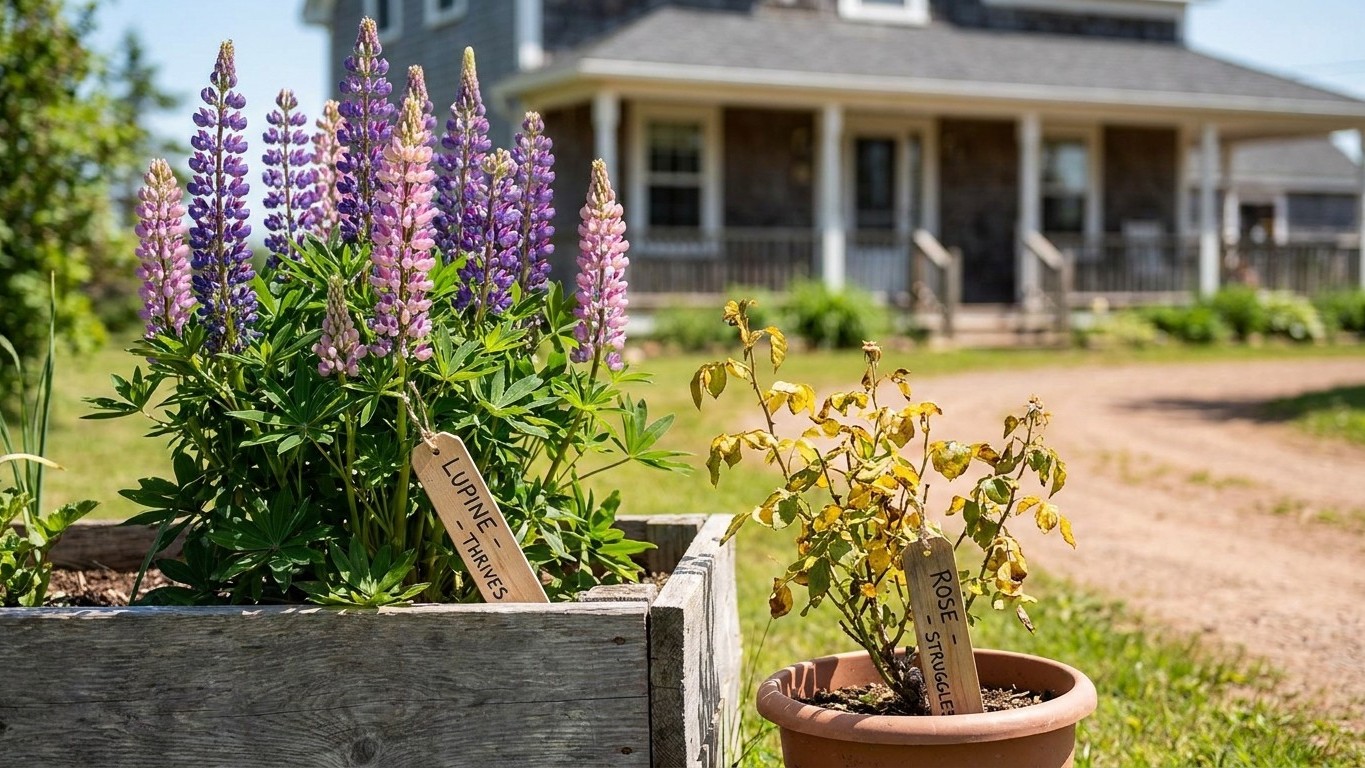

Cold-hardy perennials and short-season annuals are what actually thrive on Prince Edward Island. Environment and Climate Change Canada’s 1981-2010 climate normals, recorded at the Charlottetown A station, put the average daily minimum of the coldest month at -12.1 °C, and the same normals record zero days a year reaching 90°F. Build a border around plants that shrug off deep cold rather than ones that need a scorching July, and treat any tender bulb or tropical flower as something you lift, pot up, or replace every year instead of leaving in the ground.
Putting a border together

PEI’s growing season runs from a mean last frost of May 16 to a mean first fall frost of October 17, both dates from Environment and Climate Change Canada’s Charlottetown A normals. That is roughly five months of workable garden time in an average year, though ECCC is clear that these are mean dates, not guarantees: in one year out of two, frost arrives later than May 16 or earlier than October 17. A border planned around that window needs a backbone of plants that survive whatever the season actually delivers, with annuals filling gaps once the risk has passed.
Layering by height and a cold-hardy backbone
Put the tallest, toughest perennials at the back where wind off the coast can push them around less. Peonies, Russell hybrid lupins (the same lupins that colour PEI roadsides every June, reaching 3 to 4 feet), and delphiniums all handle the province’s winter cold without protection and form the structural layer. Stake delphiniums and tall phlox early in the season, because coastal wind flattens top-heavy stems faster than most gardeners expect. In the middle layer, daylilies, coneflower (Echinacea purpurea), and shasta daisy fill in at knee to waist height and bloom for weeks rather than days. At the front, violas, sweet alyssum, and calendula take cool nights in stride and often keep flowering into the shoulder seasons when tender annuals have already quit.
Succession of bloom across the season
A border that peaks once and goes green for the rest of the summer wastes the short window PEI gives you. Stack bloom times instead: spring bulbs and early perennials first, summer perennials next, and fall bloomers to carry the border to the mean October frost.
| Flower | Typical bloom window | Height | Note |
|---|---|---|---|
| Peony | Early in the perennial calendar | 2 to 3 ft | Extremely cold-hardy, resents being moved once established |
| Lupin (Russell hybrids) | Early summer | 3 to 4 ft | Self-seeds freely, naturalizes if left to set seed |
| Bee balm (Monarda) | Midsummer | 2 to 4 ft | Choose a mildew-resistant cultivar for humid coastal air |
| Coneflower (Echinacea purpurea) | Midsummer | 2 to 3 ft | Reliable in average garden soil, tolerates dry spells |
| Aster (New England type) | Late season | 3 to 4 ft | Carries color into the fall shoulder season |
| Sedum ‘Autumn Joy’ | Late season | 1.5 to 2 ft | Sturdy stems that don’t need staking |
Quebec gardeners work with a comparably tight window and similar late-spring frost risk, and the same succession logic drives the plant choices in our guide to Flowers That Actually Thrive in Quebec, and the Ones That Struggle.
Repeating color across the border
A border with one of everything looks busy rather than intentional. Repeat a color at least three times along the length of the bed, whether that’s a blue delphinium echoed by a blue aster further down, or the same magenta phlox planted in two or three clumps rather than one big block. Repetition is what reads as a designed border from the road or the porch, and it costs nothing extra in plants, just a different arrangement of the same varieties.
Leaving room at planting
The single most common mistake in a first-year border is planting to fill the bed as it looks on day one. Peonies need roughly 3 feet of clear space at maturity and sulk for a year or two if crowded early. Daylilies and asters both clump outward year over year, so a gap that looks wasteful in June often closes completely by the third summer. Leave room for mature spread and fill the temporary gaps with annuals like cosmos or nasturtiums that you’re happy to pull out once the perennials fill in.
Flowers that struggle here
Tender bulbs are the clearest failure point. Dahlias and gladiolus put on a strong summer show but their tubers and corms cannot survive a winter where the coldest month’s average daily minimum sits at -12.1 °C, well below what they tolerate in open ground. Lift the tubers every fall, store them cool and dry, and replant after the frost risk has passed the following spring, or treat them as a one-season purchase.
Heat-loving and tropical flowers struggle for the opposite reason. Tropical hibiscus, bougainvillea, and lantana need sustained warmth to bloom well, and with zero days above 90°F in an average Charlottetown year, they never get it. They’ll survive in a pot on a sunny deck and can be brought indoors for winter, but planted in the open ground they stay stunted and rarely flower to their catalogue potential. Further south, in a climate with real summer heat load, those same plants are the reliable performers, which is part of why the flower list in our Flowers That Actually Thrive in Illinois, and the Ones That Struggle guide looks so different from this one.
Hybrid tea roses are another common disappointment, needing winter protection most years to survive PEI’s cold. Rosa rugosa, the beach rose common along the Island’s coastline, is very cold-hardy and takes salt spray and poor soil without complaint, and makes a far more forgiving choice for a border that needs a shrub rose rather than a fussy specimen.
Local help
Before you settle on a final plant list, check with the Prince Edward Island government’s agriculture office for regional variety recommendations, since a garden on the North Shore faces different wind and salt exposure than one inland. Their agriculture topic page is a starting point at princeedwardisland.ca. Master Gardener volunteers active on the Island are also worth tracking down through that office for county-specific advice, and our broader Prince Edward Island guides cover other planting timing questions for the province.
Common questions
When is it actually safe to plant annuals outside on PEI?
Environment and Climate Change Canada’s normals put the mean last spring frost at Charlottetown at May 16, but that’s a mean, not a safe date: frost arrives later than that in about half of all years. Harden off tender annuals gradually and watch the extended forecast rather than planting by the calendar date alone, especially if your garden sits inland or at higher elevation than Charlottetown.
Can I leave dahlia or gladiolus bulbs in the ground over winter?
No, not reliably. The coldest month’s average daily minimum of -12.1 °C at Charlottetown, per ECCC’s normals, is well below what dahlia tubers and gladiolus corms can survive in open ground. Dig them after the foliage is killed by fall frost, dry them, and store them somewhere cool and frost-free until spring.
Why do lupins grow wild everywhere but the ones in my garden faded after a few years?
Wild roadside lupins persist because they’re allowed to set and drop seed every year, constantly replacing the older plants that die back. A garden clump that gets deadheaded religiously for tidiness never reseeds, and individual lupin plants are relatively short-lived, so the patch can thin out within a few seasons unless you let some seed pods mature.
Will a heat-loving flower like hibiscus or lantana ever bloom well outdoors here?
Not to the standard shown on the plant tag. With an average of zero days a year reaching 90°F at the Charlottetown reference station, these plants simply don’t get the sustained heat they need to flower heavily. They do better grown in a container that can be moved to the warmest, most sheltered spot on the property, or brought indoors before the first fall frost.
Related guides
- Flowers That Actually Thrive in New Brunswick, and the Ones That Struggle
- Flowers That Actually Thrive in Nova Scotia, and the Ones That Struggle
- Flowers That Actually Thrive in Quebec, and the Ones That Struggle