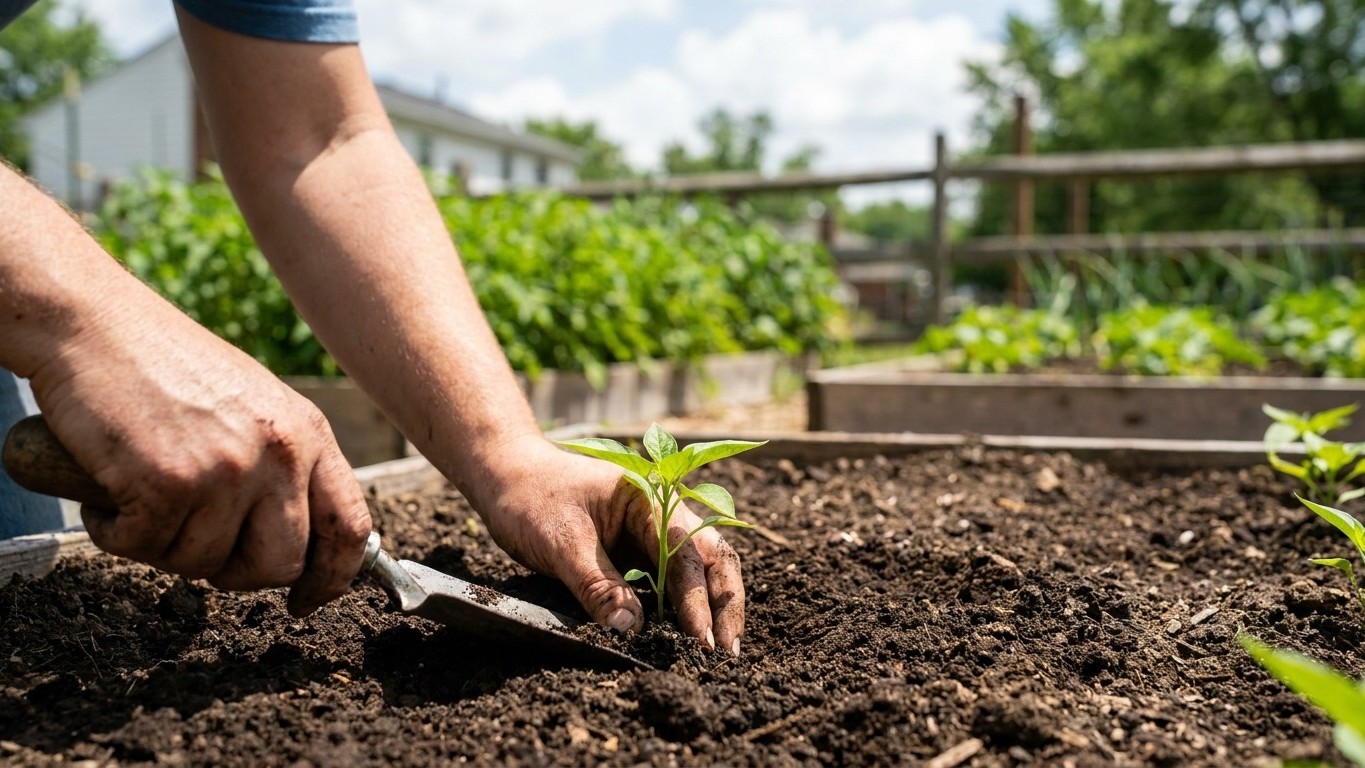

July in Prince Edward Island sits deep in the growing season, well clear of the frost windows on either end. That means the answer for this month is not “wait” but “keep planting and start harvesting”: warm-season transplants, succession sowings of quick crops, and the first real pulls of peas, lettuce, and new potatoes all belong on the July task list.
What goes in the ground in July

The average last spring frost at Charlottetown A runs May 16, and the average first fall frost lands October 17. Both are means from the 1981-2010 Canadian Climate Normals, which means in roughly half the years frost arrives later than those dates on either end. By July, though, the province is solidly past the spring threshold, and there is still a wide stretch of frost-free time ahead before the fall one arrives. That combination makes July one of the more forgiving months on the calendar rather than a gamble.
Soil temperature, not the date on the wall, still decides what thrives. Ground that has had weeks of sun since May is warm enough now for crops that would have sulked in a chilly June bed. Bush beans, cucumbers, summer squash, and zucchini can all be direct-sown early in the month with a reasonable shot at reaching harvest before the fall frost window closes. Corn started as transplants or sown directly in the first half of July still has time in most seasons, though it is closer to the edge than beans or squash.
This is also the window for the second and third waves of quick crops. Lettuce, spinach, radishes, and salad turnips sown now will mature in the cooler, shorter days of late summer, which tends to suit them better than a June sowing baked by midsummer heat. Carrots and beets for fall storage go in through the first two or three weeks of July; sown any later, they risk running out of daylight before they size up.
Transplants of broccoli, cabbage, and cauliflower destined for a fall harvest belong in the ground early in the month as well. If tomatoes, peppers, or squash transplants were delayed for any reason, the first week of July is close to the last comfortable point to get them in and still expect a full crop before frost returns.
What to start under cover
Counting backward from the average October 17 fall frost is the more reliable way to decide what still has time, rather than picking a date off a calendar. A fall cabbage or broccoli transplant that needs roughly 60 to 70 days from transplant to harvest, plus two to three weeks in a tray before it goes out, needs to be started under cover by early to mid-July to have any margin before frost.
Quick greens like lettuce, mustard, and Asian greens are more flexible. They can be started under cover in succession through July and into early August, since they mature in three to six weeks and tolerate the cooler nights that arrive as fall approaches. Starting them indoors rather than direct-sowing also gives some protection from the heat spikes that can stall germination outdoors in midsummer.
The two failure modes to watch for both cost a harvest. Starting fall brassicas too early, back in June, means they sit finishing size in the heat of midsummer and can bolt or turn bitter before the weather that actually suits them arrives. Starting them too late, past mid-July, runs the other risk: the plants are still small and unhardened when the first real cold snap shows up, well before the average frost date if the season runs early. Splitting a fall brassica sowing across two dates a week or two apart hedges against both problems at once.
What is ready to pick
July is when the garden starts paying back the spring’s work. Peas sown in the cooler weeks of spring are usually at their peak now, best picked daily once pods fill out, since they toughen fast in warm weather. Garlic scapes, the curling flower stalks of hardneck garlic, should be cut as soon as they curl, both to eat and to redirect the plant’s energy into the bulb.
Lettuce, spinach, and radishes sown in spring are finishing their run; picking them promptly before the heat pushes them to bolt keeps the quality up. Strawberries planted in prior seasons typically bear through part of July, and early potato varieties are often ready for a first “new potato” harvest, dug carefully from the edge of the hill while the plants are still green.
Herbs like chives, dill, and cilantro are usually generous by this point, and cutting them back regularly keeps the plants productive rather than letting them flower and stop. Anyone checking on crops stored from a previous season, winter squash, potatoes, or onions held over, should look them over now: the humidity of a warm month can wake up rot faster than expected, and a soft spot on one squash is worth pulling before it spreads to its neighbors in storage.
The jobs that matter this month

Watering rhythm matters more in July than almost any other month, because a dry stretch combined with full sun can stress plants faster than gardeners expect. Deep, less frequent watering that reaches the root zone works better than a light daily sprinkle, particularly for tomatoes, squash, and anything newly transplanted. Uneven watering is also the main driver of blossom end rot in tomatoes and peppers, so consistency counts more than volume.
Mulching pays off directly this month: a two- to three-inch layer around vegetables holds soil moisture, keeps weed pressure down, and moderates the soil temperature swings that stress shallow-rooted crops. Staking and caging tomatoes, peas, and pole beans needs to happen before the plants sprawl and tangle; doing it after the fact means fighting stems that have already flopped over.
Succession sowing is a July habit worth building. Every one to two weeks, a short row of lettuce, radishes, or beans keeps the harvest coming rather than arriving all at once and then stopping. Pest scouting matters just as much: Colorado potato beetle is a well-known pressure on the province’s potato crop, and checking the undersides of leaves for the yellow-orange egg clusters, then removing them by hand, is far easier early than after a hatch takes hold. Aphids and slugs also tend to build up in warm, humid stretches, so a walk through the beds every few days catches problems while they are still small.
Hilling potatoes, mounding soil up around the stems as they grow, protects developing tubers from sun exposure that turns them green, and it is a job that needs repeating through the month rather than done once and forgotten.
What not to do in July
Heavy nitrogen feeding is the classic misstep this month, particularly on tomatoes and potatoes. Nitrogen pushes leafy growth at the expense of fruit and tubers, so a dose that made sense early in the season becomes counterproductive once plants are flowering or setting tubers. A balanced feed, or none at all if the soil was prepared well in spring, generally serves better from here on.
Letting soil dry out between waterings, then flooding it to compensate, is another common error. The swings in moisture are what cause cracking in tomatoes and carrots and blossom end rot in tomatoes and peppers, more than dry soil alone. A steady schedule, adjusted for rainfall, avoids the problem.
Wet, humid stretches in a Prince Edward Island summer also raise the risk of late blight on potatoes and tomatoes. Watering at the base of plants rather than overhead, and giving plants enough spacing for air to move through the foliage, reduces the damp conditions the disease needs. Skipping that airflow to pack in a few extra plants tends to cost more than it saves.
Finally, treating a mid-July warm spell as license to push tender crops like corn or melons in very late is optimistic rather than realistic. The average fall frost of October 17 leaves a real but finite window, and a crop planted at the very end of the month needs to be one that matures fast enough to beat it, not one that simply might.
Checking this against your own county
The dates and zone above come from a single reference station, and Prince Edward Island is not one uniform climate. Elevation, distance from the coast, and whether a garden sits closer to the milder south shore or the more exposed north shore can shift both frost dates and the effective hardiness zone by real margins, sometimes weeks in either direction. The Canadian hardiness zone of 5b cited here applies to the reference city, not to every corner of the province, and it is built on a different set of climate variables than the USDA system used elsewhere in the United States, so it should never be treated as directly comparable.
For local adjustments, the Prince Edward Island agriculture service is the place to check conditions specific to a given county before finalizing a July planting plan.
Common questions
Is it too late to plant tomatoes in Prince Edward Island in July?
Transplants set out in the first week or two of July can still produce a crop before the average October 17 fall frost, though the margin is tighter than for a June planting. Starting from seed outdoors this late is not realistic for tomatoes.
Can I still start a vegetable garden from scratch in July on PEI?
Yes, with the right crop choices. Bush beans, summer squash, cucumbers, and quick greens like lettuce and radishes can all be sown directly in July and reach harvest with time to spare before the average fall frost.
Why does my lettuce keep bolting when I sow it in midsummer?
Heat, more than the calendar, triggers bolting in lettuce. Sowing in the cooler soil of early morning shade, or timing sowings so plants mature as temperatures ease later in summer, reduces the problem more reliably than adjusting the date alone.
How reliable is the May 16 last frost date for planning?
It is a mean date from Environment and Climate Change Canada, not a guarantee. In roughly half of all years, frost occurs after that date, so it should be treated as the midpoint of a risk window rather than a safe cutoff, especially for a single reference station that may not match a specific garden’s microclimate.
Gardeners who plant by the Moon can check the July 2027 moon planting calendar, a tradition rather than a proven method.