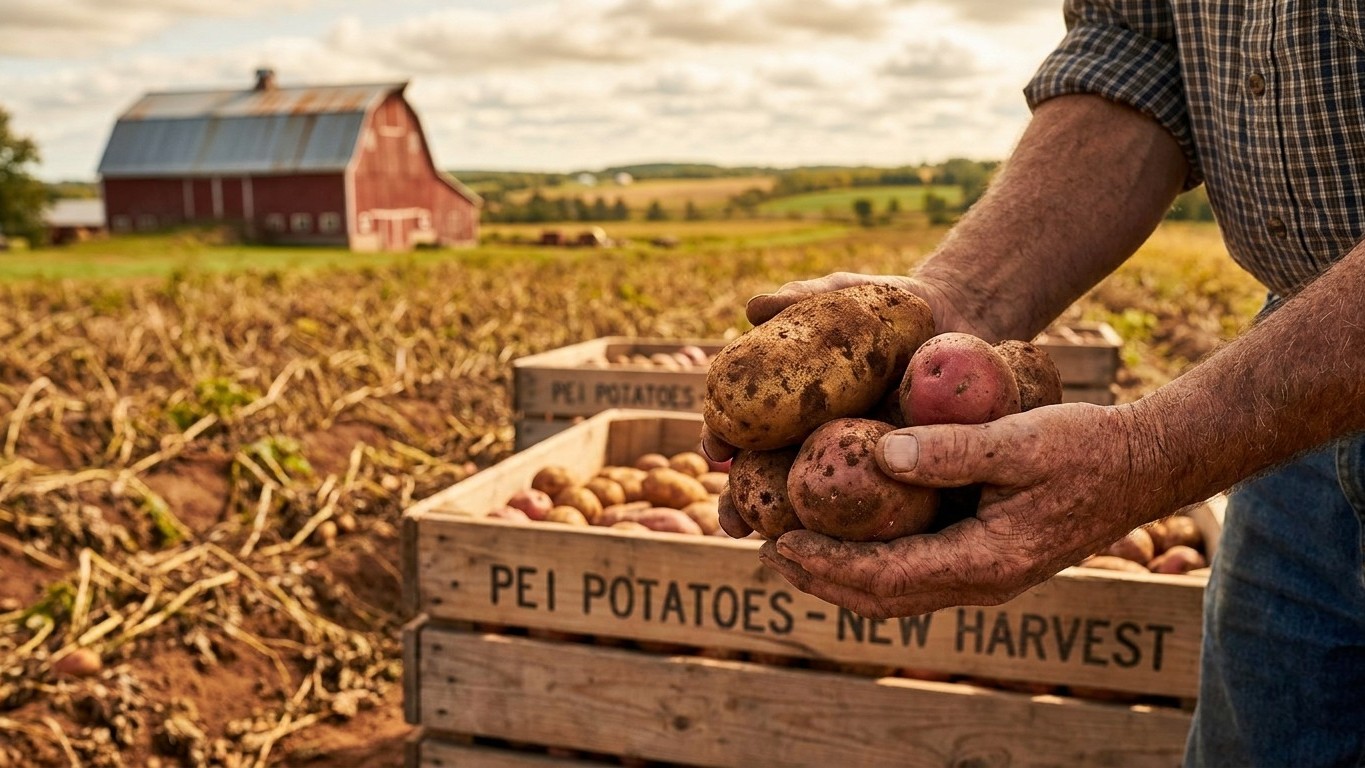

Dig Prince Edward Island potatoes before the ground cools hard, since the average first fall frost lands October 17 and in half the years frost arrives later than that, in half it arrives sooner. Once out of the ground, the crop needs curing at 55-60 F for two to three weeks before it goes anywhere cold. Long-term storage after that wants 40-45 F, and an unheated shed or garage on the Island will not hold that range once winter sets in, because the mean minimum of the coldest month runs 10.3 F.
The short answer
Two numbers frame everything about harvest timing here. The first is October 17, the average date of the first fall frost recorded at the Charlottetown A station. The second is 10.3 F, the mean daily minimum of the coldest month at the same reference point. Neither number is a guarantee. The frost date is a midpoint, not a boundary: Environment and Climate Change Canada’s normals period (1981-2010) shows frost arriving after October 17 in roughly half of those years, and before it in the other half. Growers who wait for a calendar date instead of watching the forecast risk digging into frozen ground.
In practice, that means most Island growers pull their crop through the first half to middle of October, ahead of the average frost rather than after it, especially in the province’s inland and northern parishes, which tend to cool faster than the Charlottetown reading suggests. A province is not one climate. Coastal areas moderated by the Gulf of St. Lawrence and the Northumberland Strait often stay a few degrees warmer into fall than inland fields, so a date that works near Charlottetown can already be tight further north or at higher elevation.
The second figure, that 10.3 F mean minimum, matters just as much once the crop is out of the ground. It answers a question every grower eventually asks: will the garage, the shed, or the unheated back porch hold potatoes all winter? The answer on Prince Edward Island is no, not without help. A structure with no insulation and no heat source will track outdoor air closely enough that on an average night in the coldest month, it sits well below freezing, let alone the 40-45 F window potatoes need. That’s not a marginal miss. It’s a 30-plus degree gap between what the tuber wants and what an open shed delivers.
So the short answer is this: harvest ahead of mid-October rather than banking on the average frost date holding, and plan for an insulated, buffered, or partly heated storage space from the start, not as an afterthought once the first cold snap arrives.
Curing, and where
Utah State University Extension specifies curing at 55-60 F with high humidity for two to three weeks before potatoes go into long-term storage. That window heals small skinning injuries from digging and thickens the skin, which is what actually prevents rot and shrinkage later. Skip curing, and even a well-managed storage space won’t save a crop that goes in with torn, unhealed skins.
On Prince Edward Island, the harvest window (roughly late September through mid-October, ahead of that average October 17 frost) lines up awkwardly with the curing temperature. Outdoor air at that point is already trending toward the low 40s and 30s at night, cooler than the 55-60 F curing target. That rules out curing potatoes outdoors in the open on the Island. It also rules out an unheated garage or shed once nighttime temperatures start dropping toward the coldest-month range, since that space will undershoot 55-60 F within days of harvest, not weeks.
What tends to work instead is an indoors, buffered space that holds residual warmth: a basement corner away from a cold outside wall, a mudroom, or an insulated porch that hasn’t yet been exposed to sustained cold. The steps that make curing succeed here, in order:
- Dig on a dry day and let potatoes sit on the soil surface for an hour or two to dry the skins, no longer, since direct sun and cold night air both work against curing.
- Move the crop indoors immediately to a space that reads 55-60 F, checked with a thermometer rather than guessed at, since basements and porches vary widely from room to room.
- Keep humidity high in that space, covering the potatoes loosely with burlap or a similar breathable material to slow moisture loss without trapping condensation.
- Hold that temperature and humidity for two to three weeks, resisting the urge to move potatoes to cold storage early just because a frost warning has been issued.
- Once the two-to-three-week window closes, move the cured potatoes to their winter storage location and drop the temperature toward the 40-45 F range from there.
A garage with no insulation, useful for many Island storage jobs later in winter for other crops, is the wrong space at this stage. Its temperature will already be tracking outdoor air by the time potatoes are dug, and that outdoor air is heading the wrong direction for curing.
Storing through this winter
Utah State University Extension lists 40-45 F as the storage target for potatoes, in the dark. The University of Maine Cooperative Extension gives a tighter figure for root cellar storage: 38 F at 95 percent humidity. Both sources agree on the core idea even if the numbers differ slightly: cold, dark, and humid, without freezing.
That last word, freezing, is the one that matters most against Prince Edward Island’s winter. With the coldest month averaging a 10.3 F daily minimum, any storage space with no thermal buffering (an unheated shed, an exterior porch, a detached garage with a single wall between the potatoes and the outside air) will drop well below both the 40-45 F and the 38 F targets on a normal winter night, not just during a cold snap. Potatoes stored at those temperatures don’t just get damp, they freeze, and a frozen potato does not recover once thawed. It turns soft, sweet-tasting from converted starches, and unusable within days.
The opposite failure matters too. A basement room near a furnace, or a mudroom that shares a wall with heated living space, can easily sit above 45 F all winter. That’s warm enough to end dormancy early, and potatoes respond by sprouting, which pulls energy and moisture out of the tuber and shortens how long it stays usable.
The Island’s coldest-month numbers argue for a storage space with real separation from outdoor air, something an insulated basement corner, a root cellar dug partly below the frost line, or a purpose-built cold room provides, but a bare unheated outbuilding does not. Growers who use a garage or shed successfully here usually add insulation, bank the exterior walls, or run a small heat source with a thermostat set near 40 F, precisely because an unheated version of that same space would track the 10.3 F outdoor minimum far too closely for the crop to survive.
Checking the space with a thermometer through the coldest weeks, rather than assuming it holds steady, catches both failures before they cost the crop.
What goes wrong here
- Digging after a hard freeze instead of ahead of it. Waiting past the average October 17 frost date, or past the first real cold snap, risks tubers frozen in the ground. Dig ahead of forecast frost rather than by the calendar, and treat the average date as the middle of a range, not a deadline.
- Curing outdoors or in an unheated shed once fall temperatures drop. The 55-60 F curing window from Utah State University Extension is already out of reach outdoors by mid-October on the Island. Move the crop to an indoor, buffered space immediately after digging rather than trying to cure it where it was dug.
- Storing in a space that freezes overnight. An unheated garage or shed will follow the coldest month’s 10.3 F mean minimum closely enough to freeze stored potatoes on an ordinary winter night, not just during an extreme cold event. Insulate the space, bank it, or add a small thermostatically controlled heat source to keep it inside the 40-45 F range Utah State University Extension recommends, or the 38 F at 95 percent humidity the University of Maine Cooperative Extension describes for root cellars.
- Storing too close to a heat source. A basement corner next to a furnace or a mudroom sharing a wall with living space often runs warmer than 45 F all winter, which brings sprouting on early. Move storage to the coolest available indoor spot and check it with a thermometer rather than assuming a basement is automatically cold enough.
- Skipping the dark requirement. Both extension sources call for storage in the dark, and light exposure encourages greening and sprouting even at an otherwise correct temperature. A covered bin or a windowless room solves this without any added cost.
Common questions
Is October 17 a safe date to dig by on Prince Edward Island?
No. It’s the average first fall frost date at the Charlottetown A station over the 1981-2010 normals period, which means frost arrives later than that in roughly half of all years and earlier in the other half. Treat it as the midpoint of a window and watch the actual forecast rather than digging by the calendar alone.
Curing can’t happen outdoors on the Island once potatoes are dug in fall, since nighttime air is already well below the 55-60 F range Utah State University Extension recommends. Move the crop indoors to a buffered space, a basement corner or an insulated porch, and hold it there for the full two to three weeks before starting cold storage.
Will an unheated garage hold potatoes all winter?
Not reliably. With the coldest month’s mean daily minimum at 10.3 F, an unheated garage will track outside air closely enough to freeze stored potatoes on an average winter night, well below the 40-45 F range from Utah State University Extension or the 38 F target from the University of Maine Cooperative Extension.
What’s the difference between the two storage temperatures cited by the extension services?
Utah State University Extension gives a broader 40-45 F range for general storage in the dark, while the University of Maine Cooperative Extension specifies 38 F at 95 percent humidity for root cellar storage. Both aim at the same outcome, a cold, dark, humid space that stays above freezing, and either target works as long as the space actually holds it through the coldest month.