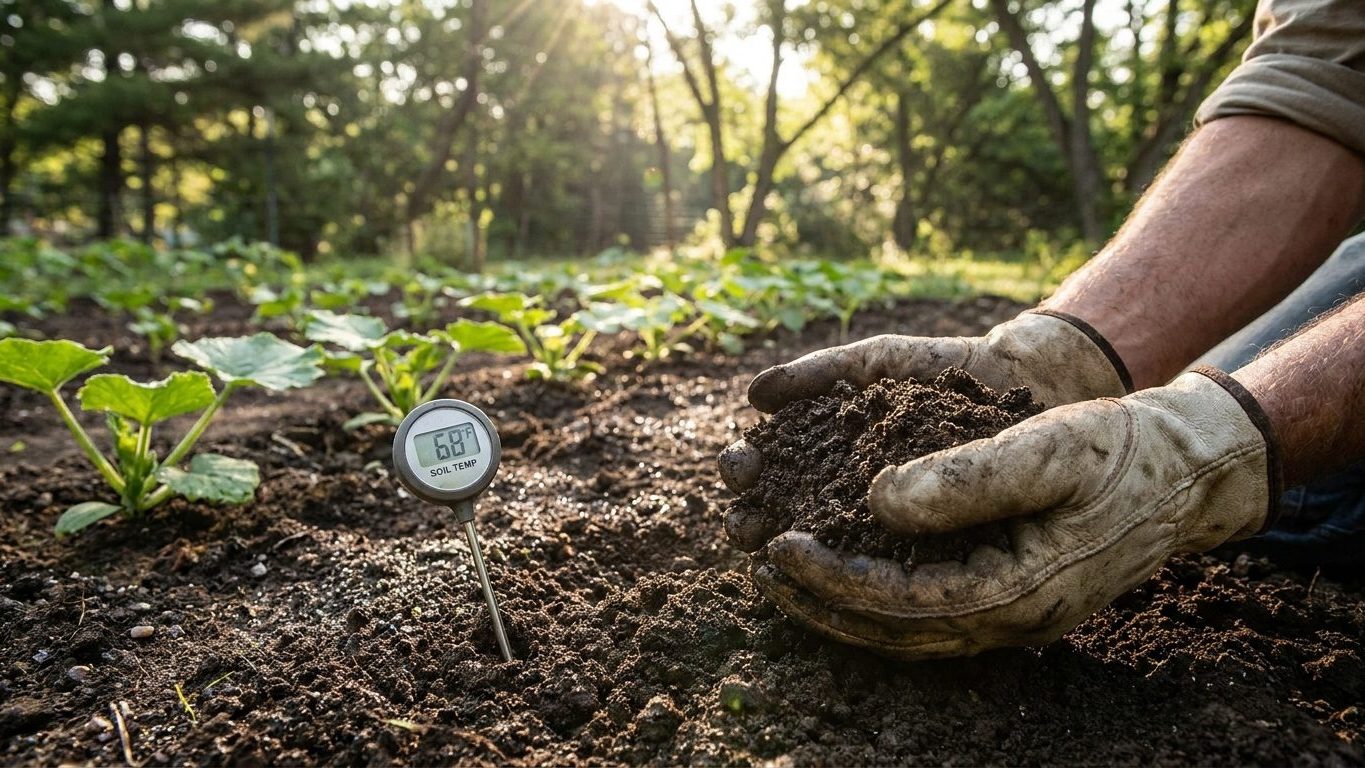

In most of southern Quebec, winter squash go into the ground between roughly May 20 and June 5, once the soil has had a couple weeks to warm past the region’s average last-frost date of May 6. That date is a fifty-fifty average, not a guarantee, and it comes from one reference station near Montreal. Harvest has to wrap up before the average first fall frost on October 5, and that sets a hard ceiling on how long a variety’s season can run.
The short answer for Quebec
The frost-free window at the MONTREAL/ST-HUBERT A station runs from a mean last spring frost of May 6 to a mean first fall frost of October 5. That’s a mean frost-free stretch of about 152 days on paper. In practice, growers should treat both ends of that window with caution: because these are averages from Environment and Climate Change Canada’s 1981-2010 normals, frost arrives later than May 6 in one spring out of two, and earlier than October 5 in one fall out of two. Sowing squash the week after the mean date isn’t safe. It’s a coin flip.
That’s why the practical direct-seed window for winter squash sits closer to May 20 through June 5, once soil temperatures have had time to climb well past the frost mark. Gardeners starting seedlings indoors to get a jump on the season should sow around three to four weeks before that, so roughly mid to late April, and move plants out once nights are reliably above 50°F.
The other end of the calendar matters just as much, because winter squash are judged by days to maturity, and that number has to fit inside what’s left of the season after the frost buffer is subtracted. Here’s how three common maturity classes stack up against an October 5 mean frost, assuming a June 1 sowing date:
| Days to maturity | Approx. harvest date | Buffer before Oct. 5 mean frost |
|---|---|---|
| 80 days (acorn types) | around Aug. 20 | about 45 days |
| 100 days (butternut types) | around Sept. 9 | about 26 days |
| 120 days (large Hubbard/pumpkin types) | around Sept. 29 | about 6 days |
That six-day buffer on a 120-day variety is the whole story in one line: it assumes the frost holds off until the mean date, and it assumes nothing else slows the plant down. Neither assumption is safe to build a season around.
What will not work here

Long-season squash pushed to their limit is the single most common failure here. A 115 to 120-day Hubbard or a big storage pumpkin sown on the earliest date most people feel comfortable with, late May, is still cutting it close against an October 5 mean frost that could easily land two or three weeks earlier in a cold year. Growers chasing the biggest, longest-storing types need to either start those seedlings indoors well ahead of transplant, or accept the variety isn’t a fit for this calendar without protection like row cover for the shoulder seasons.
Heat is the other limiter, and it works in the opposite direction from most of the country. The Montreal reference station logs a mean of 0.0 days per year above 90°F. That’s not a warm-summer climate with a hot stretch to fall back on if the plant runs a little behind. Squash varieties bred for regions with long, hot summers, the ones that rely on accumulated heat to fully cure their skin and concentrate sugars before storage, often finish soft-shelled or under-sweet in a Quebec summer even when the calendar days line up. Days to maturity on a seed packet assumes a certain amount of warmth, not just a certain number of days, and Quebec’s summers don’t supply the heat load those numbers were built around.
Rainfall creates a third, quieter problem. Summer rain totals about 10.6 inches across June, July and August, with June, the driest of the three, still delivering 3.42 inches. That’s enough moisture, spread across a cool season with little evaporative heat to dry leaves quickly, to keep foliage damp longer than a drier climate would. Winter squash planted at tight, seed-packet spacing in this kind of summer are set up for powdery mildew and downy mildew before the vines even reach full size. Wider spacing and airflow between plants isn’t optional here the way it might be in a hot, dry climate; it’s the difference between a crop that finishes and one that collapses under fungal pressure in August.
A second, fall-targeted sowing of winter squash, the kind some warmer regions use to spread the harvest, simply doesn’t fit. There isn’t enough season left after early June to squeeze in a second planting cycle before the October frost closes things down.
What changes across Quebec
Quebec is not one garden, and the hardiness zone number makes that obvious on its own. The Canadian hardiness zone for the Montreal reference area is 5b, but that figure belongs to one city, not the province. Quebec stretches from the St. Lawrence lowlands, where Montreal sits, all the way north into subarctic territory, and the zone spread across that distance is enormous, running from the milder zones near the U.S. border down to zones too cold to register on the same scale used for Montreal. There is no single hardiness number for Quebec as a whole, and no version of this page could honestly give one.
That spread matters directly for a squash calendar because both frost dates shift with it. A garden in the Eastern Townships or the milder pockets near the Quebec-Vermont border can expect a last frost close to, or even a little ahead of, the May 6 mean used here. A garden in Abitibi, the Saguenay, or along the Côte-Nord is working with a shorter season on both ends, a later last frost in spring and an earlier first frost in fall, which squeezes the safe window for anything past a 90 or 100-day variety.
Elevation adds another layer that a province-wide date can’t capture. Cold air drains downhill and pools in low ground and valley bottoms, so two gardens a few miles apart, one on a slope and one at the bottom of it, can see frost dates weeks apart in the same spring. None of that shows up in a single reference-station average.
Rather than guess at where any individual garden falls on that spread, the reliable move is checking Natural Resources Canada’s Plant Hardiness Site, which maps zones by municipality using the same 1991-2020 normals methodology behind the Montreal figure cited here.
Where to check this for your own county
This page gives the provincial picture, built from one weather station near Montreal. That’s useful as a baseline, but it’s not a substitute for what Quebec’s own agricultural extension service publishes for a specific county or MRC (municipalité régionale de comté). The Ministère de l’Agriculture, des Pêcheries et de l’Alimentation du Québec, MAPAQ, is the province’s extension authority, and its site is the next stop for anyone trying to narrow this calendar down to their own township.
Two things are worth hunting down there specifically. First, any regional planting calendar or growing guide MAPAQ or its regional offices have published for the reader’s own agricultural zone, since Quebec’s extension work is often organized by region rather than as one blanket provincial document. Second, variety trial results for winter squash conducted in or near the reader’s own county. A variety that performed well in a multi-year trial near Quebec City tells a grower in that region far more than a generic “100 days to maturity” printed on a seed packet designed for a national market.
The general rule holds here the same way it does anywhere else: a county-level or regional recommendation beats a provincial one every time, because it accounts for local soil, local microclimate, and local pest and disease pressure that a province-wide average simply can’t see. This page is the provincial one. The county-specific answer sits with MAPAQ.
Checking this against your own garden
Every date on this page comes from an average measured at one station decades ago. A gardener’s own soil, standing in their own yard on a given morning, outranks all of it. Three simple checks say more than any calendar.
- Soil warmth by feel. Winter squash seed sulks and rots in cold, wet soil rather than germinating. Pushing a bare finger a couple inches into the bed on a morning in mid to late May tells a grower more about their own microclimate than any frost-date average. Soil that still feels cold and damp that late in the month means a garden is running behind the provincial norm, whatever the calendar says.
- The first flush of male flowers. Squash plants send out male blossoms before female ones, usually appearing days to a couple weeks ahead. Their appearance signals the plant has settled into steady growth in that particular garden’s conditions, and it’s a useful marker for timing when to expect the first fruit set.
- The first true leaves. The rounded seed leaves that emerge first aren’t the plant’s real leaves. Watching for the first set of true, lobed squash leaves shows how quickly a specific bed is pushing growth compared to a neighbor’s garden even a short distance away, which is often the clearest sign of a warmer or cooler pocket than the regional average suggests.
None of these require a thermometer or any tool beyond attention. Taken together over a season or two, they build a picture of a specific garden’s own rhythm, one that will consistently beat a single weather station’s average for deciding what actually works there.
Some gardeners also time this by the Moon: when to plant winter squash by the moon, as almanac tradition rather than fact.