
Insulation does help keep a Saskatchewan home cool, but the honest answer is that summer heat barely shows up here in the first place. The reference station at Saskatoon logs an average of zero days a year above 90°F. The real payoff of insulation in this province is holding heat in through a long, cold winter, and the same material happens to slow heat gain on the rare hot afternoon too.
The short answer for Saskatchewan

Yes, insulation slows summer heat gain in a Saskatchewan house, and no, that is not where most of the value sits. The number that settles it is 0.0, the mean number of days a year reaching 90°F or more at the Saskatoon reference station, per Environment and Climate Change Canada’s 1981-2010 Climate Normals. That is not a rounded-down “almost none.” It is the recorded average. A summer that rarely crosses 90°F is not a summer that puts real pressure on a building envelope the way a Texas or Arizona summer does.
The climate-zone number tells the same story from a different angle. Saskatoon Diefenbaker International Airport records roughly 5,743 heating degree days below 18°C a year, which places that station in Natural Resources Canada’s climate zone 7a under the “Keeping the Heat In” framework. NRCan sets its zones by annual heating degree-days, from Zone 4 (under 3,000 HDD) up to Zone 8 (over 7,000 HDD). A station with nearly 5,743 HDD sits deep on the cold side of that scale, a place where the heating season dominates the year, not the cooling season.
That single fact should reset expectations for anyone shopping for insulation in this province with summer comfort as the goal. In a climate where days above 90°F are effectively a rounding error, insulation is not going to be judged on how it performs during a heat wave, because heat waves of that intensity are not the pattern here. It earns its keep from October through April, when the temperature differential between inside and outside is large and constant for months at a time. The summer benefit is real but secondary, a side effect of a wall and ceiling assembly built for a cold-dominant climate, not the reason to buy it.
This is worth stating plainly because so much general insulation advice is written for climates where the opposite is true. A homeowner in a hot, humid U.S. state reads about radiant barriers and attic ventilation because their summer is the harder season to manage. In Saskatoon and across most of Saskatchewan’s settled area, the winter is the harder season, and the insulation levels that matter most are the ones sized for degree-days in January, not for the handful of warm afternoons in July. Any Saskatchewan homeowner should check their own municipality’s degree-day figures before assuming their zone matches Saskatoon’s, since a province this size spans more than one NRCan zone.
What happens above the ceiling
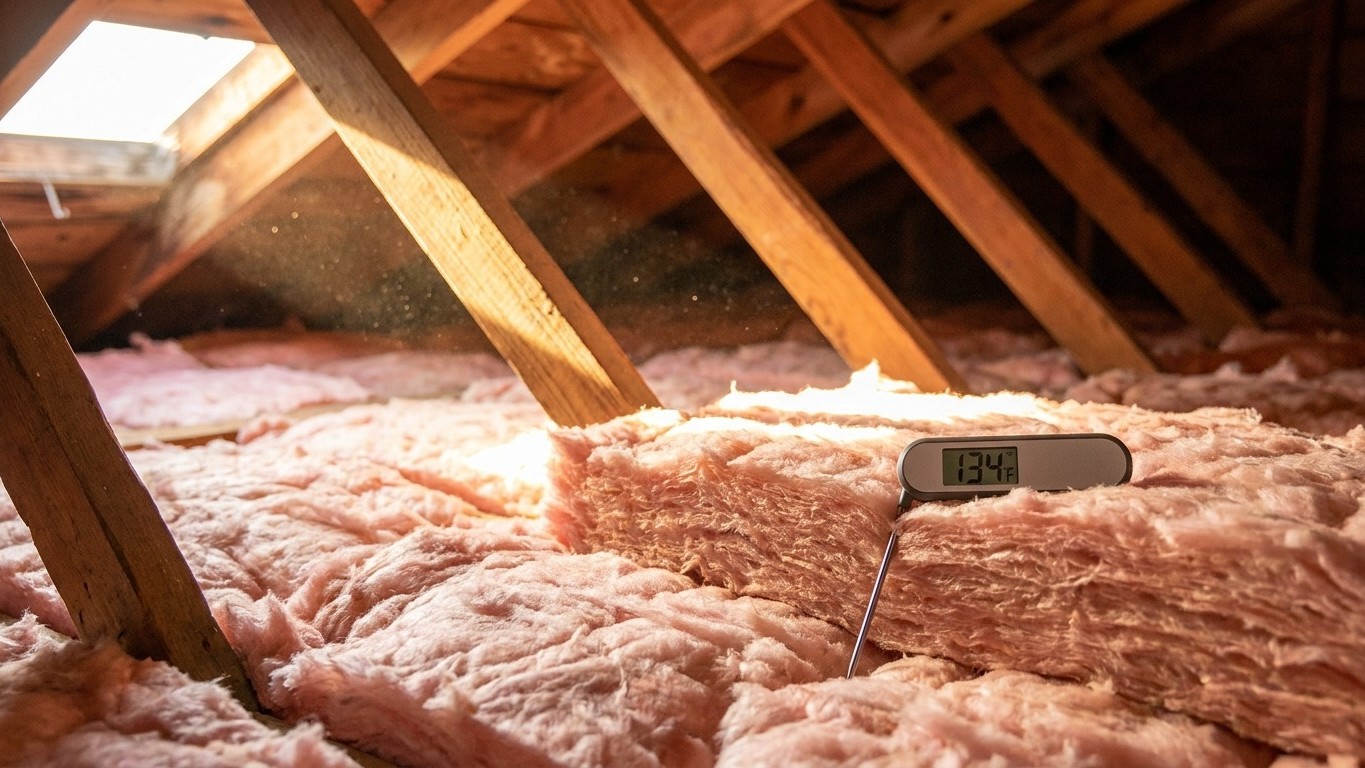
Even in a climate with almost no extreme heat, an attic can still run far hotter than the air outside on a sunny day. A dark, sun-loaded roof deck absorbs radiant energy and can push attic air temperatures well above the outdoor reading, sometimes by a wide margin, simply because that space is sealed, poorly ventilated, and sitting directly under solar exposure. Everything below that roof deck, the ceiling drywall, any ductwork routed through the space, and boxes stored up there, sits under that heat load whether or not the rest of the house feels warm.
The useful point is that the insulation doing the winter job and the insulation doing the summer job are the same material, working in the same direction of resistance. Insulation does not “know” which season it is; it simply resists the flow of heat across itself, and in July that flow runs downward, from a hot attic into a cooler living space, instead of the winter direction, from a heated house upward into cold outdoor air. A homeowner does not need a different product for summer. They need enough of the same product.
Natural Resources Canada’s “Keeping the Heat In” guide lists recommended minimum insulation values by climate zone, and for zone 7a, the zone the Saskatoon reference station sits in, those minimums are:
| Assembly | Recommended minimum (RSI) | Recommended minimum (R-value) |
|---|---|---|
| Walls | RSI 7.1 | R 40 |
| Basement walls | RSI 5.3 | R 30 |
| Roof or ceiling | RSI 14.1 | R 80 |
| Floor over unheated spaces | RSI 8.8 | R 50 |
These are nominal insulating values presented as recommended minimums for that zone, not a building-code mandate, provincial and municipal code can require more, and a colder pocket of the province could sit in a different zone entirely with its own numbers. The ceiling and roof figure, RSI 14.1 (R 80), is the one that does double duty. It was sized against the province’s heating degree-days, but it is the exact same resistance layer standing between a scorched attic deck and the living space below on the handful of hot days each summer brings. There is no separate “summer insulation” to buy on top of it — hitting the recommended ceiling value covers both jobs at once.
What homes in Saskatchewan cool with
Air conditioning is far from universal in this part of the country, and that changes how insulation fits into the cooling picture. Statistics Canada’s Canadian Social Survey on Quality of Life and Energy Consumption Behaviours found that 57.2% of households in the Prairie region have air conditioning, compared with 68.3% across Canada as a whole. That figure covers the Prairie region as a single block in the survey, not Saskatchewan on its own, and it is a share of households surveyed, not a share of houses standing, a lower regional rate can reflect a milder cooling need, an older housing stock, or both, and the survey does not separate those causes.
Where a household does run central air conditioning through ductwork routed through the attic, that duct run sits inside the hottest space in the entire building, the same overheated attic described above. Ceiling insulation does nothing to protect that ductwork; a duct sitting in a 130°F attic loses cooled air to that heat regardless of how thick the insulation is on the attic floor beneath it. Sealing and insulating the ducts themselves is a separate task, and it is worth handling separately rather than assuming a well-insulated ceiling has already solved it.
For the households running a window unit or a ductless mini-split instead of central air, which is common in a region where nearly 43% of Prairie households report no air conditioning at all, the calculation is simpler: the insulation and air-sealing of that one room’s walls, windows, and ceiling is what determines how hard that single unit has to work. There is no attic duct run to worry about, just the envelope immediately around the equipment. Readers dealing with either setup can find more detail in this site’s duct sealing guides and its room air conditioner guides.
What the heat asks for that the cold does not
Two tools that show up constantly in hot-climate insulation advice have little or no place in a Saskatchewan house, and it is worth saying so directly rather than listing them as options.
A radiant barrier reflects radiant heat rather than resisting conducted heat the way insulation does. It carries no R-value on its own and only earns its keep under a roof deck that takes a heavy, sustained solar load, day after day, for months. With a reference station averaging zero days above 90°F, that condition simply does not describe this territory. A radiant barrier is not the tool this climate is asking for, and the recommended zone 7a insulation levels above do the actual work.
Vapour behaves differently depending on which direction the moisture is trying to travel, and that direction flips between a cold climate and a warm, humid one. In a hot, humid climate, the damp air sits outside the wall for most of the year, which is why the model code does not require an interior vapour retarder in the warmest zones, trapping that outside moisture inside a wall assembly would cause more harm than good. Saskatchewan’s cold, dry winters put the moisture pressure in the opposite direction most of the year, which is a separate question with its own answer. Rather than settle it here, that question belongs on this territory’s vapour barrier page, where the province’s own moisture pattern can be addressed properly.
What the work is worth
The clearest published estimate of what air sealing and insulation are worth comes from the U.S. Environmental Protection Agency’s ENERGY STAR program: “EPA estimates that homeowners can save an average of 15% on heating and cooling costs (or an average of 11% on total energy costs) by air sealing their homes and adding insulation in attics, floors over crawl spaces, and accessible basement rim joists.”
Both numbers matter, and they measure two different things. The 15% figure applies specifically to heating and cooling costs combined, not to a household’s full utility bill. The 11% figure applies to total energy costs, the broader number that also includes water heating, appliances, and everything else running on the meter. Neither figure should be quoted without the other, since a true number loses its meaning the moment its denominator gets dropped.
This estimate is exactly why a page on summer heat and insulation belongs in a cold-dominant climate like Saskatchewan’s. The savings figure is not framed as a heating saving that happens to carry over into summer as an afterthought, it is presented as heating and cooling together, from the same air sealing and the same attic, crawl space, and rim joist work. That combined framing matches what this page has argued from the start: the ceiling insulation sized for a Saskatchewan winter is doing real, measurable work on the rare hot day too, even in a climate where those days are few.
These figures come from energy modelling of a typical existing U.S. home, an average across a broad and different housing stock, not a guarantee for any individual house in Saskatoon or elsewhere in the province. The work itself is also specific: attics, floors over crawl spaces, and accessible basement rim joists. It does not extend to walls, windows, or doors, and it comes with no price tag or payback timeline attached here, since actual costs vary too widely by house and by contractor to state as a single figure.