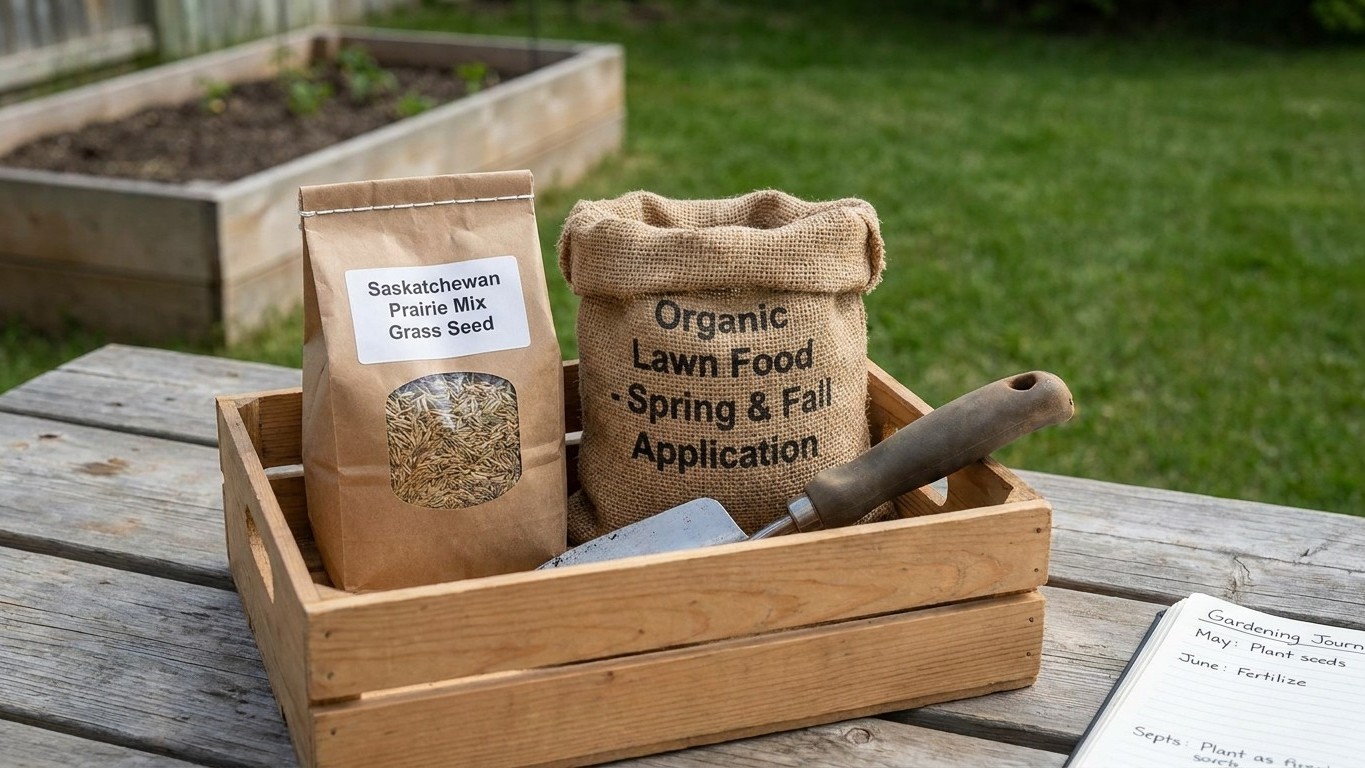

Saskatchewan lawns need cool-season grass, full stop: a winter that averages -20.7°C in its coldest month kills warm-season turf outright, and every seeding date, feeding rate and mowing height follows from that one fact. Plant Kentucky bluegrass, fine fescue, perennial ryegrass, tall fescue or rough bluegrass, mixed or alone, and run the whole calendar around the plant’s fall root-building, not the calendar year. Seed in the weeks before the average first frost, not in May the way a warm-season lawn further south would.
Which grass belongs in Saskatchewan

The numbers behind Saskatoon’s climate settle this before you even shop for seed. Environment and Climate Change Canada’s 1981-2010 normals for Saskatoon put the mean daily minimum of the coldest month at -20.7°C, a level no warm-season grass such as bermudagrass or zoysia survives without dying back to bare ground. The same station reports only 4.98 days a year that reach 32°C, alongside a broader count of 13.1 days a year above 30°C, so summer heat here is real but brief. Together those two figures point to one answer: a cool-season lawn, not a warm-season one.
Clemson Cooperative Extension’s HGIC 1214 fact sheet, compiled with Penn State Extension’s cool-season species data, lists the species that hold up under a winter like this: Kentucky Bluegrass, Fine Fescues, Perennial Ryegrass, Rough Bluegrass and Tall Fescue. All five are bred to go dormant through cold rather than die from it, and all five green up again once the ground opens in spring. None of them tolerate the kind of prolonged summer heat that Iowa’s transition-zone lawns deal with, where Iowa Lawn Care: What to Plant and When to Feed It has to weigh a cool-season lawn against a warm-season one because neither wins outright. Saskatchewan does not have that argument. The choice here is cool-season, and the real decision left is which species or blend suits the yard.
| Species | Cold tolerance | Drought tolerance | Typical mowing height |
|---|---|---|---|
| Kentucky Bluegrass | Excellent | Fair, needs supplemental water | 2.5 to 3.5 in |
| Fine Fescues | Excellent | Good, best of the group | 2.5 to 3.5 in |
| Perennial Ryegrass | Good | Fair | 2 to 3 in |
| Rough Bluegrass | Good, prefers moist shade | Poor | 1.5 to 2.5 in |
| Tall Fescue | Good | Good, deep-rooted | 3 to 4 in |
Most home lawns here do best on a blend rather than a single species: Kentucky bluegrass for a dense sod look, mixed with fine fescue for the shady or dry corners a bluegrass-only lawn struggles with. Straight tall fescue works too and shrugs off drought better than bluegrass, but it clumps rather than spreads, so bare patches need reseeding rather than filling in on their own.
When to seed or sod here
Cool-season grass is seeded in the weeks before it goes dormant, not while it is pushing new top growth in the heat of summer. Clemson Cooperative Extension’s HGIC 1203 fact sheet on lawn establishment sets that window in the mid to late September for cool-season lawns generally, while warm-season species go in around May. Since nothing on the warm-season list belongs in Saskatchewan, the May date does not apply here at all. Every seeding decision runs off the fall side of that calendar.
Anchoring the window on this territory’s own frost
The fall window has to be set against this territory’s own frost, not a generic month. Environment and Climate Change Canada’s 1981-2010 normals for the SASKATOON SRC station put the average first fall frost at September 18, and that figure is a midpoint, not a guarantee: in roughly half of all years the real frost lands later, and in the other half it lands earlier. New grass needs roughly six to eight weeks of growth before a hard freeze to root in well, and counted back from September 18 that lands the safe seeding window in late July to early August for most of the area around Saskatoon. Gardeners further north or at higher ground should expect that window to arrive earlier, since a shorter frost-free season is the whole reason Yukon Lawn Care: What to Plant and When to Feed It pushes seeding even earlier in the summer.
Sod follows the same clock as seed, though it tolerates a slightly later start since the roots are already established rather than germinating from scratch. A spring seeding is possible, but it competes against weeds that germinate fast in warm soil, and a young cool-season lawn seeded in spring often looks thin through its first summer no matter how well it is watered. Fall seeding into cooling soil, ahead of that September frost, gives roots a full autumn to establish before winter and another spring to thicken up before the first hot stretch.
The feeding calendar that fits this climate
Cool-season grass in Saskatchewan needs nitrogen at the two ends of its growing season, not through the heat in between. The plant is building root and rhizome mass in September as topgrowth slows, and that is when nitrogen does the most good. A light feeding in early spring as growth resumes helps green-up, but a heavy feed then pushes soft top growth right into the low-heat, high-humidity stretch where fungal disease takes hold. Save the bulk of the year’s nitrogen for early autumn.
Clemson Cooperative Extension’s HGIC 1219 Tall Fescue Maintenance Calendar lays out a full season of feeding, mowing and pest timing for tall fescue specifically, and it is worth reading in full if that is the species in your yard: Tall Fescue Maintenance Calendar. The same fall-weighted approach applies to a Kentucky bluegrass or fine fescue lawn even though Clemson’s calendar is written around fescue: split the year’s nitrogen so the larger share, commonly applied at a rate of roughly 0.5 to 1 pound of actual nitrogen per 1,000 square feet per application, goes down in early September rather than June.
Skip a heavy nitrogen feed in July or August altogether. It does not speed up growth much in weather cool-season grass already finds stressful, and it feeds brown patch fungus rather than the lawn. A light iron application can green up a summer-stressed lawn temporarily without adding the nitrogen that fuels disease, if color is the only concern.
A typical program on this kind of lawn runs two to three nitrogen applications a year: a modest one as the lawn greens up in spring, another in September, and for lawns pushed for a dense look, a light one in late October just before the ground freezes to feed roots without triggering new topgrowth. Never guess quantities from the bag alone. A soil test tells you whether phosphorus and potassium are also needed, since piling on nitrogen to a soil already short on potassium just trades one weakness for another.
Mowing height and watering here
Mow a Kentucky bluegrass or fine fescue lawn at 2.5 to 3.5 inches, and a straight tall fescue lawn slightly taller, at 3 to 4 inches. Height does most of the lawn’s work for you: a taller cut shades the soil, holds moisture longer between waterings, and crowds out germinating weed seed better than a lawn scalped short. Never remove more than one third of the blade in a single mow, the rule every cool-season extension calendar repeats for a reason. Cutting a 4-inch lawn down to 2 inches in one pass stresses the plant right when it can least afford it, whether that is the heat of midsummer or the cold snap of early fall.
Watering through a Saskatoon summer
An inch of water a week, from rain and irrigation combined, is the standard cool-season guideline and a reasonable default here. What moves that number is the small stretch of genuinely hot days: Saskatoon averages 13.1 days a year above 30°C by Environment and Climate Change Canada’s count, and on those days a lawn loses water fast enough that a once-a-week soak may not carry it through. Deep, infrequent watering still beats a daily light sprinkle, since shallow watering trains roots to stay near the surface where they dry out first. Sandy soil, common in some outwash areas of the province, drains faster than the heavier clay loam found elsewhere and needs that inch split into two waterings rather than one.
What goes wrong on lawns in Saskatchewan

The specific ways a Saskatchewan lawn fails are different from a lawn in a humid southern state, and they follow directly from the climate described above.
- Snow mold shows up as matted, grey or pink patches as snow melts off a lawn that went into winter with long grass or a thick layer of fallen leaves still on it.
- Summer dormancy mistaken for death happens during the driest stretches, when a cool-season lawn goes brown and crisp on purpose to survive, then greens back up within a couple of weeks of rain.
- Winterkill follows an open, snow-free cold snap more than it follows depth of cold, since bare crowns exposed to -20°C or colder with no insulating snow cover are far more vulnerable than the same crowns under a foot of snow.
- Thin turf in shade is common under the poplar and spruce windbreaks many Saskatchewan yards rely on, since Kentucky bluegrass thins out fast without enough light and needs a fine fescue or rough bluegrass mixed in to hold that ground.
None of these four failures means the lawn is finished. A brown lawn in August is very often a dormant lawn, not a dead one, and the test is simple: tug a handful of grass, and if the crown resists and stays rooted, water and patience bring it back. Snow mold usually clears on its own once the lawn dries out and gets its first spring mow, though a bad patch benefits from a light raking to let air in. The one failure worth acting on before it happens rather than after is winterkill, since there is no fixing a dead crown once spring arrives, only reseeding it.
Local help
For a soil test, county-specific pest pressure or a second opinion on a lawn that will not recover, the Saskatchewan Ministry of Agriculture’s agribusiness, farmers and ranchers office is the starting point, and its staff can point a homeowner toward the nearest regional office rather than guessing at a province-wide answer. A soil test is worth doing before assuming a lawn needs more nitrogen, since a pH or potassium problem does not fix itself on a nitrogen schedule, however precisely timed.
Common questions
Can I grow zoysia or bermudagrass if I protect it over winter?
No. A winter cold enough to average -20.7°C in its coldest month, as Saskatoon’s does by Environment and Climate Change Canada’s normals, kills warm-season crowns outright regardless of mulch or covers. Stick to the cool-season species that are actually bred to survive that cold.
Is it too late to seed in October?
Probably, and it is a gamble either way. Seed needs time to root before the ground freezes hard, and October soil in this region is already cooling fast toward that average September 18 frost mark, leaving little margin if the season runs even slightly early.
My lawn turned brown in August, is it dead?
Almost certainly not. Cool-season grass browns on purpose in a dry stretch to protect its crown, and it greens back up once rain or irrigation returns, usually within a couple of weeks. Tug a small patch: if the roots hold firm in the soil, the lawn is dormant, not dead.
Do I need to dethatch every spring?
Only if thatch has built up past about half an inch, which most home lawns here do not reach every year. Dethatching a lawn that does not need it just opens bare ground for weed seed to move into.
Can I mix Kentucky bluegrass and tall fescue in the same lawn?
You can, but they do not blend evenly. Tall fescue grows in coarse clumps rather than spreading like bluegrass, so a mixed stand often ends up patchy in texture rather than uniform. A cleaner result comes from picking one as the base and using the other only to overseed a specific problem area, like shade or a slope that dries out fast.