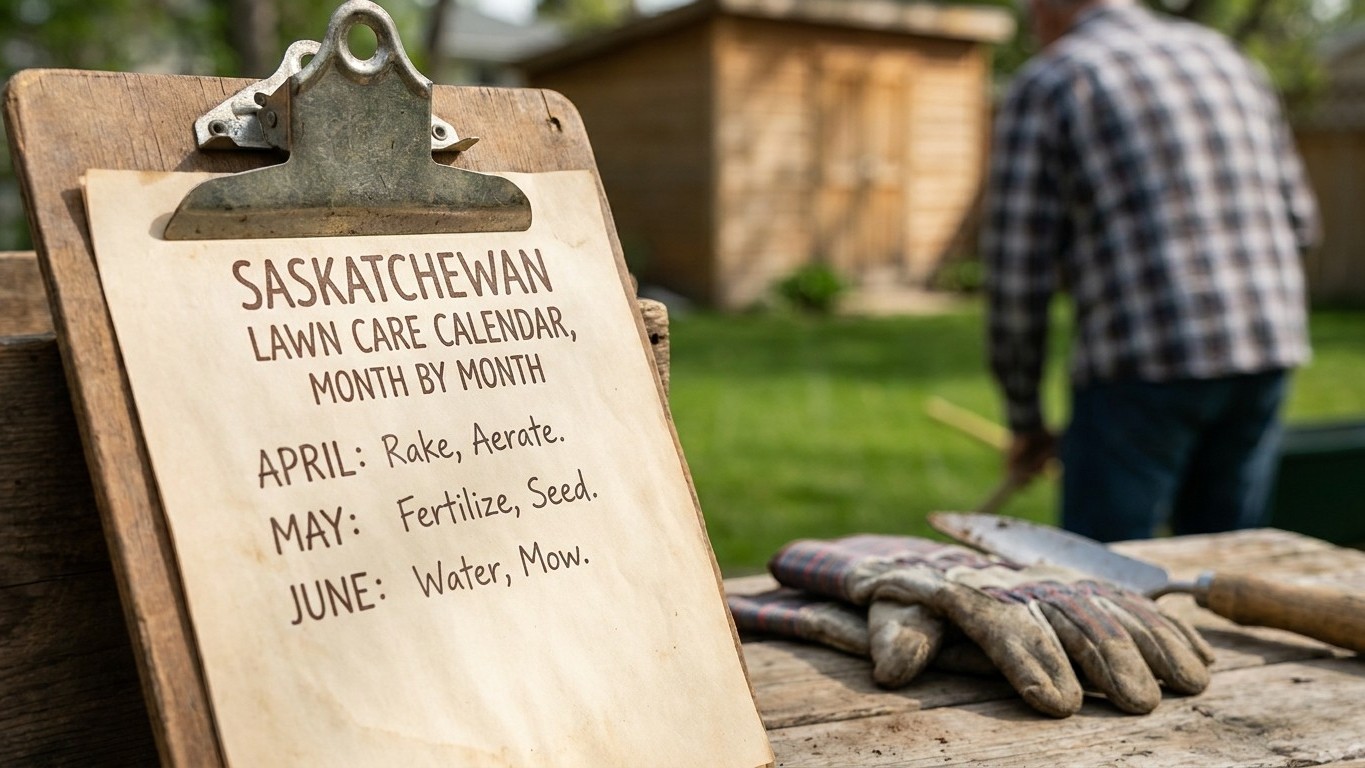

Saskatoon’s growing season ends earlier than most lawn calendars assume, with frost settling in by mid-September most years — which is exactly why a bag of Bermuda or zoysia seed, however drought-tolerant the label promises, never gets the chance to prove it here. This is bluegrass and fescue country, full stop, and every task worth doing in a given month only makes sense once you’re planning backward from that September cutoff rather than forward from some generic spring start date.
The short answer for Saskatchewan
The short answer: this is a cool-season lawn zone centered on Saskatoon, and the species worth planting are Kentucky bluegrass, tall fescue, perennial ryegrass, fine fescues and rough bluegrass, the list Clemson Cooperative Extension’s HGIC 1214 guide and Penn State Extension group together as cool-season turf. The Homestead Post assigned that zone by weighing how many days a year run at or above 90°F and how cold the coldest month’s average low gets, then reading those figures against the season tolerances HGIC 1214 publishes.
The grasses that work here
Warm-season species like Bermuda or zoysia are built for long, hot summers and don’t survive a Saskatchewan winter, so they’re off the table regardless of how drought-tolerant the seed bag claims. If you haven’t settled on one of the cool-season options yet, The Best Grass Seed for Saskatchewan Lawns breaks down what each one trades off in shade tolerance, wear and water needs.
The date that drives the calendar
The other figure that shapes everything below is the mean first fall frost. Environment and Climate Change Canada’s Canadian Climate Normals for 1981-2010, recorded at the Saskatoon SRC station, put that date at September 18. Treat it as a midpoint, not a guarantee: in roughly half the years on record frost arrives after that date, and in the other half it arrives before. That fact decides when fall feeding, aeration and overseeding need to happen, since each job needs real weeks of active growth to finish before the lawn shuts down.
What the answer depends on is where you stand relative to Saskatoon. The SRC station sits in the city itself, and a yard even forty minutes away, at different elevation or further from the river valley, can run its own frost timing days or weeks off that mark. Use September 18 as a planning anchor, then watch your own local forecast as the season turns.
Working through the year

Cool-season grass does the opposite of what a warm-climate lawn does: it grows hardest in spring and fall, and slows or browns under summer heat rather than after frost. Clemson’s HGIC 1219 tall fescue maintenance calendar, written for a cool-season species, follows that same rhythm, fall as the heaviest work period and summer as a holding pattern, and it’s the model worth following here even though Clemson calibrated its calendar dates to South Carolina’s longer season, not Saskatoon’s.
Early spring
Wait for the lawn to green up on its own before doing anything to it. Rake off matted leaves and the grey, crushed patches that snow mold leaves behind once the ground has dried enough to walk on without leaving footprints. Hold off on the first fertilizer application until the grass is actively growing, since feeding turf that’s still barely green mostly feeds moss and early weeds instead.
Late spring into summer
Mow regularly once growth is underway, and keep the deck on the higher end of whatever range your species calls for. Short-cut cool-season turf loses more moisture through a hot, dry stretch and browns faster than a lawn left a notch taller. Water deeply and less often rather than lightly every day, which builds the root depth that gets a lawn Through a Dry Spell without dying back completely. Pale, dormant-looking grass in a hot July is a survival response, not death, and it typically greens back up once rain or irrigation resumes.
Late summer into fall
This is the season that matters most for a cool-season lawn, and it’s the one HGIC 1219 weights its own schedule toward. Aeration and overseeding both do their best work now, while soil is still warm enough for seed to germinate and roots to establish before growth stops for winter. Fertilizing in this window, rather than loading up in spring, builds the root reserves the lawn draws on to green up early the following year. All of it needs enough runway before the September 18 mean frost date at Saskatoon SRC that new seedlings have time to root in, which argues for getting seed down as soon as summer heat breaks rather than waiting for a fixed date on the calendar.
Before dormancy
- Keep mowing until growth actually stops, at whatever height you settled on for summer.
- Skip a late, heavy nitrogen feeding once frost is close, since it pushes soft growth the plant can’t harden off in time.
- Clear fallen leaves before they mat down and smother the crown under snow cover.
- Leave the last cut a touch lower than summer height, since matted long grass invites snow mold.
What changes across Saskatchewan
Every figure above is measured at or near the Saskatoon SRC weather station, and Saskatchewan is not one climate. The province runs a long way from the US border up into boreal forest, and a lawn’s growing season shortens the further north and the higher the ground gets.
South and north of Saskatoon
South of Saskatoon, toward Regina and on down toward the US border, the frost-free window tends to open earlier in spring and close later in fall than at the reference station, since that part of the province sits at lower latitude. North toward Prince Albert and into the parkland and forest fringe, the season compresses from both ends: spring green-up starts later and the first fall frost arrives sooner, which shortens the window for the fall seeding and aeration described above. A lawn there needs its fall work finished earlier relative to the calendar than a Saskatoon yard does.
Local geography inside a region
Geography inside a single area matters too. A yard in a low spot or a river valley collects cold air on a still night and frosts before a yard on a nearby rise, sometimes by more than a week. Wind exposure changes things as well: a lawn sheltered by a shelterbelt or a building holds heat longer into fall than one exposed to open prairie wind, and dries out faster in summer for the same reason.
None of this changes which grasses belong on the lawn, since the cool-season species list holds across the whole province. What changes is timing: shift your own fall schedule earlier than the Saskatoon anchor if you’re north of the city or in a low-lying, frost-prone spot, later if you’re well south of it.
The mistakes this climate punishes
A handful of habits that work fine in a milder or longer climate cause real damage here, and most of them come from applying a warm-season or a longer-season rulebook to a short, cool-season one.
Where the damage shows up
| Mistake | When the damage shows | Why it happens here |
|---|---|---|
| Front-loading fertilizer in spring, going light in fall | The following winter and spring, as slow green-up and thin turf | Cool-season grass builds root reserves in fall, the season HGIC 1219’s tall fescue calendar weights its own schedule toward. Spring-heavy feeding pushes leaf growth instead of the roots that carry the plant through winter. |
| Seeding cool-season grass in the heat of midsummer | Within a couple of weeks, as seedlings scorch or fail to germinate | Cool-season seed germinates best in cooler soil. Sown into peak summer heat, it either sits dormant or germinates into conditions too dry for a shallow new root system. |
| Scalping the lawn short during a hot, dry stretch | Within days, as brown patches that don’t green back up with the next rain | A short-cut lawn loses moisture faster and shades less of its own soil, so heat and drought stress compound instead of easing. |
| Seeding or heavy feeding too close to the mean fall frost date | The following spring, as bare or thin patches where new grass never rooted in | New seedlings and soft late-season growth need real time to establish before the September 18 mean frost at Saskatoon SRC, and a late start doesn’t leave enough of it. |
Why timing matters more than technique
The pattern across all four is timing rather than technique. The same fertilizer, the same seed and the same mower do real good or real harm depending only on which side of the growing season they land on. A short growing season punishes a late start harder than a mild one does, because there’s no slack left at the end of it to make up for lost time.
Checking this against your county
Everything above is anchored to one weather station and one set of climate normals, not to your specific yard. If you’re new to maintaining a lawn in this climate, it’s worth reviewing the basics laid out in Saskatchewan Lawn Care before working through a full season on this calendar.
For frost timing, soil conditions and any current pest or disease advisories closer to your own county, check with Saskatchewan’s agriculture and agribusiness extension service. It’s the most reliable way to confirm local specifics before betting a season’s fertilizer and seed budget on a single province-wide average like the ones used here.
Common questions
Can I plant a warm-season grass like Bermuda if I want something drought-tough?
No. Bermuda, zoysia and other warm-season grasses are built to survive hot summers, not Saskatchewan winters, and they winter-kill here rather than going dormant and coming back. Stick with the cool-season list: Kentucky bluegrass, tall fescue, perennial ryegrass, fine fescues or rough bluegrass.
What if I missed the fall seeding window, can I seed in spring instead?
Yes, spring is the second-best window for cool-season seed, but it comes with more weed competition and less predictable moisture than fall. Get it down as early as the soil can be worked, and expect a thinner first-year stand than fall-seeded grass typically produces.
Do I need to fertilize my lawn over winter?
No. Dormant grass isn’t taking up nutrients, so a winter application is wasted product at best and a source of runoff at worst. Save the feeding for when the lawn is actively growing again, weighted toward fall as described above rather than spread evenly across the year.
How do I tell if my lawn died over winter or is just slow to green up?
Give it a few weeks before assuming the worst. Tug gently on a patch of grass: if it resists and the roots hold, it’s likely just slow, since cool-season turf can take time after snowmelt to show real color. If blades pull away with no root resistance and the crown underneath is dry and brittle, that patch is dead and will need reseeding or patching.