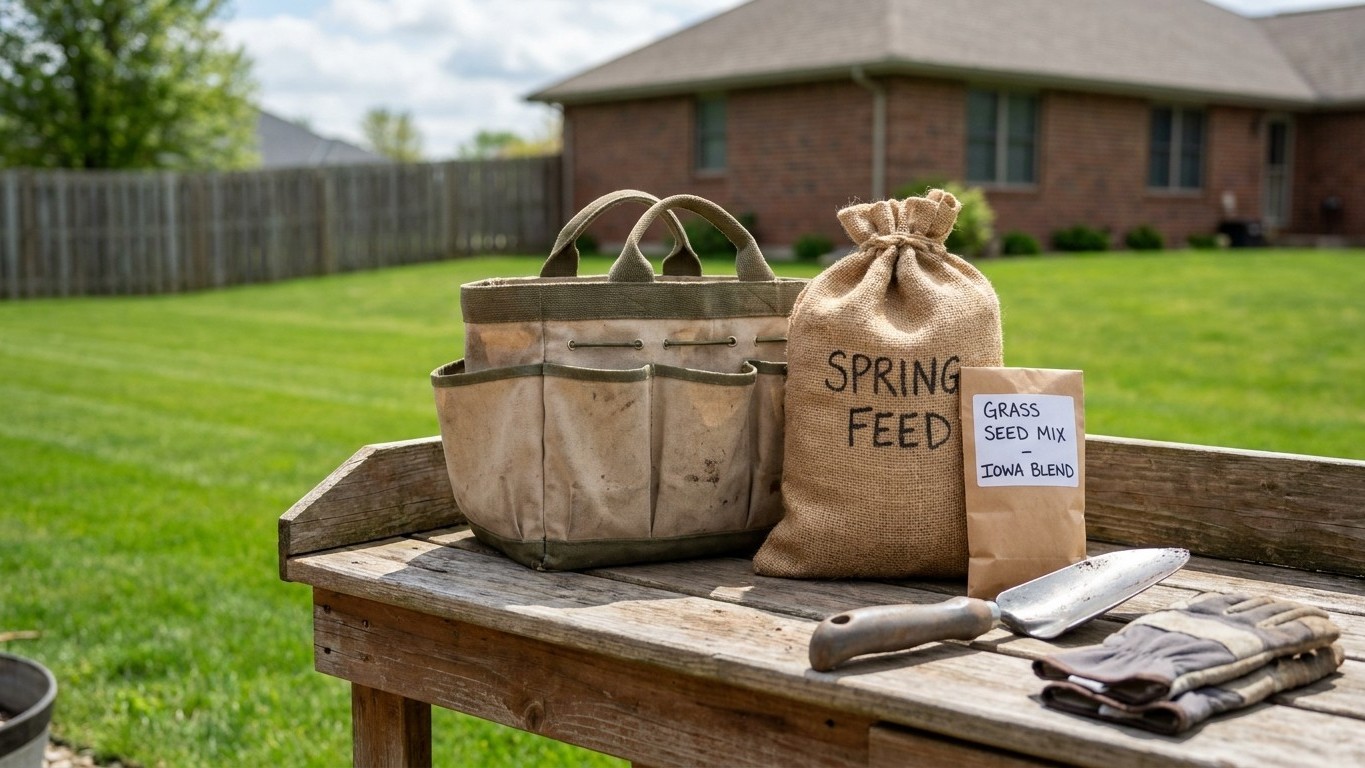

Zoysia sod laid down in an Iowa yard looks perfect for one summer and then spends October through April dead brown while the neighbor’s lawn stays green, because the state gives it only 18.4 days a year hot enough to thrive and winters that drop to 14.3F, cold enough to kill it outright. That mismatch is the whole story here: pick the wrong grass for this climate and no amount of feeding or timing saves it. Pick the right one, and most of the guesswork disappears.
Which grass belongs in Iowa

The climate numbers
Two figures decide this, and both come from NOAA’s NCEI 1991-2020 climate normals at the Des Moines reference station. The state sees only 18.4 days a year above 90F, which is too short and mild a stretch to keep a warm-season lawn thick and green through summer the way it would in the Deep South. The coldest month’s mean daily minimum sits at 14.3F, cold enough to kill warm-season turf outright over a normal winter. Together those two numbers point the same direction: this is cool-season territory, full stop, with no realistic case for the other kind of grass. For month-by-month tasks that follow from this, see the Iowa lawn Calendar.
Which species to choose
Clemson Cooperative Extension’s HGIC 1214 guide and Penn State Extension both list the same cool-season species as the ones suited to this climate: Kentucky bluegrass, tall fescue, perennial ryegrass, the fine fescues, and rough bluegrass. Each behaves differently enough that the choice matters, and a closer look at the Iowa lawn Best grass options can help narrow it down.
| Species | Mowing height | Shade tolerance | Notable trait |
|---|---|---|---|
| Kentucky Bluegrass | 2.5-3.5 in | Low | Spreads by rhizome, self-repairs bare spots |
| Tall Fescue | 3-4 in | Moderate | Deepest roots of the group, most drought-tolerant |
| Fine Fescues | 2.5-4 in | High | Best choice under trees, low fertility needs |
| Perennial Ryegrass | 1.5-2.5 in | Low | Germinates fast, common in seed mixes for quick cover |
| Rough Bluegrass | 1.5-2.5 in | High (moist shade) | Suited to damp shaded ground, struggles once heat and dryness set in |
A full-sun lawn on well-drained soil usually does best as a Kentucky bluegrass and tall fescue blend, since the bluegrass fills in gaps while the fescue’s deep roots carry it through the driest stretch of summer. A shaded yard under mature trees leans toward fine fescue or rough bluegrass instead. Gardeners in warmer, transition-zone states further south don’t get this clean an answer. In Kansas Lawn Care: What to Plant and When to Feed It, the choice comes down to a genuine trade-off between a cool-season lawn that struggles in August heat and a warm-season lawn that browns all winter, since Kansas straddles both zones. Iowa doesn’t have that problem: the cold alone rules out the warm-season side of the ledger.
When to seed or sod here
The fall window
Clemson Cooperative Extension’s HGIC 1203 guide sets the general rule: warm-season grasses go in around May, cool-season grasses go in during mid to late September. Since Iowa grows cool-season turf, that September window is the one that applies, and it’s the single best time of year to seed or sod here. Warm soil plus cooling air lets a new lawn root hard before winter, without the weed pressure and heat stress that come with a spring planting.
Anchoring the date to local frost
NOAA’s NCEI 1991-2020 climate normals put the first fall freeze at the Des Moines airport station between October 14 and October 25. That gives new seed roughly four to six weeks of cool, unfrozen soil if you sow in mid to late September, enough time to establish before growth stops for winter. But that airport figure runs on the optimistic end: Iowa State Extension’s county-level records, built from 1950-2021 data, show fall freezes arriving about ten days earlier than the airport station across much of the state. A grower in a colder county should treat late September as the outer edge of the window, not the middle of it, and sow earlier in the month rather than later.
Sod is more forgiving of timing since it arrives already rooted, but it still knits into the soil faster in the same September window than it does in the heat of July. Spring seeding works as a backup, but a cool-season lawn seeded in spring fights weeds and early heat all summer with a root system it hasn’t had time to build. Gardeners much further north face an even shorter margin: in Quebec Lawn Care: What to Plant and When to Feed It, the frost-free season closes earlier still, which pushes the entire seeding calendar back by weeks compared to Iowa.
The feeding calendar that fits this climate
Feeding on the grass’s schedule, not the calendar’s
Nitrogen timing follows how the grass actually grows, not the month on the wall. A cool-season lawn like Iowa’s builds most of its root mass and stored energy in fall, which makes September the single most important feeding of the year. A warm-season lawn, by contrast, is fed in late spring as it comes out of dormancy, but that calendar doesn’t apply here since Iowa isn’t growing warm-season turf.
Clemson Cooperative Extension’s HGIC 1219 Tall Fescue Maintenance Calendar lays out a full month-by-month schedule for exactly this species, built around split applications rather than one large dose. The reasoning transfers directly to Iowa’s tall fescue and bluegrass lawns even though the calendar was written for a different state, because the grass responds to its own growth cycle wherever it’s planted. Check the linked calendar for the specific pounds of actual nitrogen per 1000 square feet at each application, since the right rate also depends on your soil test results and how much nitrogen your clippings are already returning to the lawn.
A light supplemental feeding in early spring can help green-up after winter, but it should stay smaller than the fall application. Piling on nitrogen in June or July, when growth naturally slows under stress, pushes soft top growth right when the lawn can least afford it.
Mowing height and watering here
Mowing height
Cut a Kentucky bluegrass lawn to 2.5 to 3.5 inches and a tall fescue lawn to 3 to 4 inches, and raise the deck even higher during the hottest stretch of summer since longer blades shade the soil and slow moisture loss. The one-third rule matters more than the exact height: never remove more than a third of the blade in a single mowing, or the plant spends its energy on leaf recovery instead of roots. That means mowing more often when growth is fast in spring and fall, and less often, but not shorter, during summer slowdowns.
Watering
An inch of water a week, delivered in one or two deep sessions rather than daily sprinkles, is the common starting point for a cool-season lawn. A few things push that number around locally. Des Moines averages 18.4 days a year above 90F according to NOAA’s 1991-2020 normals, and any stretch that hits that mark back to back raises water demand well above the baseline figure. Sandy soil drains faster than the clay-heavy soils common across much of the state, so a sandy lawn needs shorter, more frequent watering to avoid runoff between root zones. Humidity cuts the other way: a sticky, still morning slows evaporation and can let you skip a scheduled watering without the lawn showing it.
What goes wrong on lawns in Iowa

The three failures this climate produces
- Brown patch shows up in hot, humid stretches of summer, especially on tall fescue mowed too short or watered in the evening, leaving blades wet overnight.
- Drought dormancy gets mistaken for a dead lawn during a dry August. A cool-season lawn that browns off in summer heat is very often alive and waiting on cooler, wetter weather to green back up, not gone for good.
- Weeds that never stop follow a mild winter, when cool-season weeds like chickweed and henbit keep growing through what should have been a dormant stretch, getting a head start on spring competition with the turf.
All three trace back to the same cool-season biology: this grass thrives in spring and fall, tolerates but doesn’t love summer heat, and goes dormant rather than dying in a hard freeze. Reading a brown lawn correctly, as dormant rather than dead, saves a lot of unnecessary reseeding.
Local help
Soil test results and county-specific advice go a long way toward getting the feeding rate and grass mix right for your particular ground, and that’s exactly what Iowa State University Extension is set up to provide. Its county offices can point you to local frost data more precise than the Des Moines airport figures, and to soil test kits that settle the nitrogen and pH questions before you spend money on fertilizer. Start there before making a major seeding or feeding decision.
Choosing What to Plant First
Before you worry about feeding schedules or mowing height, the real starting point is the seed itself. Iowa’s weather doesn’t cooperate with warm-season lawns, so the choice comes down to the cool-season species that actually hold up here. If you’re not sure which one fits your yard, start with the best grass seed for Iowa lawns, which walks through the five species worth considering, from the familiar Kentucky bluegrass to the more shade-tolerant fine fescue. It’s not just a list of names — it explains why each one earns its place in an Iowa lawn, drawing on the same cooperative extension guidance that shapes most of the recommendations on this site.
Get that first decision right and everything else — the feeding, the watering, the timing of overseeding — gets easier, because you’re working with grass that’s actually suited to the climate instead of fighting against it all season.
Common questions
Can I grow zoysia or bermudagrass in Iowa?
Not reliably. NOAA’s 1991-2020 climate normals put the coldest month’s mean minimum at Des Moines at 14.3F, cold enough to kill warm-season turf like zoysia and bermudagrass over a typical winter. Stick to the cool-season species: Kentucky bluegrass, tall fescue, perennial ryegrass, fine fescues or rough bluegrass.
Is it too late to seed if it’s already October?
It’s risky. NOAA’s NCEI 1991-2020 normals put the first fall freeze at the Des Moines airport station between October 14 and October 25, and Iowa State Extension’s county records run about ten days earlier than that in many parts of the state. Seed sown in October has little time left to root before growth stops for winter, so an early-to-mid September sowing gives it a much better chance.
Why is my lawn brown in July but fine again by September?
That’s drought dormancy, not death. Cool-season grasses shut down growth and lose color under summer heat and dry soil as a survival strategy, then green back up once temperatures drop and rain returns. Pulling and reseeding a dormant lawn in July usually wastes seed and money.
Do I need to dethatch every year?
Most cool-season lawns don’t need it annually. Thatch becomes a problem only once the layer builds past about half an inch, which happens faster on heavily fertilized Kentucky bluegrass than on tall fescue. Check by pulling a plug of turf and measuring the brown fibrous layer between the soil and the green blades before deciding to dethatch.
Should I fertilize my lawn in the middle of summer if it looks thin?
No, hold off. Iowa’s cool-season grass slows its growth during the hottest stretch of the year, and Des Moines averages 18.4 days a year above 90F according to NOAA’s 1991-2020 normals, exactly the kind of stress that makes a heavy summer feeding backfire into soft, disease-prone growth. Save the main application for September and let a thin summer lawn recover on its own once the heat breaks.