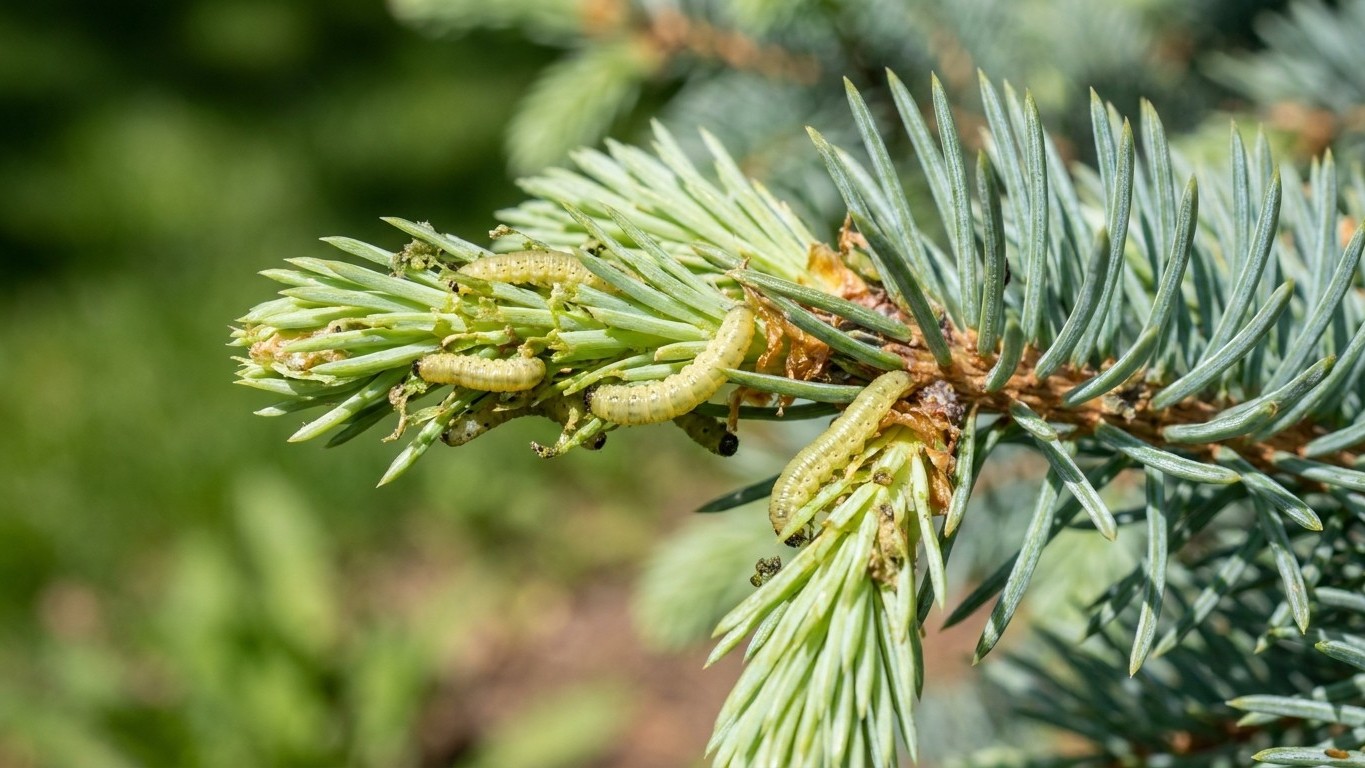

Yellowheaded spruce sawfly larvae start feeding on Saskatchewan spruce trees in late May, right as new needles emerge, and the window for effective, low-toxicity control typically closes by mid-June. Miss that stretch and you’re looking at a tree stripped of its current year’s growth, sometimes bare enough that homeowners assume it’s dying. It usually isn’t, but repeated years of feeding can kill young or stressed trees outright.
Why Saskatchewan spruce are a prime target

Colorado blue spruce and white spruce dominate shelterbelts, farmyard windbreaks, and front-yard plantings across the province. Both species happen to be favorites of Pikonema alaskensis, the yellowheaded spruce sawfly. Open-grown trees, the kind standing alone in a yard rather than crowded in a forest stand, tend to take the worst hits because sawfly adults prefer sunny, exposed branches for egg-laying.
Norway spruce sees less damage, and the pest largely leaves pines, firs, and other conifers alone. If you’ve got a mixed windbreak and only the spruce look chewed while everything else stays green, that pattern alone points toward this insect before you even find a larva.
Life cycle: when the insect actually shows up
Saskatchewan gets one generation per year, which simplifies the calendar considerably compared to pests that cycle through multiple broods. Adult sawflies, small and wasp-like but harmless to people, emerge from the soil in late April or May, right around the time spruce buds are breaking. Females lay eggs directly into the new needles at branch tips.
Larvae hatch within one to two weeks and start feeding almost immediately. Young larvae are small and green, easy to miss unless you’re looking closely at the newest growth. As they mature over four to six weeks, they turn olive-green with a yellowish-brown head capsule, the feature that gives the species its name. Full-grown larvae reach about three-quarters of an inch and feed in loose clusters, often a dozen or more on a single branch tip.
By early to mid-July, mature larvae drop to the ground, burrow into soil or leaf litter, and spin a cocoon where they’ll sit as prepupae through the winter. That underground stage is why raking and cleaning up around heavily infested trees in fall can reduce the following year’s population, though it won’t eliminate it if neighboring properties have their own reservoir of overwintering insects.
Two feeding phases, two levels of damage
Young larvae feed only on the current season’s new needles, chewing them down to stubs but leaving old growth alone. This early damage is often mistaken for late frost injury or nutrient deficiency because the tree still looks green from a distance, just thinner at the tips.
Older larvae, once they’ve exhausted the new needles, move on to consume previous years’ foliage too. This is when defoliation becomes obvious even from the road: entire branches reduced to bare twigs with just a tuft of the very newest growth left at the very tip, sometimes called a “witch’s broom” look, though that term more properly describes a different problem entirely.
Confirming it’s sawfly, not something else
Spruce budworm and spruce spider mites cause different-looking damage, and mixing them up leads to the wrong treatment. Sawfly larvae are true caterpillar look-alikes but have more than five pairs of prolegs (the fleshy stub-legs along the abdomen), while actual caterpillars have five or fewer. That distinction matters enormously for treatment, covered below.
A simple field test: hold a white sheet of paper or a bucket under a suspect branch and give it a firm shake. Sawfly larvae drop readily when disturbed. Counting how many land in thirty seconds of shaking gives a rough sense of population density, useful for deciding whether the infestation warrants treatment or is light enough to tolerate.
Frass, the greenish-brown droppings larvae leave behind, accumulates on branches and on the ground beneath heavily infested trees. Combined with visible defoliation concentrated on new growth in late May and June, that’s a fairly reliable diagnostic trio: chewed new needles, visible olive-green larvae with yellow heads, and frass underneath.
What actually stops yellowheaded spruce sawfly
The single most important fact for anyone reaching for a pest control product: Bacillus thuringiensis (Bt), the go-to organic caterpillar treatment sold at most garden centers, does not work on this insect. Bt targets Lepidoptera, true moths and butterflies. Sawflies belong to the order Hymenoptera, related to bees and wasps, and Bt’s active proteins have no effect on them. Homeowners who spray Bt on a sawfly-infested spruce and see no improvement aren’t dealing with resistance, they’re using the wrong tool.
Monitoring and timing
Because the entire feeding period runs through one generation, timing treatment to catch larvae while they’re small (under half an inch) makes control dramatically easier and reduces how much product you need to apply. Checking branch tips weekly starting in late May, especially on the sunniest, most exposed side of the tree, catches the infestation before defoliation becomes severe.
Small trees and shrubs, especially newly planted ornamentals under six feet, are worth checking most closely since they have less foliage to spare and can suffer real setback from even moderate feeding.
Low-toxicity options for light infestations
On smaller trees where larvae are reachable, several approaches work without heavy chemical inputs:
- Hand-picking or hosing larvae off branches with a strong jet of water, then sweeping up what falls before larvae can climb back up the trunk.
- Insecticidal soap sprays, which work on contact and break down quickly, making them a reasonable choice for residential yards with kids or pets nearby.
- Horticultural oil applied directly to larvae clusters, effective against young, soft-bodied stages but less useful once larvae mature and toughen.
These methods require thorough coverage since they only work on contact, meaning larvae tucked deep in the canopy or on the far side of a tall tree may survive an initial treatment.
When infestations are heavier
For larger trees or shelterbelts where hand control isn’t practical, contact insecticides labeled for sawfly control on ornamental conifers, such as products containing carbaryl, permethrin, or spinosad, give more reliable knockdown. Spinosad in particular has a lower toxicity profile toward beneficial insects than older broad-spectrum options, which matters if the tree is near flowering plants or a working farmyard with livestock nearby.
Application should target the larvae directly during their active feeding weeks in June, following label directions for conifers specifically. Spraying after larvae have already dropped to the soil in July accomplishes nothing since the damage for that season is already done and the insects are no longer on the tree.
Reducing next year’s population
Since prepupae overwinter in soil and litter directly beneath infested trees, raking up fallen needles and debris around the base each fall removes some portion of the population before it has a chance to emerge as adults the following spring. This won’t fully solve a persistent infestation on its own, particularly in shelterbelt settings where sawflies can move in from neighboring trees or untreated windbreaks, but it’s a reasonable low-effort step that costs nothing beyond a rake and a bag.
Natural predators, including several parasitic wasp species and general predators like birds, do keep populations in check in many years without any human intervention at all. That’s part of why outbreaks tend to run in cycles rather than building steadily year over year. A bad sawfly year on your street doesn’t necessarily predict a worse one the following spring, and light, tolerable feeding on mature, otherwise healthy spruce often doesn’t need chemical treatment at all.
Trees under five years old or already stressed by drought, root damage, or transplant shock are the ones where intervention matters most, since they have far less stored energy to recover a full season’s needle loss. A mature 30-foot white spruce that loses new growth on a few branches one summer will likely push out normal growth again the following year; a three-foot ornamental spruce hit the same way may take several seasons to recover its shape.