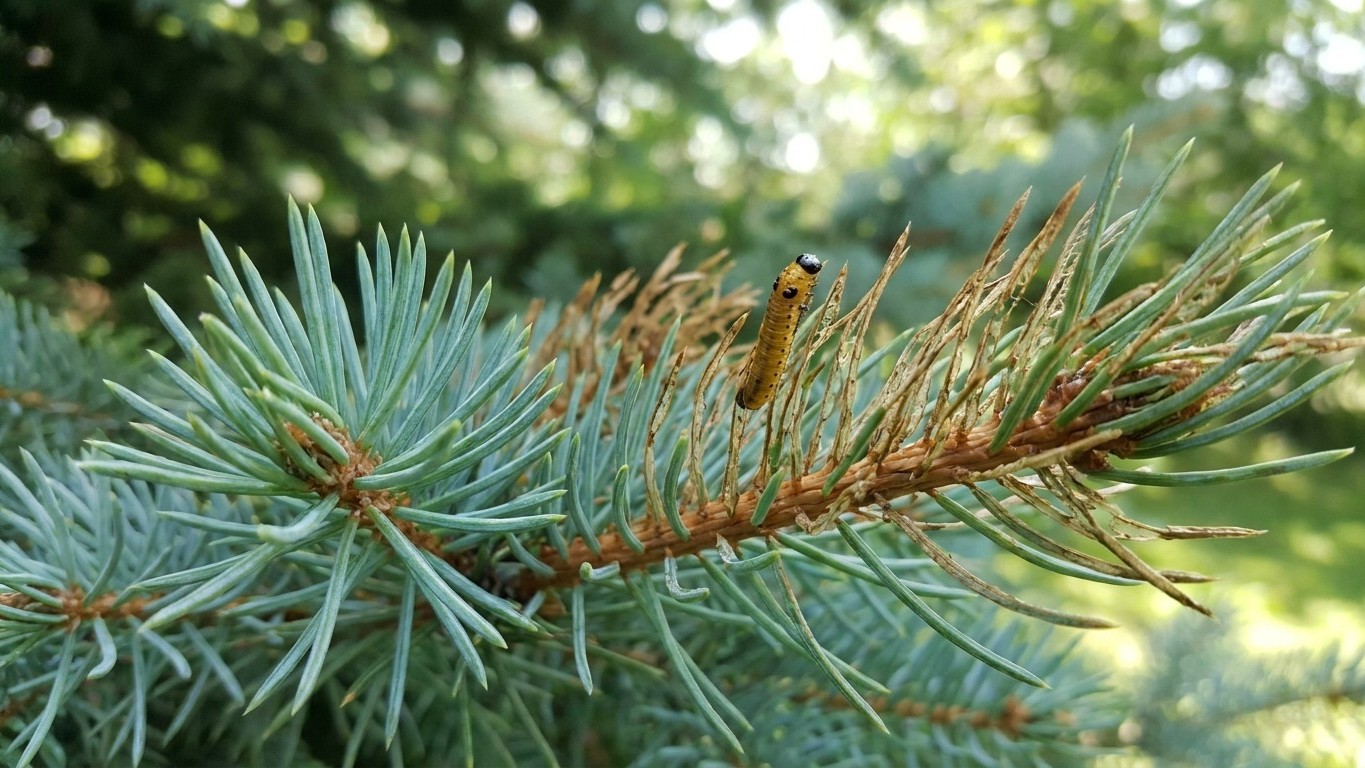

Yellowheaded spruce sawfly larvae start feeding on new spruce growth in Manitoba around late May to early June, once daytime temperatures settle into the 60s. The window closes by mid-July, when the larvae drop to the soil to pupate. Catching them early, before they move from tender new needles to older growth, is what separates a tree that bounces back from one that looks scorched by August.
This isn’t a wasp in the stinging sense, even though the adult looks like one. Pikonema alaskensis belongs to a family of plant-feeding sawflies, and in Manitoba it’s one of the most common defoliators on ornamental and windbreak spruce, particularly white spruce, black spruce, and the blue-needled Colorado varieties homeowners plant along property lines on the Prairies.
When Yellowheaded Spruce Sawfly Appears in Manitoba

Adult sawflies emerge from the soil in spring, timing that tracks closely with new bud break on spruce trees. Females don’t need a mate to reproduce (a trait called parthenogenesis), which means a single overlooked female can seed a noticeable infestation the following year. She lays eggs along the edges of new needles, usually on the current season’s growth near the top of the tree.
Eggs hatch within one to two weeks. The larvae that emerge are the real damage-doers, and they feed in a very specific pattern that’s useful for identification. Young larvae stick to the soft, newly emerged needles, skeletonizing them so the tree’s new growth turns brown and dry while older needles lower on the branch stay green. As the larvae mature over four to six weeks, they broaden their diet to include one- and two-year-old needles, stripping branches down to bare twigs in heavily infested trees.
Manitoba typically sees one generation per year. By mid-summer, mature larvae drop into the leaf litter or soil beneath the tree, spin a cocoon, and overwinter there until the following spring’s emergence. There’s no second wave of feeding in the same season, which is actually good news: whatever damage happens between late May and mid-July is generally the extent of it for that year, though a tree can get hit again the following spring if the population in the soil wasn’t addressed.
Which Spruce Trees Are Most at Risk
Open-grown ornamental spruce, the kind planted as a single specimen tree in a yard or spaced out in a farmstead shelterbelt, tend to take the worst hits. Trees under 15 feet tall are especially vulnerable because the larvae concentrate their feeding in the upper and outer crown, and on a young tree that’s most of the canopy. Dense forest stands see less severe outbreaks, likely because natural predators and parasitoids have an easier time finding the sawflies in a more complex habitat.
How to Tell It’s Sawfly Damage and Not Something Else
Misdiagnosis is common because several spruce problems produce similar-looking browning. Spruce spider mites, for instance, cause stippled, dusty-looking needles and leave fine webbing, while sawfly damage shows a much cleaner, stripped appearance with needles chewed to stubs. Needle cast diseases tend to brown older needles from the inside out over multiple years, whereas sawfly damage hits new growth first and shows up fast, within weeks.
The larvae themselves are the clearest giveaway. Full-grown yellowheaded spruce sawfly larvae run about three-quarters of an inch long, with a pale green to yellow-green body marked by darker green stripes running the length of it, and a head that’s distinctly orange to yellow-brown, which is where the common name comes from. They’re often found in clusters on a single branch, sometimes a dozen or more feeding side by side, which distinguishes them from many other needle-feeding caterpillars that scatter more widely.
A simple tap test helps confirm an infestation before damage becomes obvious. Hold a piece of white paper or a clipboard under a suspect branch and give it a firm shake; larvae will often drop and are easy to spot against the light background.
What Actually Stops Yellowheaded Spruce Sawfly
Timing matters more than product choice here. Because the larvae are small and exposed on new growth early in the season, this is one of the easier landscape pests to knock back if you catch it in the first two or three weeks after egg hatch, roughly early to mid-June in most of southern Manitoba.
For a handful of small or young trees, physical removal works and costs nothing. Pruning out heavily infested branch tips, or simply knocking larvae into a bucket of soapy water, can meaningfully reduce a population on a single specimen tree without any chemical input. This is realistic for a backyard tree or two; it’s not practical for a quarter-mile shelterbelt.
Insecticidal soap and horticultural oil are the go-to low-toxicity options, and both work by direct contact, so thorough coverage of the new growth where larvae feed is what makes or breaks the treatment. Spinosad, derived from a naturally occurring soil bacterium, is another option that’s effective against sawfly larvae with a lower impact on many beneficial insects compared to broad-spectrum products.
One point worth flagging because it trips up a lot of homeowners doing their own research: Bacillus thuringiensis (Bt), the biological insecticide widely marketed for caterpillar control, does not work on sawflies. Bt targets the digestive systems of moth and butterfly larvae specifically. Sawflies are more closely related to wasps and bees, and their gut biology doesn’t respond to Bt the same way, so a product that works great on tent caterpillars or gypsy moth larvae will do nothing here. For heavier infestations on larger trees, broader-spectrum contact insecticides labeled for sawfly control, such as those containing carbaryl or permethrin, are more reliable, but they should be applied while larvae are still young and feeding on new growth for the best results.
Natural predators do provide some background suppression. Various parasitic wasps target sawfly eggs and larvae, and birds, particularly chickadees and other insectivorous species common in Manitoba yards, will pick larvae off branches. This natural pressure rarely eliminates an outbreak on its own but can keep populations from building year over year on trees that aren’t under other stress.
Why Repeated Defoliation Matters More Than a Single Bad Year
A spruce tree that loses new growth to sawflies one season usually recovers, since the older needles further down the branch keep photosynthesizing. The real damage comes from repeat infestations. Spruce trees, unlike many deciduous species, don’t push a second flush of growth in the same year if the first one is destroyed, so a tree hit hard two or three years running can end up with permanently thin, scraggly branch tips or dead terminal shoots. That’s the point at which a tree’s overall vigor and its resistance to secondary problems, like bark beetles or root rot, starts to decline.
Monitoring and Prevention for Next Season
Because the larvae pupate in the soil right beneath the host tree, the ground around an infested spruce carries next year’s population. Raking and disposing of fallen litter under heavily infested trees in late summer or fall can physically remove some of the overwintering cocoons, though it’s a modest reduction rather than a fix on its own.
Scouting in late May, before visible damage appears, is the single most useful habit for anyone managing more than one or two spruce trees. Checking new growth for eggs along the needle margins, or simply watching for the first small clusters of larvae, gives enough lead time to treat while the population is still small and concentrated near the branch tips.
Trees under drought stress or planted in poor soil tend to show more severe symptoms from the same level of feeding, since they have fewer stored resources to push replacement growth. Regular watering during dry Prairie summers and avoiding heavy fertilization late in the season (which encourages the soft, attractive new growth larvae prefer) both play a supporting role in keeping outbreaks manageable on ornamental plantings.