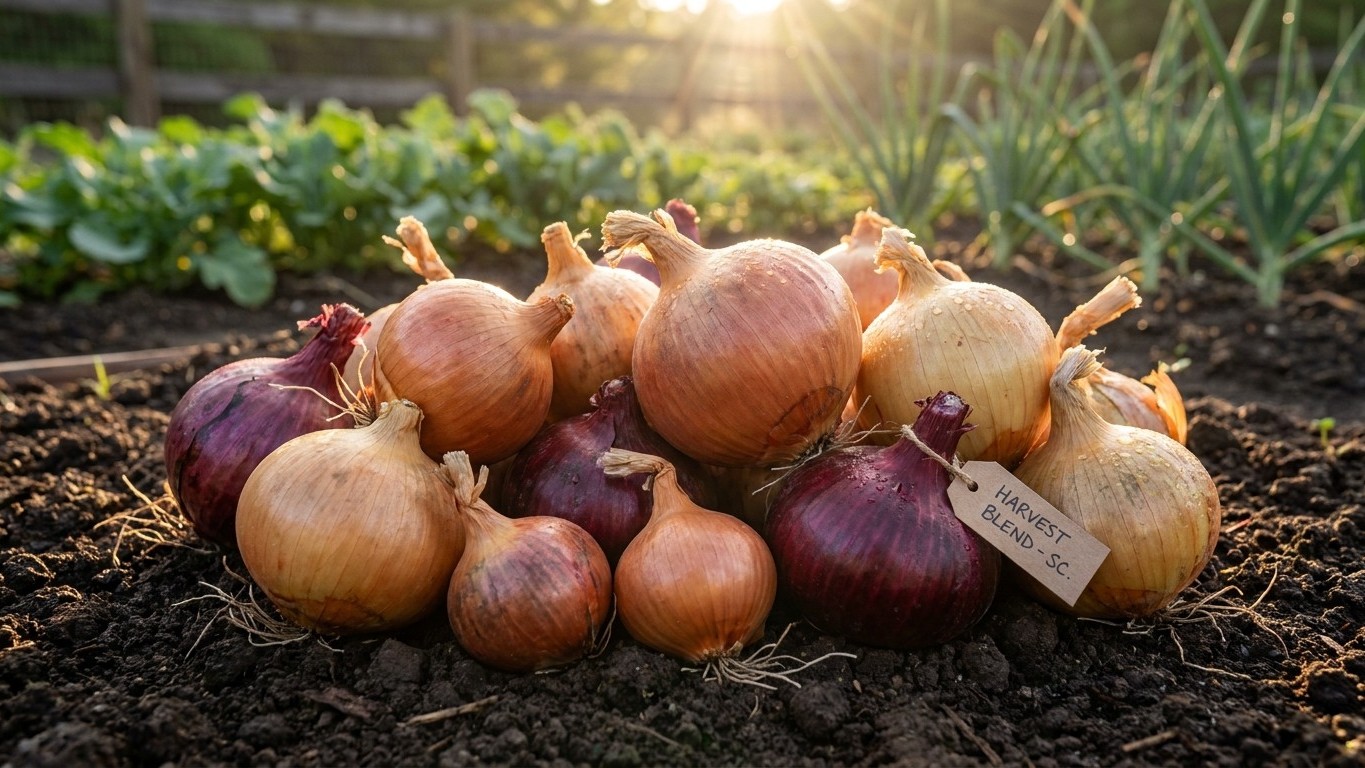

Short-day and intermediate-day onions are the varieties built for South Carolina. At 32.90 degrees north, near Columbia, the growing season delivers 14 hours and 10 minutes of daylight on the longest day of the year, which is nowhere close to the 14-to-16-hour window that long-day onions need before they’ll form a bulb. That single fact rules out most of the classic long-day types sold in seed catalogs and points South Carolina gardeners toward a specific, shorter list.
The short answer for South Carolina

Onions don’t bulb because of heat, soil, or how long they’ve been in the ground. They bulb because of day length, and only day length. A short-day variety starts converting its leaves into a bulb once daylight reaches roughly 12 hours, which in South Carolina happens well before summer even peaks. An intermediate-day variety waits a bit longer, needing somewhere around 12 to 14 hours, and still fits comfortably within what a Columbia-area summer provides. Long-day varieties, the ones that need 14 to 16 hours, are asking for a day length that this latitude simply does not deliver, not even on June 21.
That 14-hour-10-minute ceiling at the reference city is the number to hold onto. It’s close enough to the 14-hour mark that some intermediate-day varieties sit right at the edge of their published range, which matters more than it sounds like it should. A variety rated for “32 to 45 degrees north” isn’t guessing. Seed breeders test bulbing response across latitude bands, and a plant rated for that range will read 32.9 degrees north as daylight it can work with.
Based on the documented ranges for varieties grown on this site, eleven fall squarely within a latitude window that covers 32.90 degrees north. On the short-day side, that includes Red Sensation, Texas Grano 1015Y, and Vidora, plus three others without a dedicated page here: Gabriella, Madalyn, Red Rock, and White Castle. On the intermediate-day side, Elsye, Expression, Scout, and Sierra Blanca all list latitude ranges that comfortably include this part of South Carolina.
One more variety, Candy, sits in a gray zone. Its published range starts at 33 degrees north, just half a degree above the reference latitude, which puts a Columbia-area garden right at the southern edge of what the variety is rated for. It may bulb well there. It may also struggle in a year with an unusually short frost-free window. That’s a variety to try as a second bed, not a whole harvest.
For anyone growing near the coast, where South Carolina dips closer to 32 degrees north, the short-day types listed above are the safer bet. Intermediate-day onions still work, but they have less daylight margin to spare the further south the garden sits.
What will not work here
Nineteen varieties documented on this site are rated for latitudes north of what South Carolina offers, and every one of them will fail the same way. The plant doesn’t stall or produce a smaller bulb. It grows leaves all season, keeps growing leaves because the trigger it’s waiting for never arrives, and then rots in the ground or in storage without ever forming an onion worth pulling. That’s not a risk to hedge against with better soil or more water. It’s a mismatch between the plant’s genetics and the amount of daylight this part of the country produces, and no amount of gardening skill changes the math.
Here’s the full list of varieties from this site’s catalog that are published for latitudes above 32.90 degrees north, meaning South Carolina’s daylight never reaches what they require:
- Ailsa Craig (long-day, rated 38-60N), needs day lengths this state never produces
- Barolo (long-day, rated 38-55N), same failure, leaves without bulbs
- Blush (long-day, rated 38-55N), will not trigger bulbing here
- Bridger (long-day, rated 35-50N), daylight ceiling too low in South Carolina
- Cabernet (intermediate-day, rated 35-45N), just north of what this state offers
- Calibra (intermediate-day, rated 35-45N), same margin problem as Cabernet
- Frontier (long-day, rated 40-50N), a northern-plains variety, out of range here
- Monastrell (intermediate-day, rated 35-46N), rated above South Carolina’s latitude band
- New York Early (long-day, rated 38-50N), built for a much longer summer day
- Patterson (long-day, rated 38-55N), a storage onion for northern gardens only
- Powell (long-day, rated 43-47N), needs far more daylight than this state gets
- Red Carpet (long-day, rated 40-45N), out of range for any South Carolina county
- Red Long of Florence (intermediate-day, rated 38-50N), rated too far north
- Red Long of Tropea (intermediate-day, rated 35-48N), same daylight gap
- Redwing (long-day, rated 43-65N), a far-northern variety, not viable here
- Rossa di Milano (long-day, rated 38-50N), needs a summer day South Carolina doesn’t have
- Safrane (long-day, rated 42-50N), rated for latitudes far north of this state
- Talon (long-day, rated 42-50N), same mismatch, no bulb will form
- Walla Walla Sweet (long-day, rated 35-55N), a Pacific Northwest variety, wrong latitude for South Carolina
If any of these names look familiar, it’s probably because they’re widely sold and heavily marketed. Availability at a garden center says nothing about whether a variety is rated for your latitude.
What changes across South Carolina
South Carolina isn’t a single point on a map, and the 32.90-degree figure belongs specifically to the Columbia area, where the reference weather station sits. The state actually stretches from around 32 degrees north near Hilton Head and the southern coast up to roughly 35.2 degrees north along the North Carolina border in the Upstate. That’s a real spread, more than three degrees of latitude, and it shifts both the daylight numbers and the timing advice a gardener should follow.
| Region | Approximate latitude | What it changes |
|---|---|---|
| Coastal SC (Beaufort, Hilton Head) | ~32.0N | Slightly less summer daylight than Columbia; short-day varieties are the safer default |
| Midlands (Columbia, reference city) | 32.90N | 14h10 on the longest day; short-day and most intermediate-day varieties fit |
| Upstate (Greenville, Spartanburg) | ~35.0-35.2N | Slightly more summer daylight; intermediate-day varieties, including Candy, have more margin |
A gardener in Beaufort County is working with marginally less daylight than Columbia, which makes the case for short-day varieties even stronger and makes Candy’s borderline rating a bigger gamble. A gardener in Greenville or Spartanburg, closer to 35 degrees north, has a bit more daylight margin, which is exactly why Candy’s published range starts at 33 degrees north instead of sitting higher. It also means Upstate gardeners are closer to the line where intermediate-day varieties rated up to 45 or 46 degrees north, like Scout, still work fine, but where some varieties in the “will not work” list, while still out of range, are at least less dramatically mismatched than they’d be on the coast.
None of this changes the basic verdict. Every part of South Carolina sits well south of where long-day onions belong. But the three-degree spread across the state is real enough that a gardener near the coast and a gardener near the mountains shouldn’t assume they’re gardening under identical daylight.
Sweet now, or onions that last
South Carolina’s daylight profile pushes gardeners toward short-day and intermediate-day onions, and that choice comes with a flavor and storage trade-off that has nothing to do with taste preference and everything to do with chemistry. The compounds that make an onion sharp, the volatile sulfur compounds responsible for tears and bite, are the same compounds that protect the bulb once it’s in storage. Fewer of those compounds means a milder onion at the cutting board. It also means a bulb with less natural defense against rot, which is why sweet varieties break down faster in a pantry or root cellar.
Short-day onions, the type best suited to South Carolina’s daylight, tend to run sweeter and lower in those sulfur compounds. That’s not a flaw in the variety. It’s a direct result of the shorter, more intense daylight trigger these onions respond to. According to University of Missouri Extension, sweet onions do not store as well as more pungent types, a pattern that holds regardless of where the onion is grown. Long-day onions, the ones that can’t bulb in South Carolina at all, are generally the sharper, longer-keeping types precisely because they develop under a different daylight rhythm.
The practical result: a South Carolina onion bed is built for eating through late summer and fall, not for feeding a household deep into winter. A pantry stocked entirely with short-day onions from a spring harvest is unlikely to still hold firm, usable bulbs by March. Gardeners who want both, sweet onions for July and something that lasts into the cold months, generally have to accept that South Carolina’s climate hands them the first and not the second. That’s a limitation of daylight, not of gardening effort, and it’s worth planning the kitchen calendar around rather than fighting.
Checking this against your own garden
The 32.90-degree figure and the 14-hour-10-minute daylight number both belong to the Columbia area specifically. A garden in Charleston, Myrtle Beach, or Greenville sits at a different point on that latitude line, and the further a garden is from Columbia, the more that difference matters for choosing between short-day, intermediate-day, and the handful of borderline varieties like Candy.
- Look up your own latitude if you garden more than an hour’s drive from Columbia; a simple coordinate search gives a number accurate enough for this purpose
- Compare that latitude against the ranges listed above for short-day and intermediate-day varieties before ordering seed
- Check your local average first and last frost dates, since those determine when onion sets or transplants actually go in the ground
- Contact your county’s Clemson Cooperative Extension office for planting windows specific to your soil and microclimate
- If you’re within a degree or two of a variety’s published boundary, like Candy at 33 degrees north, treat it as a trial planting rather than your main crop
A statewide recommendation is a starting point, not a guarantee. South Carolina’s own three-degree spread in latitude is proof enough that what works reliably in Columbia deserves a second check anywhere else in the state.