
South Carolina’s growing season runs on day length, not on the calendar most seed packets assume. At Columbia, the reference point for the state’s climate data, the longest day of the year gives 14 hours and 10 minutes of daylight, at a latitude of 32.90 degrees north. That single number decides the planting season and the variety group before you ever pick a date. For most of South Carolina, onions go into the ground in fall or in the dead of winter, never in April the way a Midwest garden would.
The short answer for South Carolina

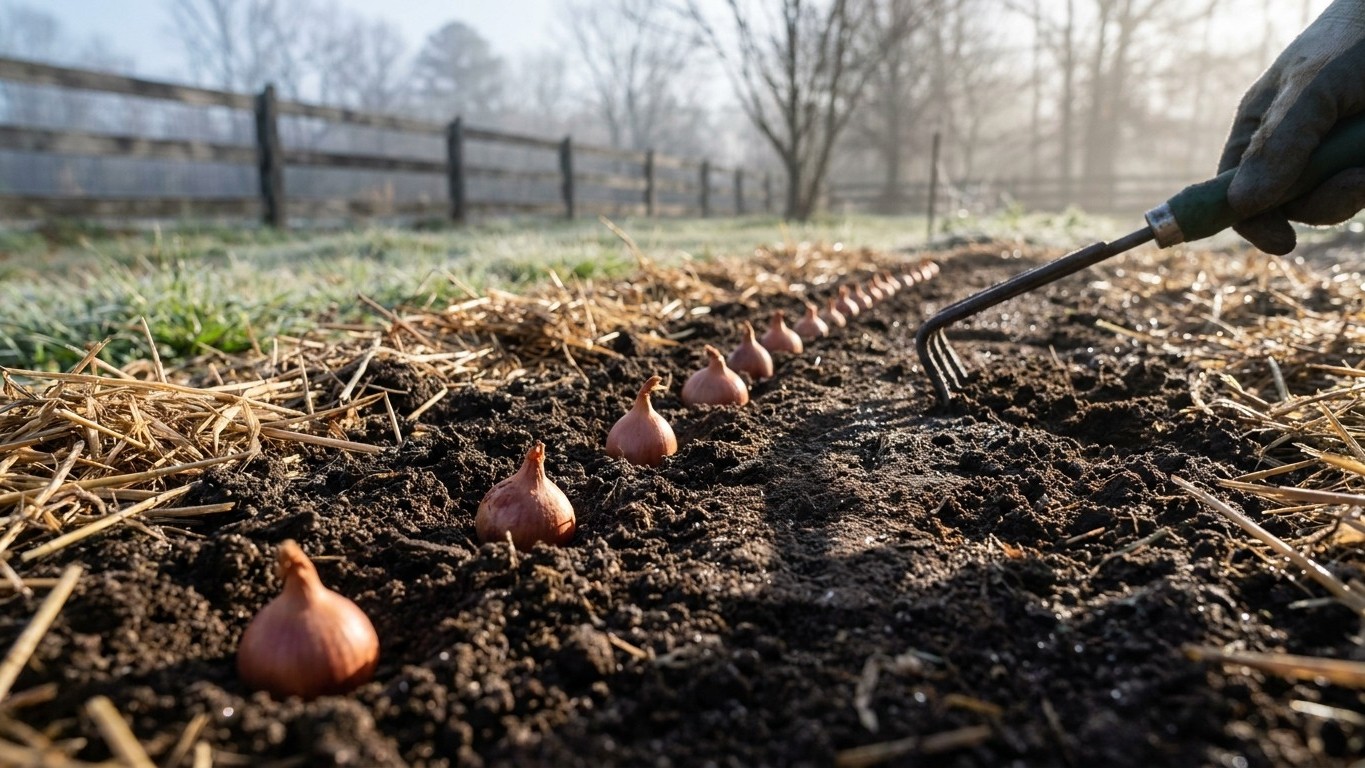
Plant onions in South Carolina in fall, typically October into November, or in the earliest weeks of the year if you missed the fall window. Set transplants or sets out while the soil is still workable and let them establish roots and a modest set of leaves through the cool season. This timing exists because of what happens at 32.90 degrees north, Columbia’s latitude, where the longest day of the year tops out at 14 hours and 10 minutes of daylight. Onions do not bulb because of warmth. They bulb because a rising day length crosses a threshold, and once it does, the plant stops making leaves and starts putting everything into the bulb.
Clemson Cooperative Extension’s Home & Garden Information Center puts the short-day bulbing trigger at roughly 12 hours of daylight. In South Carolina, day length climbs past that mark well before summer, which means the plant needs to already have a solid frame of leaves built up by the time the trigger fires. A fall or late-winter start gives it that time. A spring start does not.
Which onions actually fit this daylight
Because South Carolina’s longest day never exceeds 14 hours and 10 minutes, the onions that work here belong to the short-day group, which bulbs near that 12-hour mark, and the intermediate-day group, which bulbs between roughly 12 and 14 hours. Varieties documented for a range that covers 32.90 degrees north include the short-day types Texas Grano 1015Y, Vidora, Red Sensation, Gabriella, Madalyn, Red Rock, and White Castle, and the intermediate-day types Elsye, Expression, Scout, and Sierra Blanca. Long-day onions, the group that needs 14 to 16 hours before bulbing starts, sit outside this picture entirely, which the next section spells out.
What will not work here
Planting late does not push the harvest back a few weeks. It shrinks it. Whatever size the plant has managed to reach when day length crosses the bulbing threshold is the size the bulb will be, full stop. A short-day onion set out in March instead of October has maybe eight or ten weeks of leaf growth before South Carolina’s daylight climbs past 12 hours, instead of the four or five months it would have had from a fall planting. The plant still bulbs. It just bulbs small, because there was never time to build the leaf mass that becomes bulb size.
A separate problem has nothing to do with timing at all. Long-day onions need 14 to 16 hours of daylight before they will bulb, and South Carolina’s longest day, at 14 hours and 10 minutes, sits at the very bottom of that range or below it depending on the variety. Plant a true long-day type here and the outcome is not a small onion. It is no onion. The plant spends the whole season making leaves, the day length it needs never arrives, and the bulb rots in the ground once summer heat and humidity set in.
The following varieties, documented for latitude ranges that begin north of Columbia’s 32.90 degrees, will not bulb in South Carolina regardless of when you plant them:
- Ailsa Craig (long-day, 38-60N): needs far more daylight than South Carolina’s summer ever provides.
- Barolo (long-day, 38-55N): same daylight gap, no bulb forms.
- Blush (long-day, 38-55N): the 14h10 ceiling here falls short of its trigger.
- Bridger (long-day, 35-50N): range starts three degrees north of Columbia.
- Cabernet (intermediate-day, 35-45N): published minimum sits above 32.90N.
- Calibra (intermediate-day, 35-45N): same gap, leaves only, no bulb.
- Frontier (long-day, 40-50N): needs summer daylight South Carolina cannot supply.
- Monastrell (intermediate-day, 35-46N): range begins north of the reference latitude.
- New York Early (long-day, 38-50N): daylight trigger never reached here.
- Patterson (long-day, 38-55N): far outside South Carolina’s daylight ceiling.
- Powell (long-day, 43-47N): a northern-latitude variety only.
- Red Carpet (long-day, 40-45N): needs hours of daylight South Carolina never sees.
- Red Long of Florence (intermediate-day, 38-50N): minimum range starts well north.
- Red Long of Tropea (intermediate-day, 35-48N): edge of range still above 32.90N.
- Redwing (long-day, 43-65N): a far-northern variety.
- Rossa di Milano (long-day, 38-50N): daylight trigger out of reach here.
- Safrane (long-day, 42-50N): needs a summer day length South Carolina lacks.
- Talon (long-day, 42-50N): same story, no bulb forms.
- Walla Walla Sweet (long-day, 35-55N): range begins north of Columbia’s latitude.
What changes across South Carolina
South Carolina is not one latitude. The coastal Lowcountry around Hilton Head and Beaufort sits close to 32 degrees north, while the Upstate around Greenville and Spartanburg pushes toward the state’s northern border, close to 35 degrees north. Columbia, the reference city behind the 32.90-degree figure and the 14h10 daylight figure used above, sits roughly in the middle of that span, which makes it a fair midpoint for the state as a whole, but not a perfect stand-in for either edge.
| Region | Approximate latitude | What changes |
|---|---|---|
| Lowcountry coast (Hilton Head, Beaufort) | ~32.0N | Daylight tracks slightly below Columbia’s; short-day varieties fit comfortably, timing matches the reference advice closely. |
| Columbia (reference city) | 32.90N | Baseline used for the figures on this page: 14h10 of daylight on the longest day. |
| Upstate (Greenville, Spartanburg) | ~35.0N | Slightly more summer daylight; the intermediate-day variety Candy (33-40N) moves from excluded to a genuine edge case here. |
That two-and-a-half-degree spread matters for one variety in particular. Candy, an intermediate-day onion documented for a 33 to 40 degree range, sits within a degree and a half of Columbia’s 32.90 and squarely inside the Upstate’s range. A gardener near Greenville is close enough to that range that Candy may bulb reasonably well. A gardener in the Lowcountry, further from that 33-degree floor, is taking more of a gamble on the same variety. Neither answer is a flat yes or no. It is a matter of how close to the edge your own garden actually sits.
Sweet now, or onions that last
South Carolina’s climate hands gardeners a trade-off, and it comes down to chemistry rather than luck. The compounds that give an onion its sharp bite are volatile sulfur compounds, and those same compounds are what protect the bulb during months of storage. University of Missouri Extension puts it plainly: sweet onions do not store as well as the more pungent types, because pungency and shelf life come from the same source.
Short-day and intermediate-day onions, the groups that actually bulb at South Carolina’s latitude, tend to run milder and sweeter than long-day types. That is partly why Vidalia-style sweet onions come from the Southeast rather than from Vermont or Minnesota. But that same mildness means fewer of the sulfur compounds that would otherwise keep the bulb firm on a shelf through the winter. A South Carolina onion crop is built for eating soon after harvest, not for rationing out over months.
Compare that to a northern garden growing long-day onions under 15 or 16 hours of summer daylight. Those bulbs run sharper right out of the ground, and that same sharpness is what lets them sit in a cool, dry pantry into March without going soft. A South Carolina gardener does not get that option, not because of a mistake in growing technique, but because the variety group that fits this state’s daylight is chemically built for the opposite trade. Expect to use or preserve most of a South Carolina onion harvest within a few months, not to be pulling bulbs out of storage as the following spring approaches.
Checking this against your own garden
The figures on this page come from Columbia and its 32.90-degree latitude. If your garden sits closer to the coast or up near the North Carolina line, the details shift enough to matter, particularly for a variety like Candy that sits right at the edge of its published range. Before you commit to a planting date or a variety list, a few things are worth confirming for your own location rather than assuming the state-wide figures apply exactly where you garden:
- Look up your own latitude if you garden well north or south of Columbia, since even two degrees can shift a variety from a safe fit to an edge case.
- Check your local average first and last frost dates, since fall planting timing depends on getting transplants established before hard frost, not on a fixed calendar date.
- Contact your county’s Clemson Cooperative Extension office for current variety recommendations and planting windows specific to your area of the state.
- Watch soil temperature and moisture in early fall before setting out transplants, since a stretch of unusually dry or hot weather can push the safe planting window later than usual.
- Ask locally about which short-day or intermediate-day varieties nurseries in your area actually carry, since availability narrows the list faster than latitude does.