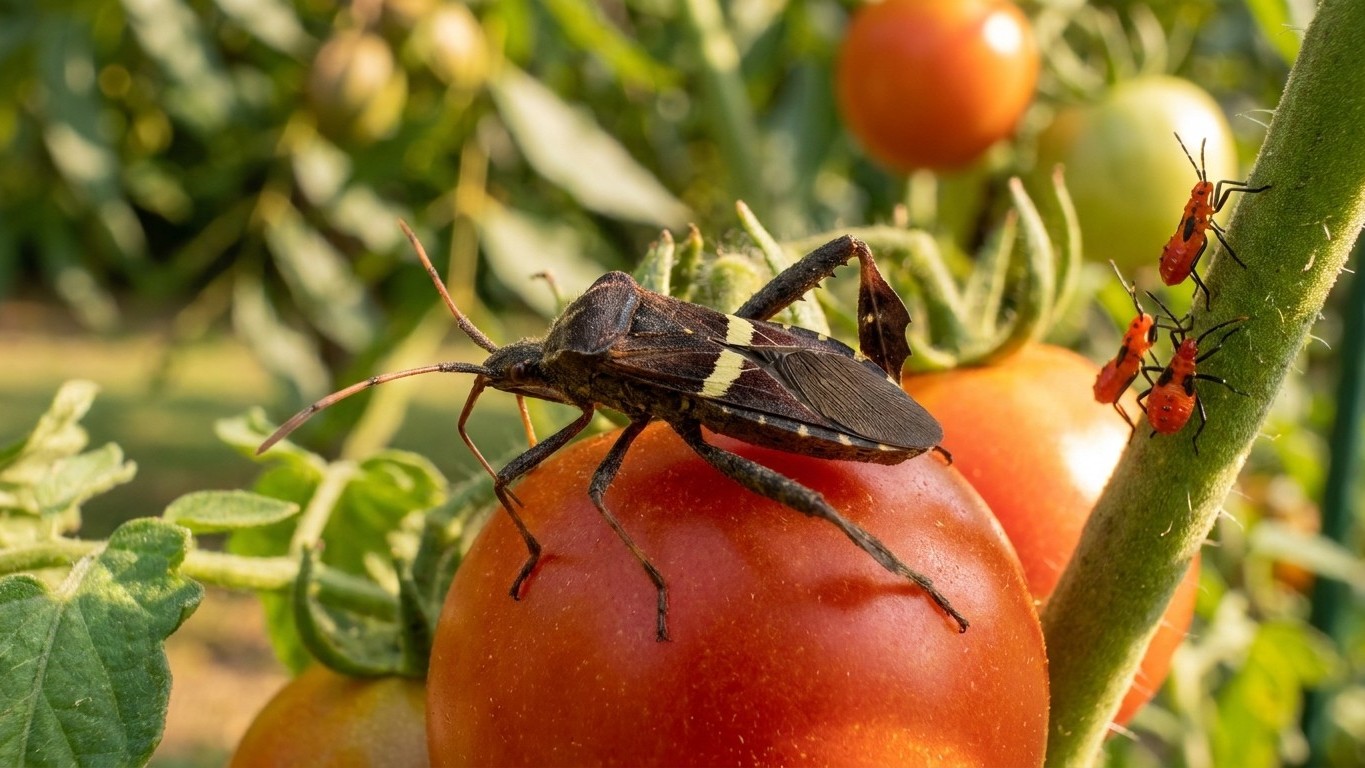

Leaffooted bugs show up in Mississippi gardens in late summer and early fall, targeting tomatoes and peppers just as fruit is setting. There’s no cool-season generation to worry about here. Row covers, timely harvest, and hand-picking adults off the vines are what actually keep populations down, since no home remedy stops them once they’re feeding on ripening fruit.
The weeks to watch

Mississippi State University Extension pins the leaffooted bug surge to late summer and early fall, the same stretch when squash vine borer and pickleworm pressure also peaks in home gardens. That’s the window named in Extension Publication 2347, and it’s worth taking at face value rather than narrowing it to a single week. The publication doesn’t break the leaffooted bug’s activity into separate spring, summer, and fall generations the way it does for some cool-season pests like the yellowmargined leaf beetle.
What “late summer and early fall” actually covers
In practice, that means the bugs become a real threat once tomato and pepper plants are carrying a full load of ripening or near-ripe fruit, not when the plants are still flowering. Gardeners who transplant early and harvest most of their crop before August tend to see far less damage than those with a second planting still fruiting into September.
Why there’s no spring flight to track
Unlike harlequin bugs, which the same MSU publication lists as active through winter and dormant over summer, leaffooted bugs don’t show a documented cool-season presence in Mississippi vegetable gardens. That absence in the source is itself useful information: it means scouting effort belongs almost entirely in the back half of the growing season, not in spring.
Reading the calendar from your last frost

The leaffooted bug doesn’t answer to a date on the wall. It answers to how warm the soil and air have gotten, and to how far along the tomato and pepper crop is. That’s why the last spring frost matters here only as a starting point for counting forward, not as a predictor of when the bugs themselves arrive.
NOAA’s 1991-2020 climate normals put the last spring freeze at the Jackson-area reference station somewhere between March 6 and March 22, based on a 30 to 70 percent freeze probability band. Suburban and rural gardens away from that airport station commonly see their own last frost run a week or two later, and more at higher elevations, so treat this as a normal to check against your own county rather than a guarantee.
- Start from the reference window of March 6 to March 22, add roughly one to two weeks for a typical home garden away from the airport station, and plant tomatoes and peppers out from mid-March into early April depending on your location.
- Count forward from that transplant window to the late-summer and early-fall peak named in the MSU publication. That puts first significant leaffooted bug damage somewhere around four to six months after transplanting, meaning covers protecting young plants can safely come off well before the bugs are a factor, and the real watch period starts once fruit begins ripening in July and August.
What it attacks, and what the damage looks like

Most gardeners notice the fruit before they notice the insect. Tomatoes and peppers develop cloudy, discolored spots or dimpled, sunken patches where the bug has fed, and the tissue underneath often turns pithy or corky. On tomatoes especially, those marks can look like a disease at first glance, which is why the damage gets misdiagnosed as often as it gets correctly identified. The feeding itself doesn’t rot the fruit outright, but it opens the door for secondary decay and makes the fruit unmarketable or unappetizing even when it’s technically still edible.
Mississippi State University’s Extension publication names two crops specifically for this pest in home vegetable gardens:
- Tomatoes
- Peppers
Both nymphs and adults feed with piercing-sucking mouthparts, but adults do most of the damage because they’re mobile, feed longer, and move readily between plants once one host starts declining. That matters for treatment timing: this insect never burrows inside the stem or fruit the way a squash vine borer does, so surface-level control measures can still work throughout the season, not just early on.
How Mississippi sits in this pest’s range
The MSU Extension guide doesn’t single out one region of the state for leaffooted bugs the way it does for mole crickets, which are flagged specifically for the southern half of Mississippi on sandy soils. That absence of a regional carve-out is itself telling: the publication treats leaffooted bug pressure on tomatoes and peppers as a statewide concern rather than a problem tied to a particular corner of the state.
That fits the broader pattern for this insect across the Southeast, where it’s common wherever tomatoes and peppers are grown in warm, humid summers. What differs from one Southern state to another tends to be the length of the late-summer window and how early the first hard frost shuts the season down, not whether the bug shows up at all. Gardeners in the Mississippi Delta and along the Gulf Coast should expect the same late-summer and early-fall pressure described statewide, just potentially stretched a little longer where the growing season itself runs longer.
What actually works against it

- Time the harvest window. Getting an early tomato and pepper crop in and mostly picked before the late-summer surge sidesteps a large share of the damage, since the insect isn’t documented as a spring problem in Mississippi gardens.
- Use row covers during early fruit set. A lightweight cover keeps adults off young plants while flowers and small fruit are developing, but it has to come off once pollinators are needed and once the fruit load gets too heavy for the fabric to clear.
- Hand-pick adults and egg clusters. This works because the insect doesn’t hide inside the plant tissue; both nymphs and adults feed openly on the fruit and stems, so they’re visible and removable through the whole season.
- Clear garden debris after harvest. Adults overwinter in leaf litter, weeds, and plant residue near the garden, so removing that material in fall reduces the population that emerges to attack next year’s crop.
- Rotate host crops where space allows. Moving tomatoes and peppers away from where they grew the previous year makes it slightly harder for overwintered adults to find the new planting immediately.
Some gardeners rely on a soapy water spray aimed directly at nymph clusters, and it does appear to knock down the soft-bodied immature stages on contact. It has far less effect on adults, whose harder shell resists the same treatment, which is one more reason timing and hand-picking matter more than any single spray.
Common questions
Do leaffooted bugs damage Mississippi tomatoes before they ripen?
They can feed on green fruit, but the documented pressure described by MSU Extension concentrates in late summer and early fall, which usually overlaps with fruit that’s already sizing up or starting to color.
Are leaffooted bugs active in Mississippi during spring?
The state’s Extension guide doesn’t list a spring generation for this insect, unlike harlequin bugs, which are active through winter. Scouting effort is better spent from midsummer onward.
Can leaffooted bug damage be confused with disease?
Yes. The cloudy, sunken spots left by their feeding on tomatoes often get mistaken for a fungal or bacterial issue, especially before a gardener spots the insect itself on the plant.