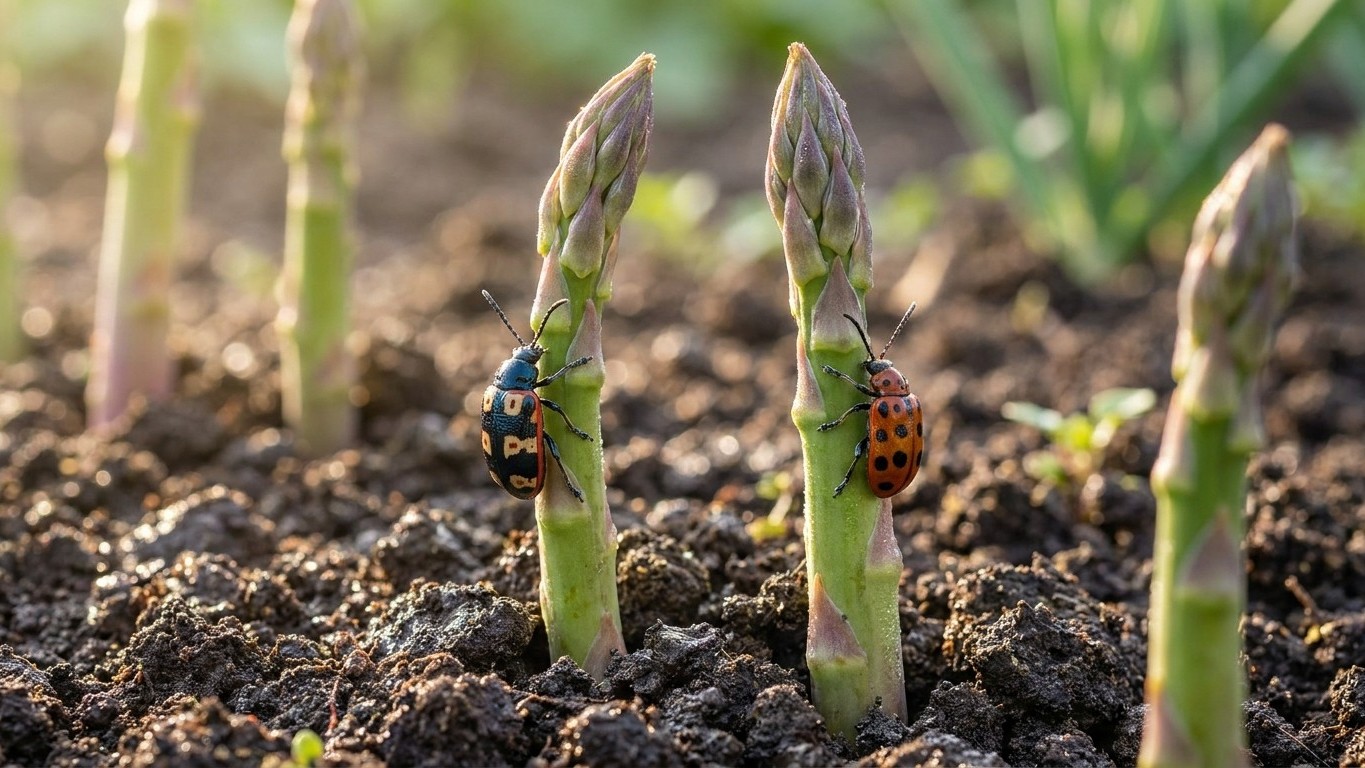

Stop cutting when most of the spears coming up are thinner than a pencil. That is a signal from the plant, not a date on the calendar. Cut spears have their own rules: above 50°F they toughen within hours, and below about 31°F they freeze and collapse. The target is 32 to 35°F with the cut ends standing in water. Both rules depend on a bed that will still be producing a decade from now, so start with the ground.
The short answer
A planted asparagus bed is a long commitment. Crowns go into 8-inch furrows, nothing is cut until year 3, and then the bed produces for 10 to 15 years. That is roughly half a typical 30-year mortgage. Once harvest starts, the cutting season runs 4 weeks, then 6, then 8, so the payoff builds slowly. The full growing picture is in Growing Asparagus in South Dakota. Here the question is narrower: will your ground still be a good home in year twelve?
The only soil requirement in Utah State University Extension’s guidance is that the soil drains. Most soils will do, provided they are well drained. It names no pH target, so I won’t invent one.
South Dakota’s official state soil is the Houdek series, a Mollisol: the deep, dark prairie ground that built the Corn Belt. USDA NRCS records the surface layer of its major components as loam to silt, at 38 percent sand, 22 percent clay and 40 percent silt. Organic matter is about 3.0 percent, surface pH is about 6.7 (near neutral), and the drainage class is well drained. With only 22 percent clay, that profile is nowhere near the heavy, sticky ground that holds a crown in standing water. On that evidence, the dominant soil here drains well enough for asparagus.
That is a starting point, not a diagnosis. The Houdek figures are representative values for the surface horizon of mapped soil, not a measurement of your worked garden bed, and the pH is the series’ number, not yours. South Dakota spans hundreds of soil series. River-bottom ground, hill country and any lot a builder has scraped or filled can behave completely differently, and fill soil is often the worst offender.
Test your own spot before you dig a single furrow. Dig a hole about a foot deep, fill it with water, and see what it looks like the next day. If water is still standing, don’t plant there. With most crops a heavy soil is a nuisance you amend each season. With a 15-year bed it is a decision you can’t undo. Your options are a different spot, or a raised bed built up above the surrounding grade so the crowns sit above the wet. For your actual numbers, a soil test through your county extension office beats any state average. The drainage question gets a fuller treatment in Will South Dakota Soil Hold an Asparagus Bed for Fifteen Years?
Will the summer here water it for you?
Partly. The bed wants 1 to 2 inches of water every other week for its first two years, then every three weeks after that. NOAA’s 1991-2020 normals for the reference station show about 10.8 inches of rain across June, July and August, out of 27.9 inches for the year. Here is how that plays out.
- The monthly numbers. June averages 4.23 inches, July 3.25 and August 3.34. July is the driest of the three. Spread evenly, the summer works out to a little under an inch a week, which lines up with the 1 to 2 inches every other week the young bed needs.
- The catch is delivery. Averages don’t fall evenly. A summer thunderstorm can drop an inch in an hour, and much of that runs off instead of soaking in. Hot days above 90°F pull water back out of the ground quickly. A normal total can still leave the bed dry between storms.
- Your soil helps. Loam to silt, like the state soil, holds rain better than sand and drains better than clay. On a sandy patch, the same rain leaves the root zone within a day. On a clay patch it lingers for a week, which is the drainage problem again.
- What you add. In an ordinary summer, rain covers most of the schedule, and you top up where a 2-week stretch passes without a soaking. In a dry July, expect to supply the full inch or two yourself. After year two, the every-three-weeks rhythm is easier for rain to meet.
- A rain gauge settles it. These are normals for a single airport station over thirty years. They are not a forecast, and a slope, a rain shadow or a city lot can shift them. A cheap gauge on your own plot tells you what actually arrived.
When to put the crowns in
Early spring is crown-planting time. In South Dakota, that points to the weeks around the last spring frost. NOAA NCEI’s 1991-2020 normals put the last 32°F freeze at around April 29 to May 9 for the reference station, the 30 to 70 percent probability band. A mean frost date is an average, so some years it arrives earlier and some years later.
Those dates come from an airport weather station, not from your yard. Suburban and rural gardens typically see the last spring frost later than the reference city, often by one to two weeks, and more at elevation. Check your own county’s dates, and let the soil’s workability make the final call. Ground that is still soggy or frozen isn’t ready for a furrow.
When you plant, dig the furrow 8 inches deep and set the crowns in the bottom. Do not fill it in at once. Backfill gradually through the year, about 2 inches every other month, so the growing shoots are never buried too deep to reach the surface. By the end of the first season the furrow should be level with the surrounding ground.
Seed is the alternative to crowns. It means starting the plants yourself instead of buying one-year-old roots. The source I’m drawing on here gives no sowing dates or germination figures for seed, so I won’t give you a made-up timetable. Ask your county extension office for the local sowing window. Either way, the no-harvest-until-year-3 clock applies, and cutting early is the most common way to shorten a bed’s life.
Common questions
When do I stop cutting each season?
Stop when most of the spears coming up are thinner than a pencil. Don’t tie it to a week number. A bed that is still sending up fat spears isn’t done, and one that has gone thin is. Once you stop, leave the remaining spears alone. Seasons are 4 weeks long when harvest begins, then 6, then 8. For what feeds on the spears and ferns along the way, see What Eats Asparagus in South Dakota, and When.
Can I cut a few spears in the first two years?
No. The bed is not harvested until year 3. Taking a few spears early cuts into a plant that is still building its root system. Be patient for the first two seasons.
How do I keep cut spears fresh?
Aim for 32°F to 35°F with relative humidity near 95 to 100 percent. The window is narrow. Above 50°F, spears toughen rapidly. At about 31°F or below, they freeze and turn mushy when they thaw. In a home kitchen, stand the cut ends in a jar of water, or wrap the butts in something damp. The cut end loses water faster than any other part of the spear.
Which variety should I plant?
Four varieties are named in the guidance I have, and only by sex. Jersey Giant and Jersey Knight are all-male. UC 157 F1 and Purple Passion are male/female. The source publishes no flavor, yield or reason to prefer one over another, so none of that is claimed here. What the labels do tell you is which plants will produce berry-bearing females, and which will not.