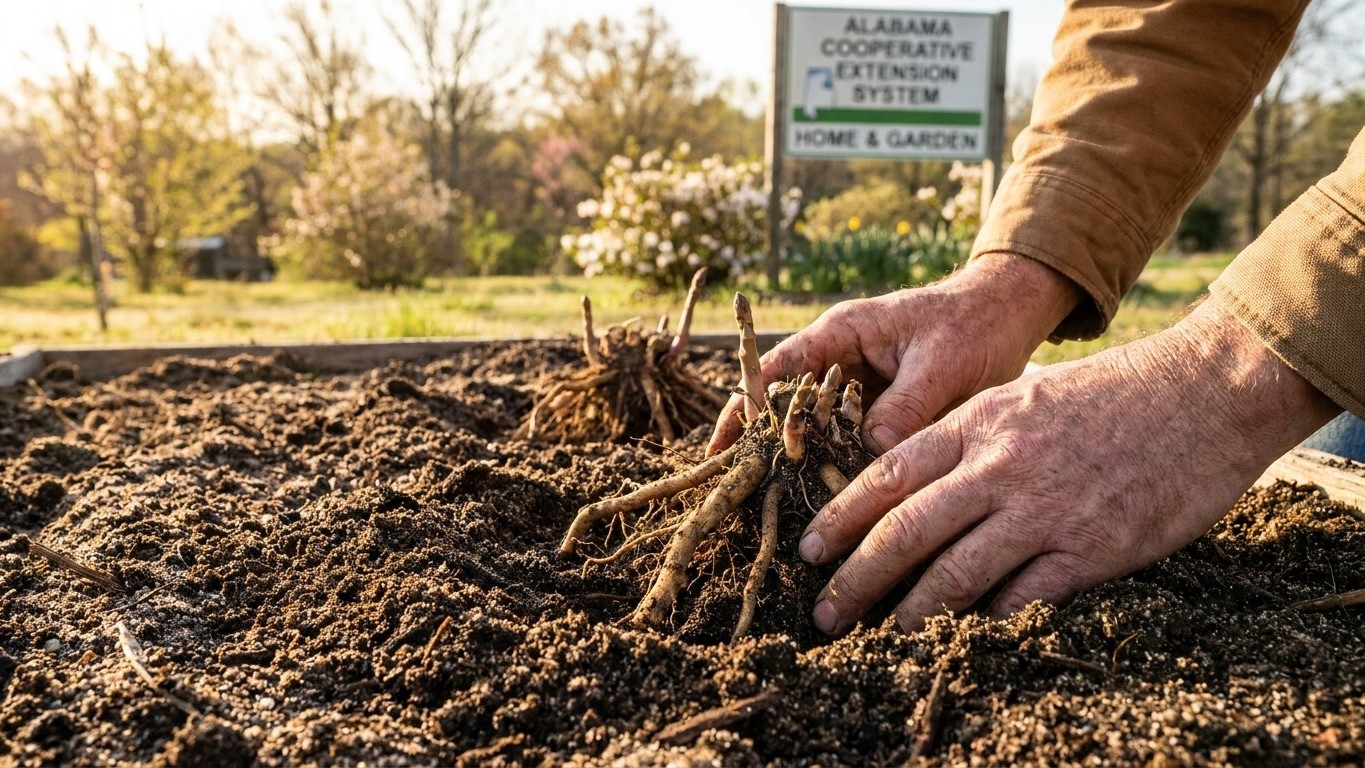

Crowns go into South Dakota ground in early spring, as soon as the soil can be worked, roughly bracketing the state’s late-April to early-May frost window. That timing matters less for the frost itself than for what happens underground for the next decade and a half: asparagus is a one-shot planting decision, and the soil you choose today is the soil that plant lives with for 10 to 15 years.
The short answer
South Dakota’s official state soil, the Houdek series, gives a useful read on what the ground here tends to do. It’s a Mollisol, the deep, dark prairie soil that built the Corn Belt, running loam to silt (38 percent sand, 22 percent clay, 40 percent silt) with organic matter around 3.0 percent and a surface pH near neutral, about 6.7. Most relevant to a fifteen-year asparagus bed: it’s classified well drained.
That single word, drained, is the only soil condition Utah State University Extension attaches to asparagus. The crop tolerates most soils. What it does not tolerate is standing water around the crown, and that’s a problem you only discover after the bed is established, the roots have spread three feet down, and moving the planting means starting over from year one. A heavy clay pocket that pools water every spring is an annual nuisance in a tomato bed you replant every year. In an Asparagus Bed, it’s a decision you’re stuck with for a decade.
The Houdek series itself doesn’t raise that flag; it drains well as mapped. But the state soil describes a representative surface horizon across ninety mapped components, not the eight-by-twenty-foot strip behind your garage. River bottoms, hill country, and anywhere a builder has scraped topsoil and brought in fill can behave completely differently from the Houdek profile, even within the same county. The only way to know your own ground is to watch it after a hard rain. If water stands for more than a few hours, or the soil stays greasy and slow to dry days later, that spot isn’t the one.
The fix isn’t complicated, but it has to happen before the crowns go in the furrow, not after. Raised beds or mounded rows lift the crown above a slow-draining subsoil. Working in organic matter, compost, aged manure, loosens a tight clay fraction and gives water somewhere to go besides sitting on the surface. A simple soil test through your county extension office will also tell you what the Houdek average can’t: your actual pH, your actual organic matter, and whether the spot you’ve picked needs amending before it becomes a fifteen-year commitment. Asparagus rewards patience at planting and punishes shortcuts for years afterward.
Will the summer here water it for you?
An established asparagus bed asks for 1 to 2 inches of water every other week through its first two years, then eases to about every three weeks once the crowns are settled. South Dakota’s summer doesn’t hand that over on its own.
- What the sky delivers. Normals from the reference weather station put summer rainfall at about 10.8 inches across June, July, and August combined, out of 27.9 inches for the full year. Spread over three months, that’s a modest amount, and it isn’t even.
- The dry month to watch. July is the thin point of the season, averaging 3.25 inches, against June’s 4.23 and August’s 3.34. That’s the stretch, often the hottest stretch too, when a new bed is most likely to run short between rains.
- Translating that to the bed’s need. The asparagus target of roughly 1 to 2 inches every other week works out to somewhere near 2 to 4 inches a month during the demanding first two seasons. July’s 3.25 inches sits inside that range on paper, but it rarely arrives on schedule: a single thunderstorm can dump most of a month’s total at once, and much of that runs off rather than soaking down to a crown planted eight inches deep.
- Why the soil changes the math. A well-drained loam like the Houdek profile holds moisture longer than sand but lets excess drain rather than pool, which is the balance a new asparagus root system wants. On a lighter, sandier patch, that same July rainfall vanishes faster and the gap between storms starts to show as stress. On a heavier, slower patch, the rain lingers, which for once works in the plant’s favor between waterings.
- The practical takeaway. Treat the summer normals as a floor, not a plan. A rain gauge staked next to the bed, checked weekly, is what actually tells you whether nature covered the interval or whether it’s time to run a hose. In practice, most South Dakota beds need supplemental water at least a few weeks each summer, especially through July, and more so in the crowns’ first two establishment years than once the planting matures.
When to put the crowns in
Early spring is the target, and in South Dakota that lines up with the stretch around the state’s average last spring frost, which the reference weather station places between April 29 and May 9. That’s a mean, built from three decades of freeze data, not a promise for any single year or any specific county, and suburban and rural gardens away from the airport station often see their own last frost run a week or two later. Crowns don’t need frost-free soil to go in; they need soil that can be worked, meaning dry enough to dig and no longer frozen a few inches down. For many South Dakota gardeners, that means watching the ground rather than the calendar, and being ready to plant once it thaws and dries even if that falls a little before or after the reference window.
Planting itself follows a specific method: crowns go into furrows about 8 inches deep, set at that depth rather than buried all at once. Utah State University Extension’s guidance is to backfill gradually across the season, adding roughly 2 inches of soil back into the furrow every other month rather than filling it in a single pass. That staged backfill lets the emerging spears keep pushing through loose soil instead of fighting a compacted trench, and it’s a detail worth following exactly rather than shortcutting to save a weekend.
Seed is the alternative route, and it demands more patience up front. Starting from seed pushes the harvest timeline back roughly another year compared with starting from crowns, since the plant needs to grow a season indoors or in a nursery bed before it’s ready to transplant as a crown-sized root system. Most home gardeners choose crowns specifically to skip that extra year, given that harvest is already out of reach until year three regardless of the starting point.
On variety, the published record is narrow and it’s worth being honest about that rather than padding it with claims nobody has tested. Utah State University Extension names four varieties by sex characteristic alone: Jersey Giant and Jersey Knight are all-male, while UC 157 F1 and Purple Passion are male and female. No flavor comparison, no yield figures, and no stated reason to prefer one over another appear in that guidance. All-male varieties are generally chosen because they don’t spend energy producing seed, which some gardeners associate with more vigorous spear production, but that reasoning is a general horticultural pattern, not a claim made specifically for these four names in the source. Choose based on what’s available locally and suited to your bed, not on marketing language attached to any single variety.
Winter chilling requirements and soil pH preferences for asparagus aren’t addressed in the Utah State University Extension guidance this article draws from, so no figure is given here for either. If you’re weighing a hardiness zone against a chilling need, that’s a judgment call outside what’s published, not a number to borrow from somewhere else and present as settled.
Common questions
How long before I can harvest asparagus after planting crowns?
No harvest happens until year three. That’s not a suggestion to hold back a little; it’s the rule. Once harvest begins, the season starts short, typically around 4 weeks, then extends to about 6 weeks the following year, then up to 8 weeks after that as the crown system matures.
How do I know when to stop cutting spears each season?
Stop when most of the spears coming up are thinner than a pencil. That’s the signal the plant is using, not a date on the calendar, and it holds regardless of how many weeks you’ve already harvested that season. Cutting past that point weakens the crown for the following year.
Can I plant asparagus in a raised bed instead of testing my native soil?
Yes, and it’s a reasonable option if you already know or suspect your ground drains slowly. A raised bed sidesteps the drainage question entirely, which matters more here than almost anywhere else in the garden, given how long this planting stays in the ground.
Does South Dakota’s soil need amending before planting asparagus?
Not necessarily. The state’s representative soil, the Houdek series, is already well drained with organic matter around 3.0 percent, which is a workable starting point. But that figure describes a mapped average, not your yard, so a simple soil test remains the only way to know whether your specific spot needs organic matter worked in before the crowns go in the furrow.
The Moon calendar is a separate, older custom: see when to plant asparagus by the moon, written as tradition rather than fact.