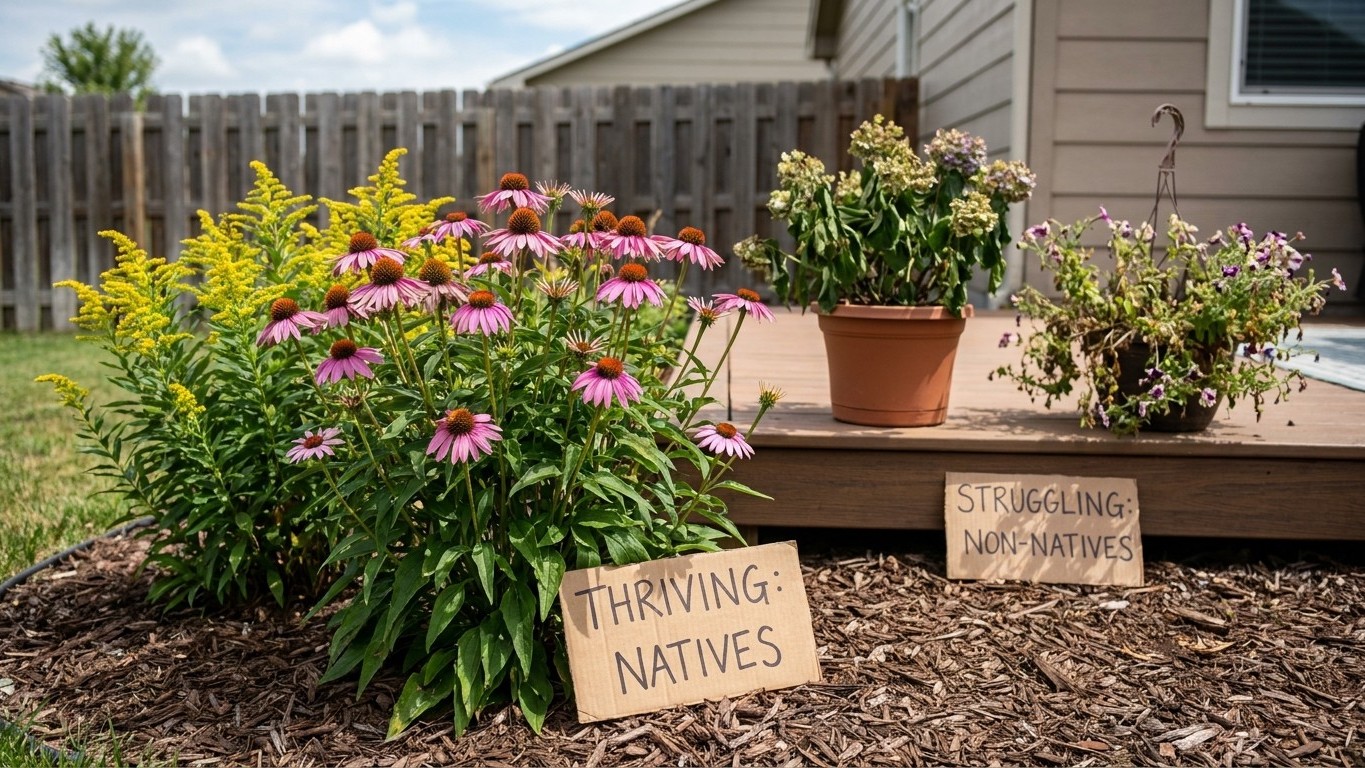

South Dakota’s growing conditions split flowers into two clear camps: cold-hardy perennials and native prairie species that shrug off winter, and humidity-loving or long-season varieties that struggle to finish before frost. The USDA Plant Hardiness Zone Map, using 1991-2020 normals, places the state across zones 3b to 5b, and NOAA’s climate normals put the average low of the coldest month near Sioux Falls at 8.5°F, the number that decides what actually overwinters without a cold frame or heavy mulch. Before buying anything, check the plant tag’s hardiness zone against your own county, not the state average.
What thrives in South Dakota

Some flowers come back every spring here, and some just die trying. The ones that make it are the tough, deep-rooted kind — coneflower, black-eyed Susan, sedum, peonies once they’ve settled in — because they can sit through a real winter low and still bloom before the frost catches them again. The ones that struggle are the pretty catalog varieties bred for milder places, the ones that need a longer season or a softer winter than your yard actually gives them. Before you plant anything, flip the tag over and check the zone number against your own spot in the yard, not just the state average.
Heat is a secondary but real filter. Sioux Falls averages 13.8 days a year at 90°F or above, according to NOAA’s climate normals, which is enough to stress cool-season flowers like pansies and primrose by midsummer but far short of what would rule out sun-loving prairie natives. Cold hardiness matters more here than heat tolerance, which flips the usual gardening advice from warmer states on its head.
Plant families built for this climate
The families that consistently perform share a few traits: deep or fibrous root systems that reach moisture during dry spells, foliage that sheds wind rather than catching it, and dormancy habits suited to a hard freeze. The daisy family (Asteraceae) covers most of the reliable performers here, from purple coneflower to black-eyed Susan to asters, because their taproots and basal rosettes handle both drought and cold. The stonecrop family (Crassulaceae), especially sedum, stores water in thick leaves and needs almost no irrigation once established. Peonies (Paeoniaceae) are slow to establish but essentially indestructible once their crowns are three years in the ground, since they actually require a hard winter chill to bloom well the following spring.
Zone 3b conditions rule out anything that needs a mild winter to reset, which is why catalog descriptions written for zone 7 or 8 gardens rarely translate directly. A plant tag that says “perennial” without a zone range is not useful information in South Dakota. Look for the specific number, and if it reads 6 or warmer, plan on treating that flower as an annual here regardless of what the tag calls it.
Native plants worth the space
Plants native to the wider Great Plains and upper Midwest region have already solved the local climate problem over thousands of years, which is why they need far less water, fertilizer and pest management once their root systems are established, usually by the second full season. A nursery-grown perennial from a warmer nursery zone often needs a full year of babying to reach the same self-sufficiency a regional native reaches almost immediately.
Purple coneflower (Echinacea purpurea) is probably the most widely available of these, with its daisy-like purple-pink petals around a raised orange-brown cone, and it blooms through the hottest stretch of summer when many garden flowers stall. Blazing star (Liatris species), with its tall purple bottlebrush spikes, and black-eyed Susan (Rudbeckia hirta), with bright yellow petals around a dark brown center, round out a reliable trio that blooms in sequence from early to late summer. Butterfly milkweed (Asclepias tuberosa), with its clusters of bright orange flowers, is worth the space specifically for monarch butterflies, since it is one of the few plants their caterpillars can eat.
What natives bring for pollinators
Native flowers and native pollinators evolved on the same schedule, so bloom times line up with when local bees, butterflies and moths actually need the nectar and pollen. A border heavy on native species tends to draw more visible pollinator activity than one built entirely from ornamental hybrids bred mainly for flower size or color saturation. This matters most in early spring and late fall, the shoulder seasons when few non-native ornamentals are blooming but native bees are still active.
- Purple coneflower: mid to late summer bloom, full sun, tolerates poor soil
- Blazing star: mid to late summer bloom, full sun, tolerates dry soil once established
- Black-eyed Susan: early to late summer bloom, full sun to part shade
- Butterfly milkweed: early to mid summer bloom, full sun, needs sharp drainage
None of these need staking, deadheading to keep blooming, or winter protection at the zone 3b to 5b range NOAA and USDA data cover for South Dakota. That low-maintenance profile is the actual argument for using them, more than any aesthetic preference for “wild” over “cultivated” plantings.
Perennials that come back

At zone 3b to 5b, the perennials that return reliably year after year share the cold-hardiness traits described above, but garden centers stock plenty of perennials rated for zones that never get this cold. Reading the tag correctly is the single habit that prevents the most wasted money in a South Dakota flower bed.
Reliable returners versus tender perennials
Peonies, daylilies, hardy phlox, sedum, coneflower, black-eyed Susan and most true hostas are all rated hardy well into zone 3, so they come back reliably across the entire state range NOAA and USDA cover. Lavender is borderline. Some cultivars, like ‘Munstead’ and ‘Hidcote’, are often listed to zone 5, which means they may survive in Sioux Falls or Rapid City but are a gamble in colder pockets of the state, especially without a protected, south-facing spot and good winter drainage.
A hibiscus or lantana grown as a returning perennial farther south, the kind covered in our guide to Flowers That Actually Thrive in Kentucky, and the Ones That Struggle, is grown strictly as a summer annual in South Dakota. Neither survives a winter with an average coldest-month low of 8.5°F, per NOAA’s normals, no matter how well it performed the summer before. Buying it anyway isn’t wrong, as long as the budget accounts for replacing it every spring rather than expecting it to overwinter.
| Perennial | Typical bloom season | Hardy to zone | Reliable in South Dakota? |
|---|---|---|---|
| Peony | Late spring | 3 | Yes, statewide |
| Coneflower | Mid to late summer | 3 | Yes, statewide |
| Hardy phlox | Mid to late summer | 4 | Yes, most of state |
| Lavender (‘Munstead’) | Early to mid summer | 5 | Borderline, sheltered sites only |
| Lantana | Summer to frost | 8 | No, grown as annual |
Putting a border together
A border that looks good all season is built in layers, not planted flower by flower as impulse buys arrive home from the nursery. Tall plants like blazing star or delphinium go at the back or center of an island bed, mid-height plants like coneflower and phlox fill the middle, and low, spreading plants like sedum or creeping phlox edge the front. Skipping the height plan is the most common mistake in a first flower bed, and it results in tall plants shading out everything behind them by midsummer.
Succession of bloom and repeated color
Because the frost-free window runs roughly late April or early May through late September or early October at Sioux Falls, per NOAA’s normals, a border needs at least three overlapping bloom windows to avoid a bare stretch. Pair an early bloomer like hardy phlox with a midsummer anchor like coneflower and a late performer like aster or sedum ‘Autumn Joy’, whose flower heads deepen to rust and pink into fall. Repeating the same two or three colors in small clusters through the bed, rather than scattering one of everything, is what makes a border read as designed instead of accidental.
Leave real space at planting time. A coneflower or daylily bought in a one-gallon pot looks lonely at eighteen inches from its neighbor, but most perennials reach two to three times their nursery size within two growing seasons. Planting too tight now means digging and dividing in three years, which is more work than leaving the gap in the first place and filling it temporarily with an annual like zinnia or cosmos.
Gardeners just across the border face a similar layering problem with a slightly milder climate, and our guide to Flowers That Actually Thrive in Wisconsin, and the Ones That Struggle walks through the same succession logic for a longer, more humid growing season. The core habit, plan height and bloom time before buying, translates regardless of the zone.
Local help
South Dakota State University’s Extension service, at extension.sdstate.edu, maintains regional plant lists and a Master Gardener program that trains volunteers county by county on what actually performs locally. A call to the county extension office is worth more than another catalog description, since staff there see which cultivars fail in local soil and wind conditions year after year. For more on gardening across the state’s varied zones, our South Dakota guides cover soil, frost timing and vegetable planting windows county by county.
Common questions
Can I grow roses in South Dakota?
Some can, but tag reading matters more than usual. Shrub roses rated hardy to zone 3 or 4, like many in the Canadian Explorer or Parkland series, survive winters at the 8.5°F coldest-month average NOAA reports for Sioux Falls. Hybrid tea roses rated to zone 6 or warmer generally need winter mounding and burlap wrap to survive, and even then results vary by county.
Why did my perennial come back one year and die the next?
Usually it’s a borderline-hardy cultivar that survived one mild winter and then hit a harder one, or standing water around the crown during a spring thaw. Perennials rated right at the edge of a zone, like some lavenders rated to zone 5 in a state that runs to 3b in places, are the most likely culprits.
Do I need to water native flowers once they’re established?
Rarely, once the root system is developed, which usually takes a full second growing season. The first year, water new native plantings as you would any transplant, since even drought-tolerant species need consistent moisture while roots establish.
What’s the earliest I can plant flowers outside in spring?
That depends on the flower and your county’s own frost pattern, not a single statewide date. NOAA’s 1991-2020 normals put the last spring freeze at Sioux Falls between April 29 and May 9, and gardens outside that reference station, especially rural or higher-elevation sites, often see frost run later still, so hardy perennials can go in near the start of that window while tender annuals should wait until it has clearly passed.
Related guides
- Flowers That Actually Thrive in North Dakota, and the Ones That Struggle
- Flowers That Actually Thrive in Minnesota, and the Ones That Struggle
- Flowers That Actually Thrive in Wisconsin, and the Ones That Struggle
- What to Plant in South Dakota in February
- Growing Carrots in South Dakota
- The Best Cucumbers to Grow in South Dakota