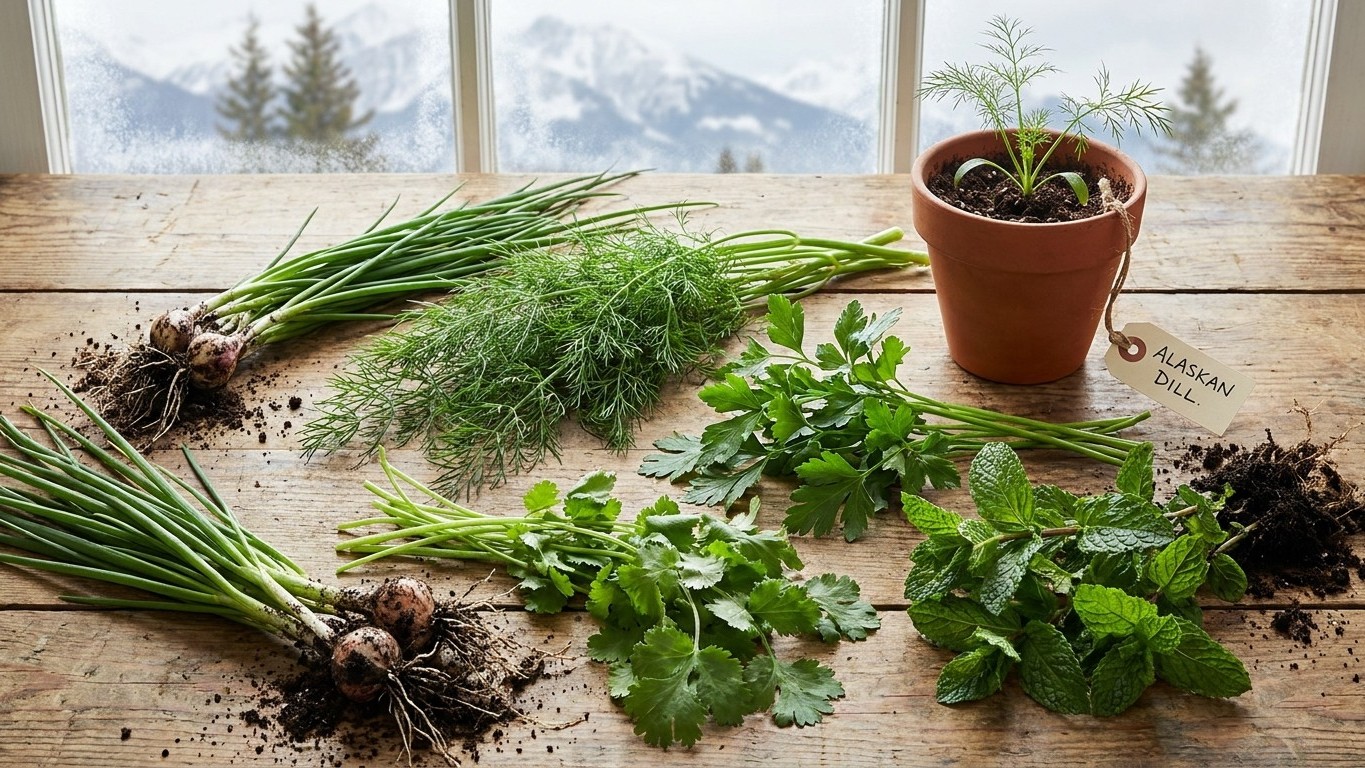

Chives, thyme, oregano, sage, dill, and cilantro top the list of herbs that reliably produce in South Dakota, thanks to their tolerance for a short growing season and winters that regularly bottom out near 8.5°F. Basil and parsley work too, but only as warm-season annuals planted after frost risk has passed. Rosemary and bay laurel are the two herbs most South Dakota gardeners eventually give up on outdoors.
The short answer for South Dakota
Pick herbs by how fast they mature and how cold they can sit through, because those two numbers decide almost everything else here. The reference station used for South Dakota’s freeze data (USW00014944) shows a last spring frost landing between April 29 and May 9, and a first fall frost between September 24 and October 4. Stack the earliest last frost against the latest first frost and the longest possible window runs about 158 days. Stack the latest last frost against the earliest first frost and the shortest possible window drops to about 138 days. That 20-day swing, in the same state, in different years or different yards, is the first thing that should shape a herb list.
The second number is the coldest month’s mean daily minimum: 8.5°F. That’s not a record low, it’s the average low South Dakota winters produce every single year in the coldest stretch. Combined with the state’s USDA hardiness range of zone 3b to 5b, it tells you which herbs can spend winter in the ground and which ones can’t survive outside at all.
Put those two facts together and the herbs sort themselves into three groups.
| Type | Examples | Why it fits South Dakota |
|---|---|---|
| Hardy perennials | Chives, thyme, oregano, sage, mint, lovage | Root systems tolerate an 8.5°F winter minimum within zones 3b-5b, especially with mulch |
| Fast annuals | Dill, cilantro, summer savory, basil (after frost) | Mature well inside a 138 to 158-day frost-free window |
| Tender perennials | Rosemary, bay laurel, lemon verbena | Cannot survive an 8.5°F winter minimum outdoors; need containers brought indoors |
Basil sits in an odd spot: it’s a fast grower that fits the season length, but it’s also frost-tender enough that it needs to go in after the last frost date, not before, which shrinks its usable window to something closer to 120 days in a short-season year.
What will not work here

Rosemary grown in the ground is the herb South Dakota gardeners lose most often, and the reason is arithmetic, not bad luck. Rosemary needs winter lows no colder than roughly 10°F to 20°F to survive outdoors, and South Dakota’s coldest month averages a minimum of 8.5°F, with plenty of nights well below that average. Bay laurel is worse: it has no tolerance for freezing at all, so it only survives South Dakota winters as a container plant that comes indoors before the first fall frost, which the reference station places as early as September 24 in some years.
Slow-to-mature herbs are the second casualty. Anything that needs a full 160 to 180 frost-free days to bulk up, long-season parsley varieties or perennial roots like licorice, is working against a season that tops out around 158 days in the best years and can run as short as 138. Plant those too late, or hit an early fall frost, and they never finish.
Basil deserves its own warning because it’s popular and it still fails constantly here. It cannot go in the ground until after the last spring frost, which the data puts as late as May 9 in some years. Put it in early because the calendar says May and a late frost event catches it, and it’s dead within hours; basil has essentially zero cold tolerance, unlike dill or cilantro, which shrug off a light frost.
French tarragon is a quieter failure. It’s often sold as a hardy perennial, but its actual cold tolerance sits closer to zone 4, which puts it on the edge of failure in the 3b portions of the state and only reliably hardy in the 5b areas, meaning the same packet of tarragon can survive in one South Dakota county and die in another.
None of these are universal herb-growing rules. They’re specific to a state where the coldest month averages 8.5°F and the frost-free window can be as short as 138 days, both of which punish slow growth and thin cold tolerance more than they punish anything else.
What changes across South Dakota
South Dakota isn’t one climate wearing one label. The USDA hardiness range for the state spans zone 3b to zone 5b, and under the USDA Plant Hardiness Zone Map system, each full zone number represents a 10°F difference in average extreme annual minimum temperature, with each half-zone (the “a” or “b”) representing 5°F. Going from 3b to 5b is four half-zone steps, which works out to roughly a 20°F spread in average extreme minimum temperature across the state, all inside the same set of state borders.
That 20°F spread matters most for the hardy perennials this list leans on. A stand of thyme or sage that overwinters in the ground without protection in the milder end of that range can lose its crown entirely in the colder end, even though both gardens are technically “South Dakota” and both are following the same seed packet instructions. Mint and chives are more forgiving across that spread since they’re tough enough to handle most of zone 3b, but oregano and especially French tarragon are the ones that separate a 5b garden from a 3b garden.
Elevation compounds this. Higher ground tends to run colder and see frost earlier and later than lower-lying areas nearby, even within the same county, so two gardens ten miles apart can sit in different practical frost windows despite sharing a hardiness zone on the map.
Which side of that 20°F spread a yard falls on depends on the yard itself. That’s a job for the USDA Plant Hardiness Zone Map, which lets you zoom to a street address. A “South Dakota” answer to which herbs overwinter safely is really two or three different answers depending on where in that 3b-5b range a garden sits.
Where to check this for your own county
The number that actually settles these questions for a specific address lives with South Dakota State University Extension. Their site, extension.sdstate.edu, publishes planting calendars and variety recommendations built from trials run inside the state, county by county, rather than from a single airport weather station.
Two things are worth looking for once there. First, a local or regional planting calendar that gives sowing and transplant windows tighter than the statewide frost-date range, since a county extension office can factor in local microclimate patterns that a single reference station 150 miles away can’t see. Second, any list of herb or vegetable varieties actually trialled by SDSU researchers in South Dakota conditions, because a variety bred and tested for Minnesota or Nebraska winters doesn’t automatically behave the same way once it’s growing in a South Dakota bed.
A county-level recommendation beats a state-level one every time, for the simple reason that it’s built on fewer assumptions. Treat this article as the broad state-level starting point, and treat the SDSU extension office as the correction for the specific piece of ground a reader is actually planting.
Checking this against your own garden
Frost dates and hardiness zones describe averages built from 30 years of weather data. They don’t describe the particular patch of soil a reader is about to plant into, and that soil will usually contradict the calendar in small but useful ways.
Soil warmth by feel is the first check. Herbs like basil and dill germinate and transplant poorly into cold soil even after the calendar says the frost risk has passed; if the top few inches still feel cool and slightly damp rather than warm and crumbly to the touch, the soil hasn’t caught up to the air temperature yet, and waiting a few more days usually beats fighting stunted seedlings for weeks.
The first true leaves on direct-sown herbs are the second check. Cilantro and dill both send up a pair of thin seed leaves first, followed by a distinctly different, more feathery set of true leaves; that second set appearing on schedule is a decent sign the local microclimate is tracking close to the state’s averages, while a long delay suggests the garden is running cooler than the state’s averages.
The third check is specific to the hardy perennials: how a mulched clump of chives, thyme, or sage looks the first week it pushes new growth in spring. Solid green growth from the center of the crown means it made it through that 8.5°F winter minimum intact. A crown that’s mushy, blackened, or slow to show anything at all is telling a reader their spot runs colder than the state average, information no calendar or map can hand them ahead of time.