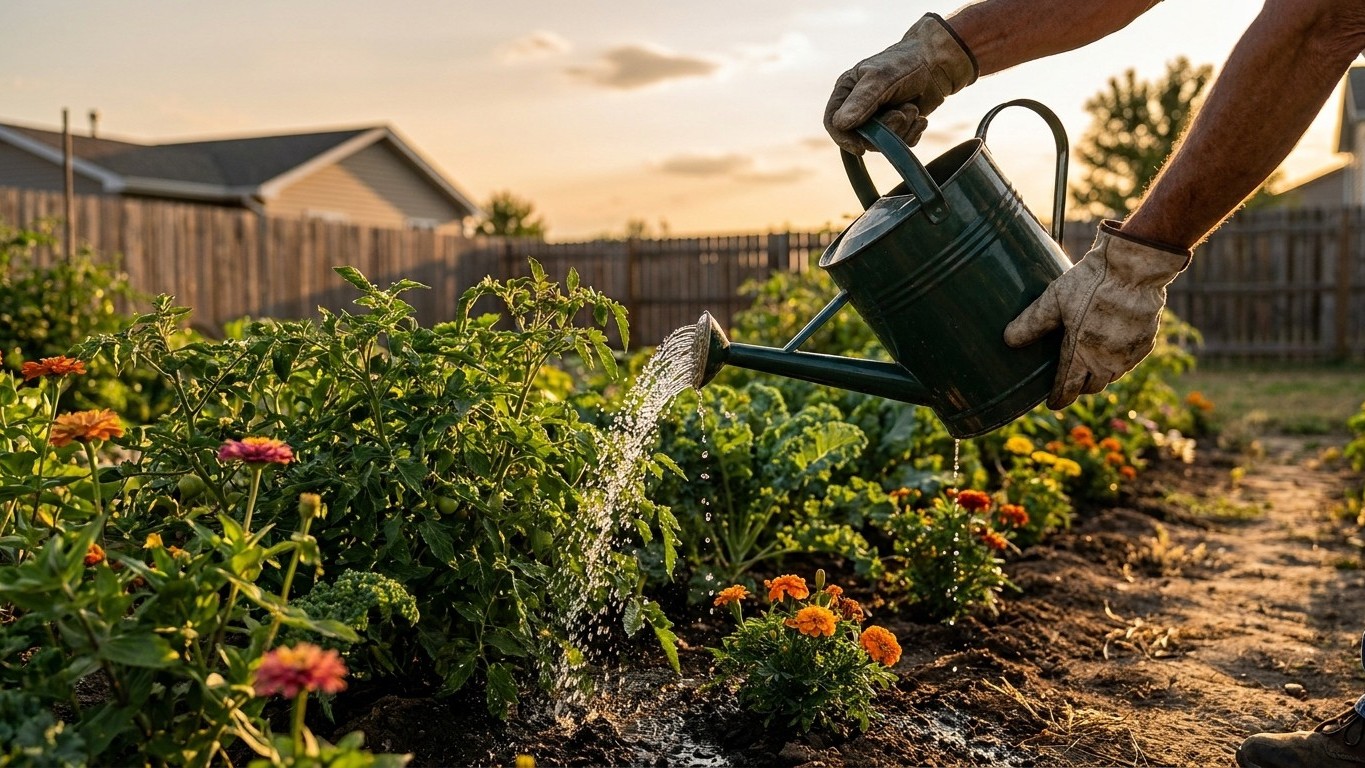

South Dakota gardens live and die on two things: how many days climb past 90F and how far apart the rain showers fall in July. Between those two numbers, the answer to “how much and how often” changes block by block, from a sandy garden near the Missouri River to a clay-heavy yard outside Sioux Falls.
What the climate asks of you

Start with the number that rules the whole growing season: the Sioux Falls reference station averages 13.8 days a year at 90F or hotter (NOAA NCEI Climate Normals, 1991-2020). That’s not a brutal desert tally, but it’s enough heat, stacked into a handful of weeks in July and August, to pull moisture out of a garden bed faster than most people expect. Those hot stretches are exactly when a watering schedule either holds or falls apart.
Frame that heat against the calendar. At the same reference station, the last spring frost typically falls between April 29 and May 9, and the first fall frost arrives between September 24 and October 4. That gives most of the state a working season of roughly four to five months, and it means the hottest, driest stretch of the year (mid-summer) lands squarely in the middle of active growth, not at the edges where a young or dormant plant could shrug it off. Suburban and rural gardens away from the airport station tend to see frost arrive later in spring and earlier in fall, sometimes by one to two weeks, so treat these dates as a starting point and check your own county’s normals.
South Dakota’s hardiness zones run from 3b to 5b across the state, a spread wide enough that a shrub thriving in Rapid City can struggle in Aberdeen. That range matters more for choosing perennials than for a summer watering plan, but it’s a reminder that this is a big state with genuinely different growing conditions from one end to the other.
What this state doesn’t offer is a single, reliable summer rainfall figure you can bank on. Totals swing enough between the wetter eastern counties and the drier western half that quoting one number for “South Dakota” would be misleading. The safer approach: track your own rain gauge, or pull your county’s monthly normals from NOAA or your local extension office, and measure your garden against the standard vegetable-bed target of about an inch of water a week, from rain and hose combined. For raised beds and containers, which dry out faster than in-ground plots, see this guide on Watering Pots and Containers in South Dakota. Whatever the sky doesn’t deliver in a given week, the hose has to make up, and knowing Watering Through a Dry Spell in South Dakota is what separates a garden that limps through July from one that keeps producing.
Soil changes the math
South Dakota soils range from sandy, fast-draining ground in parts of the state to dense clay elsewhere, and that texture decides how far that inch of water actually reaches. Sandy soil lets water run through to depth quickly but holds almost none of it, so a garden on sandy ground needs shorter, more frequent watering even in a week with decent rain. Clay holds water for days, but oversaturate it and roots start to suffocate. Knowing which one you’re gardening in matters as much as knowing the weather.
How much, how often
The rule that holds up almost everywhere: water deep, and water less often. A quick daily sprinkle wets only the top inch or two of soil, which trains roots to stay shallow, right where the sun bakes them during those 13.8 annual days above 90F. A deep soak once or twice a week pushes moisture down where roots can chase it, building a plant that tolerates a hot stretch instead of wilting the first afternoon it hits.
The simplest test costs nothing. Push a finger, or a garden trowel, about two inches into the soil near the base of a plant. Dry at that depth means it’s time to water. Still cool and slightly damp, and the plant can wait another day, even if the surface looks parched. Surface dryness lies; two inches down tells the truth.
Here’s a workable sequence for a typical South Dakota vegetable or flower bed through the hot months:
- Check soil moisture two inches down at the base of the plant, in the morning, before deciding to water at all.
- Water at the base and roots, never over the leaves, to cut down on fungal disease and wasted overspray.
- Apply enough to soak the top 6 to 8 inches of soil, roughly equivalent to an inch of water across the bed, in one session rather than several light passes.
- On sandy soil, split that inch into two shorter sessions during the week, since the ground can’t hold it all at once.
- On clay soil, wait until the two-inch test comes up dry before watering again, even if that means going five or six days between soakings.
- Water in the early morning, not the evening, so foliage dries before nightfall and roots get first pull on the moisture before the day’s heat sets in.
Tie that schedule to the calendar. With frost windows bracketing the season from late April to early October at the reference station, and the hottest days concentrated in July and August, that’s the stretch where the deep-and-infrequent approach gets tested hardest. Outside those weeks, most South Dakota gardens can lean more on rainfall and less on the hose, particularly once nights cool down heading into September.
Restrictions and rules
Watering restrictions aren’t universal in South Dakota, and where they exist, they change from one water system to the next and from one summer to the next depending on how dry the season runs. Some municipal and rural water systems set odd-even day schedules or time-of-day limits during peak summer demand; others rely on voluntary conservation requests rather than enforced rules. There isn’t one statewide watering ordinance that covers every yard.
Because the rules sit at the local level, the only reliable source is your own water provider, whether that’s a city utility, a rural water system, or a well you manage yourself. Calling ahead of a hot spell, rather than after a restriction notice shows up, saves the trouble of rethinking an irrigation timer mid-season.
Given how thin summer rainfall runs in the drier stretches of the state, particularly west of the Missouri River, it’s worth checking those local rules before setting up any automated system. A drip line or sprinkler timer built around an assumed schedule can run straight into a restriction it never accounted for. South Dakota State University Extension (extension.sdstate.edu) is a good starting point for connecting with local guidance and season-specific advisories.
Using less
Cutting water use in a South Dakota garden isn’t about one big fix. It’s a handful of smaller habits that add up, especially across a season with 13.8 days of real heat stress and rainfall that can’t be counted on evenly week to week.
- Mulch, two to three inches deep: cuts surface evaporation dramatically and keeps soil temperature down during the hottest weeks, which means the two-inch moisture test stays damp longer between waterings.
- Drip irrigation or soaker hoses: delivers water straight to the root zone instead of the air, which matters most on windy South Dakota afternoons where sprinkler spray simply evaporates before it lands.
- Grouping plants by water need: keeps a thirsty vegetable bed separate from drought-tolerant natives, so one zone isn’t overwatered just to satisfy the other.
- Organic matter worked into the soil: helps sandy ground hold water longer between soakings, and helps clay soil drain a little better instead of staying waterlogged.
- Rain barrels, where local rules allow them: an inch of rain falling on a 1,000-square-foot roof works out to roughly 600 gallons of runoff, a straightforward rainwater-harvesting figure. In a wet week that’s a real supply. In the driest stretch of a South Dakota summer, when rain simply doesn’t show up for days at a time, that same barrel can sit empty right when the garden needs it most, which is why it works best as a supplement to a hose, not a replacement for one.
None of these techniques replace watching the soil itself. But stacked together, mulch, drip lines, and a rain barrel catching what falls during the wetter weeks can trim a noticeable share off a summer water bill without asking a single plant to go thirsty.
Common questions
What time of day should I water in South Dakota?
Early morning, before the heat sets in. It gives roots first access to the moisture and lets any leaf splash dry off before evening, cutting down on fungal problems that thrive in overnight dampness.
How do I know if my area has watering restrictions?
Contact your municipal water utility or rural water system directly. Restrictions vary by provider and by how dry the season is running, so there’s no single statewide rule to check against.
Does South Dakota’s growing season length affect how much I water?
Indirectly, yes. With frost typically clearing by early May and returning by late September at the reference station, plants have a defined window to establish deep roots. Consistent deep watering early in the season builds the root depth that makes mid-summer heat easier to handle.
Is my soil sandy or clay, and why does it matter for watering?
A simple squeeze test tells you: clay holds together in a ribbon when squeezed damp, sand falls apart immediately. Clay holds water longer and needs less frequent watering; sandy soil drains fast and needs shorter, more frequent sessions to keep roots from drying out between waterings.