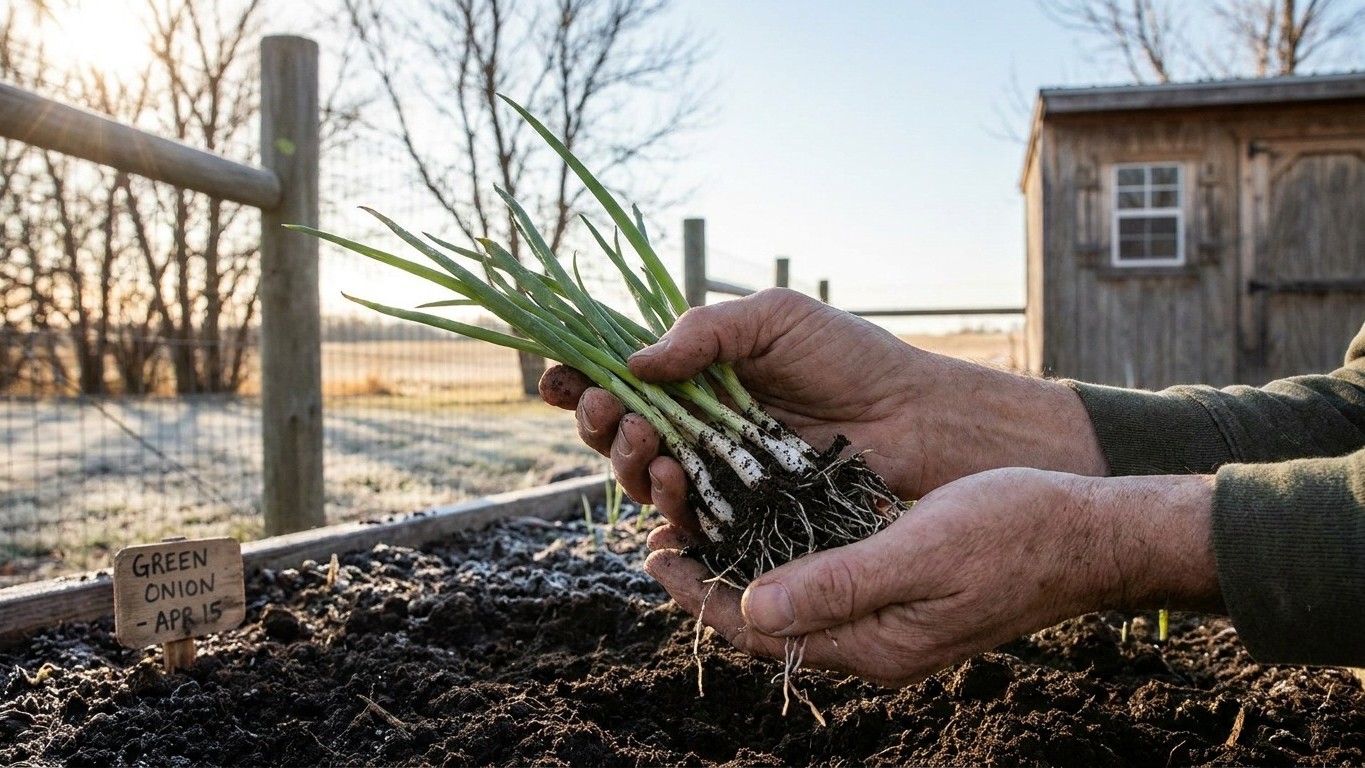

South Dakota gardeners plant onions in early spring, not fall. At 43.59 degrees north latitude, the reference station near Sioux Falls records 15 hours and 15 minutes of daylight on the longest day of the year, which is enough to trigger bulbing in long-day onions but arrives too early in the season for the shorter-day types grown further south. That single fact of geography, more than any calendar date, decides both when you plant and which varieties belong in a South Dakota garden.
The short answer for South Dakota

Forget the mild-winter approach some gardeners read about online. Fall planting works in places where winters stay above freezing long enough for a young onion to survive outdoors, tucked in the soil, waiting for spring. South Dakota winters do not offer that grace. Ground freezes hard, often several feet down, and a fall-planted onion set or transplant left exposed through a Dakota winter has little chance of surviving to spring.
That leaves one workable window: late winter into early spring. Start onion seed indoors in February, about 8 to 10 weeks before your last expected frost, or buy sets and transplants timed for outdoor planting as soon as the soil can be worked, typically in April across most of the state. The goal is to get as much leaf growth on the plant as possible before day length climbs toward that 15-hour-15-minute mark near the summer solstice, because that is the point at which the plant shifts from growing leaves to building a bulb.
This is where the daylight figure does its real work. Onion bulbing is not a response to warm soil or a specific date on the calendar. It is a response to how many hours of daylight the plant is getting. Long-day onions need somewhere between 14 and 16 hours of daylight before they start converting leaf energy into bulb growth. At 15 hours and 15 minutes on the longest day, South Dakota sits squarely in that range, which is exactly why long-day varieties, and only long-day varieties, make sense here.
Among the varieties whose published latitude ranges reach up to 43.59 degrees north, the long-day group dominates: Ailsa Craig, Barolo, Blush, Bridger, Frontier, New York Early, Patterson, Powell, Red Carpet, Redwing, Rossa di Milano, Safrane, Talon, and Walla Walla Sweet all cover this latitude. A handful of intermediate-day types, including Cabernet, Calibra, Elsye, Expression, Monastrell, Red Long of Florence, Red Long of Tropea, Scout, and Sierra Blanca, also list ranges that stretch into South Dakota’s latitude, though they sit closer to the southern edge of their comfort zone here.
What will not work here
Plant a short-day onion in South Dakota and it will not simply struggle. It will fail in a predictable, specific way. Short-day varieties are bred to start bulbing once day length reaches roughly 12 hours, a threshold South Dakota blows past by early spring, long before the plant has had time to build much leaf mass. The result is a small, undersized bulb, because whatever size the plant has reached the moment day length hits the trigger point is roughly the size the bulb will stay. Wait longer to plant, hoping to catch up, and the outcome does not shift to a delayed harvest. It shifts to a smaller one. There is no catching up once bulbing starts.
Eight varieties documented on this site carry published latitude ranges that fall entirely below 43.59 degrees north, meaning they are built for day lengths South Dakota’s summer never produces the low end of, and never will:
- Candy (intermediate-day, 33-40N): bulbs on day lengths shorter than South Dakota reaches early enough, leaving small bulbs.
- Gabriella (short-day, 20-35N): triggers bulbing far too early for this latitude, producing tiny onions.
- Madalyn (short-day, 20-35N): same short-day mismatch, undersized bulbs guaranteed.
- Red Rock (short-day, 30-36N): bulbs before the plant has grown enough leaf to size up.
- Red Sensation (short-day, 25-35N): a southern variety that cannot use South Dakota’s longer summer days.
- Texas Grano 1015Y (short-day, 25-35N): bred for latitudes where 12-hour days arrive on schedule with a full-sized plant, not this far north.
- Vidora (short-day, 25-35N): the same short-day ceiling applies.
- White Castle (short-day, 30-38N): still short of the day length South Dakota’s summer sun demands of a variety.
This is a variety mismatch, not a growing mistake. Feed a short-day onion perfectly, water it on schedule, and it will still bulb small in South Dakota, because the plant is responding to sunlight hours it has no control over.
What changes across South Dakota
South Dakota is not a single point on a map. The state runs roughly from the Nebraska border near 42.5 degrees north up to the North Dakota line close to 45.9 degrees north, a spread of more than three degrees of latitude. The 43.59-degree figure used throughout this guide comes from the weather station near Sioux Falls, in the southeastern part of the state, so gardeners closer to Aberdeen, Watertown, or the northern tier are gardening under noticeably longer summer days than the reference point suggests.
| Location | Approximate latitude | What it changes |
|---|---|---|
| Southern South Dakota (Sioux Falls area) | 43.59N | Reference figures used in this guide: 15h15 daylight, standard long-day variety fit |
| Northern South Dakota (near Aberdeen) | ~45.5N | Slightly longer summer days, more margin for long-day varieties, generally a shorter frost-free growing season |
The practical effect is small but real. A gardener near the North Dakota border gets a bit more daylight at the summer solstice than the Sioux Falls figure describes, which if anything makes long-day varieties an even safer bet, but it also usually means a later last frost and a shorter window to get transplants established before bulbing begins. Someone gardening near the Nebraska border, on the other hand, sits closer to the reference latitude and can follow the numbers in this guide with less adjustment. Neither edge of the state moves South Dakota into short-day or true intermediate-day territory. The whole state stays a long-day state.
Sweet now, or onions that last
Northern gardens like South Dakota’s trade sweetness for shelf life, and that is not a matter of luck or variety marketing. It comes down to chemistry. The compounds responsible for an onion’s sharp bite are volatile sulfur compounds, and those same compounds are what protect the bulb from breaking down in storage. A sweet onion has fewer of them, which is why it tastes milder raw but also why, according to University of Missouri Extension, sweet varieties do not store as well as the more pungent types.
Long-day onions, the group South Dakota depends on, generally run sharper and keep longer than their short-day and intermediate-day cousins grown in warmer states. Among the varieties suited to this latitude, Redwing and Safrane lean toward the pungent, long-storing end of the spectrum, while Walla Walla Sweet, despite being a long-day variety itself, is bred for sweetness and will not hold in storage the way a sharper bulb does. The intermediate-day varieties that also fit South Dakota’s latitude, Cabernet, Calibra, Scout, and Sierra Blanca among them, tend to sit somewhere in the middle, milder than a true long-day storage onion but not built for a spring harvest the way a southern short-day variety is.
What this means for a South Dakota pantry is straightforward. Plant a bed of sweet, mild long-day onions and expect to eat through most of them by winter. Plant a sharper, long-day storage variety and a March onion pulled from a cool basement or root cellar should still be firm and usable. Many gardeners split the difference, growing a row of something sweet for summer eating and a row of something sharper set aside specifically for the cellar.
Checking this against your own garden
Every figure in this guide comes from one weather station near Sioux Falls, and South Dakota is a big enough state that conditions shift meaningfully from one end to the other. Before finalizing a planting date or a variety order, take a few minutes to verify the details for your own location rather than assuming the reference numbers apply exactly where you garden.
- Look up your own latitude if you garden well north or south of Sioux Falls, since even a degree or two shifts your day-length curve.
- Check your local average last spring frost date, since that determines your safe transplant window, not a fixed calendar date.
- Confirm your variety’s day-length classification on the seed packet or catalog listing before ordering, since names alone do not tell you the group.
- Contact your county SDSU Extension office for frost data and soil-readiness guidance specific to your county.
- Track actual soil temperature in early spring rather than guessing, since cold, wet soil delays root establishment even after air temperatures warm up.