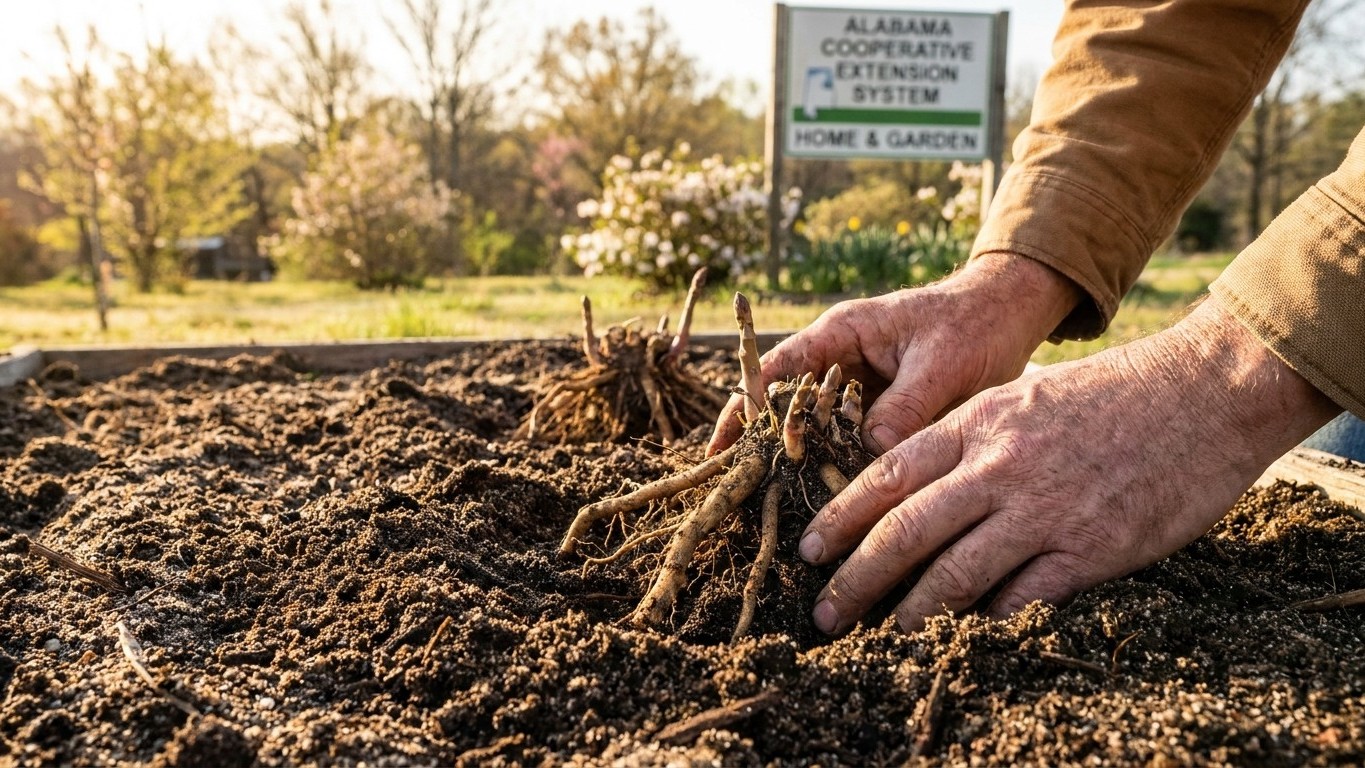

Plant asparagus crowns in Tennessee in early spring, once the soil has dried out enough to work and the ground has warmed past that last hard freeze. For most of the state, that means aiming for the weeks tucked around the region’s typical final frost. Get the timing right and that bed will feed a household for a decade or more, but the planting window is only half the story.
The short answer
Asparagus is a fifteen-year commitment dressed up as a vegetable. Plant it once, in a spot you choose carefully, and it produces for 10 to 15 years before it needs replacing. That single fact changes how you should think about the ground you’re putting it in. Utah State University Extension, which is the authority behind the growing guidance in this piece, is blunt about what the plant needs from soil: it wants to drain. Nothing about texture, nothing about a target pH, just drainage. Wet feet kill an asparagus crown faster than almost anything else, and because the bed isn’t coming out again for well over a decade, a drainage mistake made at planting time doesn’t get corrected. It gets lived with.
The soil that represents Tennessee at the state level, the Dickson series, is described by the USDA as moderately well drained. It runs mostly silt, with 68 percent silt, 20 percent clay, and only 11 percent sand in its surface layer, and it carries a strongly acid surface pH near 5.0 with fairly low organic matter, around 1.5 percent. Moderately well drained is a workable middle ground for asparagus. It’s not the free-draining sandy loam that makes this crop effortless, but it’s a long way from the standing water that rots a crown over winter. A silty surface like this one also tends to compact if it’s worked when wet, which matters at planting time since you’ll be digging a furrow roughly 8 inches deep and want the walls of that trench to stay loose rather than smear shut.
None of that is a diagnosis of your own backyard. The Dickson series is what the USDA lists as representative of Tennessee as a whole, not a soil test result for one particular garden. Tennessee spans river bottoms, hill country, and plenty of ground that’s been graded, filled, or compacted by a builder at some point, and any of those can behave nothing like the state series. If your ground stays soggy two days after a rain, or if water pools and sits rather than soaking in, that’s your answer regardless of what a statewide soil map says. The fix in that case isn’t to skip asparagus. It’s to raise the bed, work in coarse material to open up the profile, or choose higher ground on the property where water naturally moves through rather than collecting. A simple test, digging a hole a foot deep, filling it with water, and timing how long it takes to drain, tells you more about your own site than any regional soil description ever will.
Will the summer here water it for you?
An asparagus bed has a watering rhythm that changes as it matures. For the first two years, while the crowns are establishing root systems, the bed wants 1 to 2 inches of water every other week. After that, once the planting is established, the demand drops to roughly the same amount but on a three-week cycle. Tennessee’s summer rainfall, measured at a reference station under NOAA’s 1991-2020 climate normals, comes in at about 12.3 inches across June, July, and August combined, with July the wettest of the three at 4.16 inches and August the driest at 3.79 inches. Spread that out and stack it against the bed’s actual needs, and the picture looks like this:
- June: normal rainfall runs about 4.36 inches for the month, which on paper covers a young bed’s every-other-week 1 to 2 inch requirement without much help, assuming the rain falls in useful amounts rather than one violent thunderstorm that mostly runs off a silty surface.
- July: at 4.16 inches, the month still tracks close to what a two-year-old bed needs, but summer heat is climbing and evaporation starts eating into that margin, especially for an established planting drawing water every three weeks instead of every two.
- August: the driest month of the summer at 3.79 inches is where a gardener typically has to step in with a hose or drip line, since this is the point where normal rainfall starts running behind the bed’s baseline need, particularly on a silty soil that can shed a hard rain rather than holding it.
The honest takeaway is that Tennessee’s summer rainfall gets a young or established asparagus bed most of the way there, but it isn’t a guarantee in any given year. These are 1991-2020 normals for one reference station, not a forecast, and they say nothing about a particular week’s weather or a particular yard’s drainage. A rain gauge staked next to the bed is the only tool that tells a gardener, in real time, whether nature is covering the tab or whether it’s time to drag out the hose. August is the month to watch most closely, since it’s the point in the calendar where the state’s typical rainfall dips furthest below what an asparagus bed is asking for.
When to put the crowns in
Crowns go into the ground in early spring, timed to soil that’s workable and to the tail end of the frost risk rather than a fixed date on a calendar. NOAA’s 1991-2020 climate normals put the state’s typical window for the last spring freeze at around March 31 to April 12, based on freeze-probability data from a reference station. That’s a mean, not a guarantee, so treat it as a target range to plan around rather than a switch that flips on a specific day. East Tennessee and the Cumberland Plateau run cooler and later in spring than the middle of the state, so a gardener up in the hills should lean toward the back end of that window, or later, rather than rushing crowns into ground that’s still cold and wet.
The planting method itself is straightforward: crowns go into furrows about 8 inches deep, and rather than filling that trench in all at once, the soil gets backfilled gradually across the growing season, roughly 2 inches every other month as the emerging shoots grow taller. That gradual approach protects the young growth while it’s most vulnerable and lets the crown settle into place without being buried too fast or left exposed too long.
Seed is the other route into an asparagus bed, though it’s a slower one. Starting from seed means an extra year of waiting before the plants are big enough to move to their permanent spot, compared to setting out crowns that a nursery has already grown for a season or two. For a gardener who wants harvest as soon as the crop allows, crowns in early spring are the faster path. Seed is worth considering mainly for a gardener who wants a wider pool of plants to select from, or who is set on planting something not commonly available as crowns.
Variety choice, where it’s published, comes down to plant sex rather than any claim about flavor or yield. Utah State University Extension names four: two all-male varieties, Jersey Giant and Jersey Knight, and two male-and-female varieties, UC 157 F1 and Purple Passion. No nursery is named here, and the source doesn’t rank these by taste, yield, or any other quality, so the choice is really about whether an all-male planting (which avoids the volunteer seedlings that female plants produce) suits your bed better than a mixed one.
| Variety | Plant sex |
|---|---|
| Jersey Giant | All-male |
| Jersey Knight | All-male |
| UC 157 F1 | Male and female |
| Purple Passion | Male and female |
Common questions
Can I harvest asparagus the first year after planting?
No. The plant needs to build a root system before it can spare any energy for spears above ground, and pulling spears too early weakens the crown for years to come. Harvest doesn’t start until year 3.
How long can I harvest once the bed is producing?
Harvest length increases as the bed matures: about 4 weeks in year 3, extending to roughly 6 weeks, then 8 weeks as the planting fully establishes. Within any given season, the signal to stop cutting isn’t a date on the calendar, it’s the spears themselves. Once most of them are coming up thinner than a pencil, that’s the cue to let the plant grow on and rebuild its reserves for next year.
What soil pH does asparagus need in Tennessee?
That figure isn’t published in the sourcing behind this piece. What is published is that the soil simply needs to drain. Tennessee’s representative state soil, the Dickson series, runs strongly acid at the surface, around pH 5.0, but that’s a statewide reference value, not a target number for a home bed, and it isn’t a substitute for testing your own soil.
Does asparagus need a certain amount of winter cold to grow well in Tennessee?
That’s not addressed in the sourcing used here. Hardiness zone maps describe how cold a location gets in winter, but they don’t translate directly into a chilling requirement for asparagus, and no such figure is published in the material behind this guide.