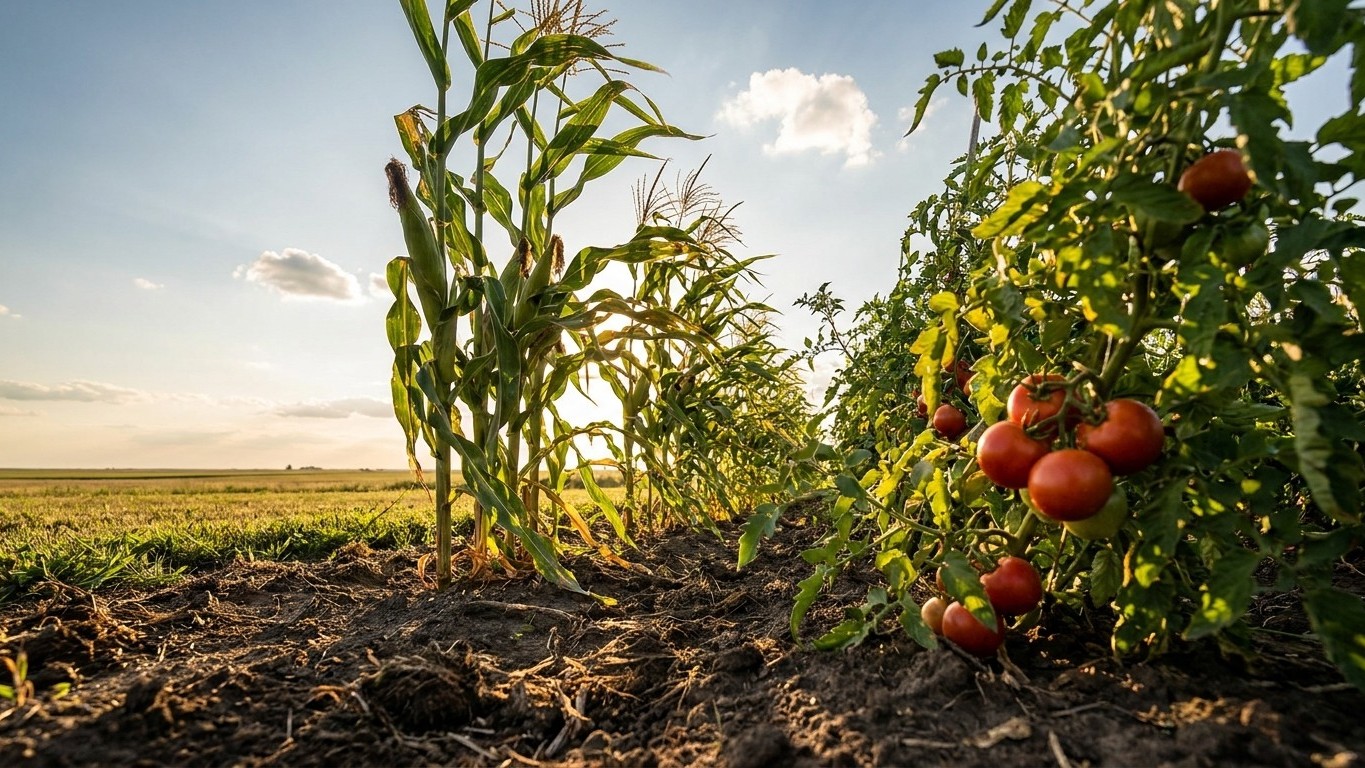

Corn in Tennessee gets eaten from three directions: the seed and seedlings in cool soil, the leaves through the growing months, and the ears from silking until the day you pick. The order follows the calendar. At the Nashville reference station, NOAA NCEI puts the last spring frost between March 31 and April 12 (the 30-70% probability band for a 32 F freeze) and the first fall frost between October 28 and November 8. Every pest problem sits somewhere inside that window.
Which pests attack corn in Tennessee
The University of Tennessee Extension is the service that documents which insects and animals damage garden crops across the state, and its county offices are where those records turn into local advice. Its lists cover everything from orchard insects to turf grubs, so the first job is sorting. Insects that feed on fruit trees, ornamental shrubs or lawn grass drop out for one reason: they live on those plants, and a corn row gives them nothing to eat. What remains falls into four feeding groups, and matching the damage to a group comes before looking up any insect name.
- Seed and seedling feeders: they work below the soil line or at ground level, so the first sign is a gap in the row.
- Leaf and whorl chewers: they leave holes and ragged edges on young and mid-season plants.
- Ear feeders: they enter at the silk or the husk tip and spoil kernels you were about to eat.
- Wildlife: animals and birds that pull sprouts early and raid ears when they sweeten.
Sweet corn is a tempting target in every one of these stages. The kernels carry sugar, the plants grow tall and lush, and a block of corn is a lot of food in one place. Tennessee summers add heat stress on top of that. The Nashville reference station averages 40 days a year at 90 F or more, and a plant stressed by heat and thin water supply tolerates feeding damage worse than a well-watered one.
The groups also overlap in what they leave behind. A missing seedling can be a feeder or a rotted seed. A chewed leaf can be an insect or a hailstorm. The county extension office can name the species once you bring in the plant, and the next section helps you narrow it down first.
When each one shows up, and what it does first
Start with the soil, because it sets the planting date and the planting date sets everything else. Clemson Cooperative Extension (HGIC) says: “Do not plant before the soil temperature at the 4-inch depth is at least 50 ºF. Wait to plant extra-sweet varieties until soil temperatures reach 65 °F.” Fifty degrees is for ordinary sweet corn, 65 degrees for extra-sweet, and the two are not interchangeable. Soil warms well after the last frost date, so a frost-free week in early April does not mean the ground is ready.
Seed and seedling stage
Seed feeders and seed rot look alike. What you see first is a gap: a stretch of row where nothing came up, or a seedling that emerged and then vanished. Dig up one of the bare spots and look at the seed. Seed that went into soil too cold for its type often sits swollen and soft, and that is a different problem from an insect hollowing it out.
Leaf stage
Once seedlings are up and growing, the first sign of a chewer is holes in the leaves, often easiest to spot when a new leaf unrolls from the center. Damage on the oldest leaves only is usually older damage. Fresh holes in the newest growth mean something is feeding now. This stretch runs through the warm months, and in a state with 40 hot days a year it overlaps with the weeks when water stress is also at its worst.
Silking to harvest
Ear feeders arrive with the silks. Look for clipped or chewed silks, a damaged husk tip, or fine debris at the tip of the ear. Wildlife shows up at the same moment, because an ear that is nearly ready is the sweetest thing in the yard. Knocked-over stalks and ears pulled down with the husk torn open are the early signs.
Two separate clocks run in the garden, and they should not be merged. Sixty to ninety days from planting (Utah State University Extension) tells you whether a variety fits before the first fall frost. Watch the silks turn brown and dry to tell you when picking is near. East Tennessee and the Cumberland Plateau run cooler and later in spring than Nashville, so those windows start later there. The guides on when to sow sweet corn in Tennessee and whether sweet corn will ripen in Tennessee work through the planting side.
Telling the damage apart from everything else
Plenty of corn problems have nothing to do with insects. The error that costs the most is treating for a feeder when the cause was water, nutrition, weather or a bad planting. The table lists what each symptom can be and what settles it. A county extension agent can confirm the answer for your own plants.
| What you see | Possible causes | What settles it |
|---|---|---|
| Gaps in the row | Feeding below ground, or seed rotted in cold soil | Dig up a bare spot. Compare the soil temperature at 4 inches with the 50 F and 65 F thresholds. |
| Holes and ragged leaves | Chewing insects, or wind and hail tearing | Tears run in the direction of the leaf veins and look torn, while chewing leaves rounded edges and droppings. |
| Yellow lower leaves | Nutrient shortage | Yellowing that starts at the leaf tip on the oldest leaves and spreads evenly across the row points away from a feeder. |
| Rolled leaves in the afternoon | Water stress | Leaves that open again by morning after watering are reacting to dryness. |
| Poorly filled ear, bare patches | Poor pollination, or ear feeding | Scattered missing kernels with no tunnel suggest pollination. Check how many rows the planting has and whether it was a single row. |
| Husks torn, ears pulled down | Wildlife | Whole ears missing or stalks flattened is not what a small insect does. |
Sweetness problems get blamed on pests too, and they are not pest problems. Utah State University Extension notes that sweetness is lost when su, se and sh2 types tassel at the same time, and that sweet corn belongs in blocks of three or more rows. Starchy kernels on a sweet ear come from the neighbors, not from a feeder.
How do you check corn damage before calling the extension office?
Look at the pattern before the plant. If damage is even across the whole row, think water, nutrition or weather. If it jumps from plant to plant, something is feeding. Note the planting date, the stage of the corn, and take a photo of a fresh leaf and the ear tip. That is all the county agent needs to start.
What actually works here, and what is a waste of time
On a season with a hard stop in late October or early November, timing does more than any product. Plant when the soil is at the right temperature for the type, and seed germinates fast, which leaves less time for anything to eat it. Sow a late planting without checking that it has 60 to 90 days before the first fall frost, and the ears fill in the coolest, slowest weeks of the year.
Physical barriers placed at the right moment beat treatments. A lightweight row cover over seedlings keeps chewers and birds off in the first weeks, but it has to come off before the plants tassel, because corn is wind-pollinated and a covered tassel cannot do its job. Fencing around the block needs to go up before the ears fill, not after the first raid. A planting block of three or more rows improves pollination, which means fuller ears and less confusion between pest damage and poor fill.
Choice of corn type matters at the table. Clemson Cooperative Extension (HGIC) writes: “Sweet corn loses sugar from the kernel rapidly at high temperatures… Sweet corn can be stored under optimal conditions for about five days, but will lose sweetness with each day of storage.” The su type loses sugar fastest, se holds it longer, and sh2 holds it longest. So a damaged ear picked late and left on a warm counter loses on two counts.
What wastes time is spraying on a schedule before anyone has identified a problem, replanting the same type into cold soil, and trying home remedies that never touch the feeding stage. Which products are labeled for corn in Tennessee changes, and the county extension office knows what is currently legal and how it is used.
Where to check this for your own county
Pest pressure in Tennessee changes from one county to the next. What the University of Tennessee Extension documents across the state does not tell you what is in a given garden. The Cumberland Plateau and East Tennessee warm up later than the Nashville area, and a neighbor two valleys over can be dealing with a different problem on a different week. Soil type, nearby fields, woodlots and the previous crop all shift the picture.
Your county’s University of Tennessee Extension office handles exactly this. Agents there can identify an insect from a photo or a sample, tell you what is active locally this month, and name the control options that are currently labeled. Bring the planting date, the corn type if you know it, and a sample of both damaged and healthy tissue.
The main guide to growing sweet corn in Tennessee covers the rest of the season. For the pest question, take one damaged plant and one photo of the ear tip to the county office before spending money on anything.
Common questions
When should I plant sweet corn to avoid losing seed?
Wait for the soil, not the calendar. Clemson Cooperative Extension (HGIC) says not to plant before the soil at the 4-inch depth is at least 50 ºF, and to wait for 65 °F for extra-sweet varieties.
Does the first fall frost matter for pests?
It matters for the crop. The first fall frost at the Nashville reference station falls between October 28 and November 8, and the corn needs 60 to 90 days from planting to finish before then.
How do I know when an ear is ready to pick?
Use three signs together: dry brown silks, husks still moist and green, and milky juice when you puncture a kernel. The window is told by the silks turning brown and dry.
How long can I keep picked sweet corn?
Clemson says sweet corn can be stored under optimal conditions for about five days but loses sweetness with each day. That is a maximum, and heat speeds the loss.