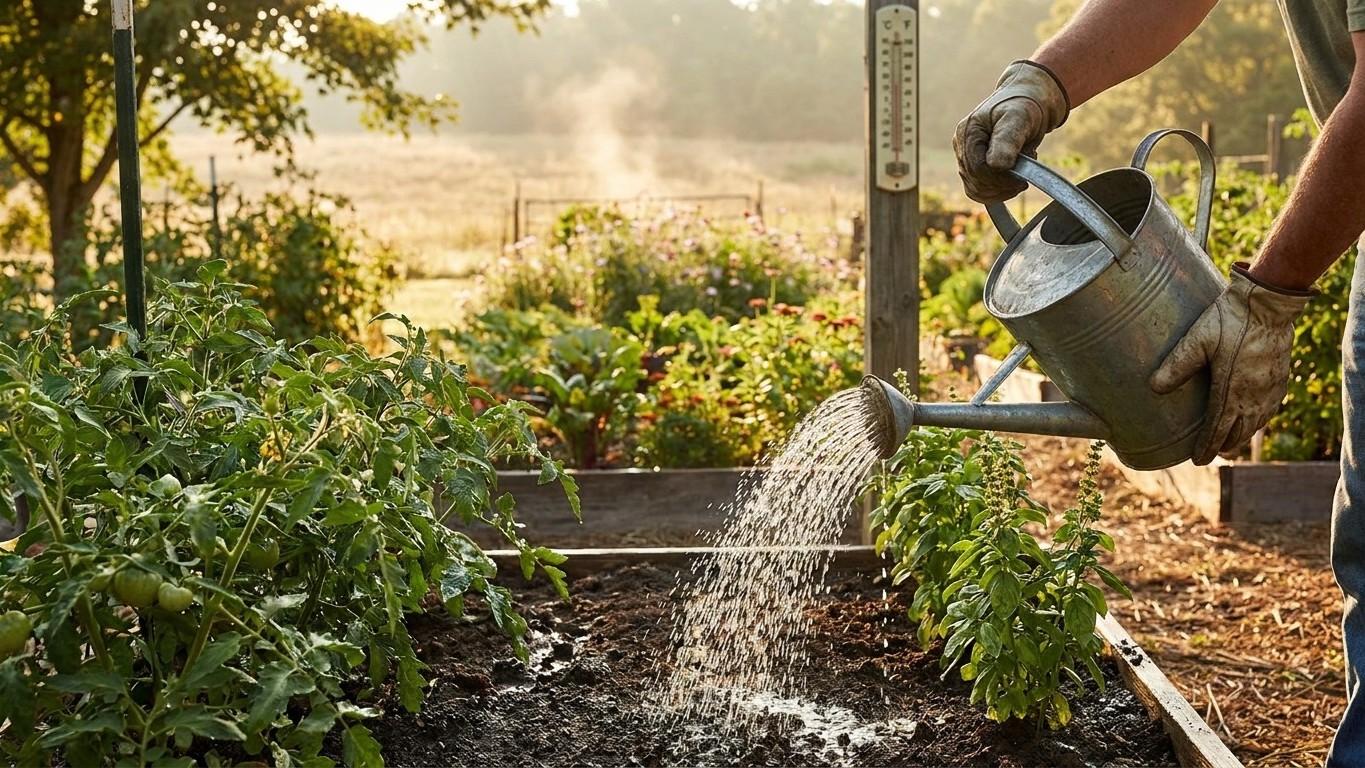

Tennessee gardens live and die by heat, not by drought maps. With 40 days a year hitting 90F or higher and a growing season that starts as early as March 31 in Nashville, the real question isn’t whether to water, it’s how to keep roots cool and deep-fed through a Southern summer without drowning them the rest of the year.
What the climate asks of you

Two figures decide everything for a Tennessee gardener: 40 days a year reach 90F or higher, and the frost-free window runs from around March 31 to April 12 at one end, and October 28 to November 8 at the other, based on the Nashville reference station. That’s a long, hot growing season with real stretches of heat stress in the middle of it, which is exactly when a garden bed needs the most consistent moisture and gets the least mercy from the sky.
Forty days above 90F doesn’t sound like much until you picture it: that’s close to six full weeks scattered through June, July, and August where soil moisture evaporates fast and plants pull water from the ground faster than they normally would. Tennessee summers don’t deliver rain evenly. Storms tend to arrive in bursts, dumping heavily in one week and skipping the next, which means a garden can look fine after a downpour and be bone-dry four days later when the next front stalls somewhere else. That unevenness is the real enemy, more than any single dry month.
Soil changes the math
Tennessee ground isn’t uniform. Middle Tennessee sits on limestone bedrock with heavy clay soils that hold water for days after a storm, sometimes too well. West Tennessee, closer to the Mississippi, tends toward looser, sandier ground that drains fast and dries out just as quick. East Tennessee and the Cumberland Plateau run cooler and wetter later into spring, which shifts the whole watering calendar back by a week or two compared to Nashville. A clay-heavy bed in Middle Tennessee might coast for a week on stored moisture. A sandy bed in the west could need attention every couple of days during a hot stretch, even after decent rain. Knowing which kind of ground you’re standing on matters more here than almost anywhere else in the region, because the difference between clay and sand changes not just how much water to give, but how often you should even be checking.
How much, how often
The rule that holds up across almost every Tennessee yard is deep and infrequent, not shallow and daily. A quick sprinkle every evening feels productive but trains roots to stay near the surface, right where the top inch of soil bakes hard during those 90F days. Deep watering pushes roots down into cooler, more stable soil that doesn’t swing from soaked to bone-dry in an afternoon.
The trick is knowing when the soil actually needs it rather than watering on a fixed schedule, and this same logic applies to Watering Pots and Containers in Tennessee, where soil volume is smaller and moisture swings happen even faster than in a ground bed.n watering on a fixed schedule, which is the whole idea behind Watering Through a Dry Spell in Tennessee. Push a finger, or better, a trowel, about two inches into the bed. If it’s dry at that depth, water. If it’s still damp, wait. This single check saves more water and more plants than any timer ever will, especially on clay ground where the surface can look dry while the root zone below is still holding plenty.
- Check soil moisture two inches down with a finger or trowel before turning on any hose or system, rather than watering on a set calendar.
- Water early in the morning, before the heat of the day sets in, so moisture soaks in instead of evaporating off the surface within the hour.
- Aim water at the base of each plant, never over the leaves, since wet foliage overnight invites fungal problems in Tennessee’s humid summers.
- On sandy ground in West Tennessee, give shorter, more frequent soakings, since the soil holds little reserve and dries out within a couple of days during a 90F stretch.
- On heavy clay in Middle Tennessee, water less often but more deeply, and never work or soak the bed while it’s still wet from a prior rain, since compacted, waterlogged clay suffocates roots.
- During the hottest weeks, when 90F days cluster together, check the two-inch test every other day rather than assuming last week’s rain is still doing the job.
None of this is guesswork once the finger test becomes a habit. The frequency should track the heat, not the calendar. A cool stretch in early June asks for less than a run of 90F afternoons in late July, and Tennessee’s summer rarely stays consistent for more than a week or two at a time.
Restrictions and rules
Watering restrictions aren’t universal across Tennessee, but they do show up, particularly during extended dry spells when local reservoirs or wells run low. Rules vary by utility and by county, and they change from year to year depending on conditions, so there’s no single statewide answer that holds for every yard.
Given how unevenly Tennessee summer rain falls, and how quickly a dry stretch during a run of 90F days can strain a local water system, checking with your water provider before setting up an irrigation schedule is worth the five minutes it takes. Some utilities post odd-even watering days by address during drought advisories, others cap outdoor watering hours, and some have no formal restrictions at all outside of a severe drought declaration. The University of Tennessee Extension Service and your local water utility are the two places to confirm what applies to your address this season, rather than relying on a rule that might have applied last summer or in a different county.
Using less
Cutting water use in a Tennessee garden isn’t about watering less overall, it’s about making the water that does go down count for more. A few techniques do most of the heavy lifting, and they work together rather than as alternatives.
- Mulch: a two to three inch layer over beds slows evaporation dramatically, which matters most during the 40 or so days a year when temperatures push past 90F and bare soil dries out within hours of watering.
- Drip irrigation: delivers water straight to the root zone instead of spraying it across the whole bed, cutting evaporation loss and keeping foliage dry, which also helps against the fungal issues that thrive in Tennessee humidity.
- Grouping plants by water need: putting thirsty vegetables together and drought-tolerant perennials elsewhere means you’re not overwatering the tough plants just to keep the thirsty ones alive.
- Organic matter in the soil: compost worked into clay improves drainage, while the same compost worked into sandy soil in West Tennessee helps it hold moisture longer between waterings.
- Rain barrels: an inch of rain falling on a thousand square feet of roof works out to roughly 600 gallons of runoff. In a wet week during a Middle Tennessee thunderstorm, that barrel fills fast. During one of those 90F dry stretches with no rain in the forecast, it sits empty, so a barrel helps most as a supplement between storms rather than as a sole water source through a long dry spell.
Where local rules allow it, rain barrels are worth setting up regardless, since Tennessee’s storm pattern of heavy bursts followed by dry gaps is almost exactly the scenario they’re built for: capture the excess when it falls, use it during the days that follow.
Common questions
How often should I water a vegetable garden in Tennessee during summer?
Check soil moisture two inches down every other day once temperatures start hitting 90F regularly, and water deeply only when that depth is dry. During cooler stretches, once a week may be enough, especially on clay soil that holds moisture longer.
Does East Tennessee need less watering than Middle or West Tennessee?
East Tennessee and the Cumberland Plateau run cooler and stay wetter later into spring, which can shift watering needs back by a week or two compared to Nashville, but summer heat still dries beds out fast once the season is in full swing.
What USDA zone is Tennessee in for planting decisions?
Tennessee spans USDA zones 5b through 8a, a wide range across the state. Use your specific location rather than a statewide average, since a plant that thrives in Memphis (closer to 8a) may struggle in the higher elevations of East Tennessee (closer to 5b).
Where can I find current watering restrictions for my area?
Contact your local water utility directly, since restrictions vary by county and change with drought conditions. The UT Extension Service can also point you toward resources specific to your county.