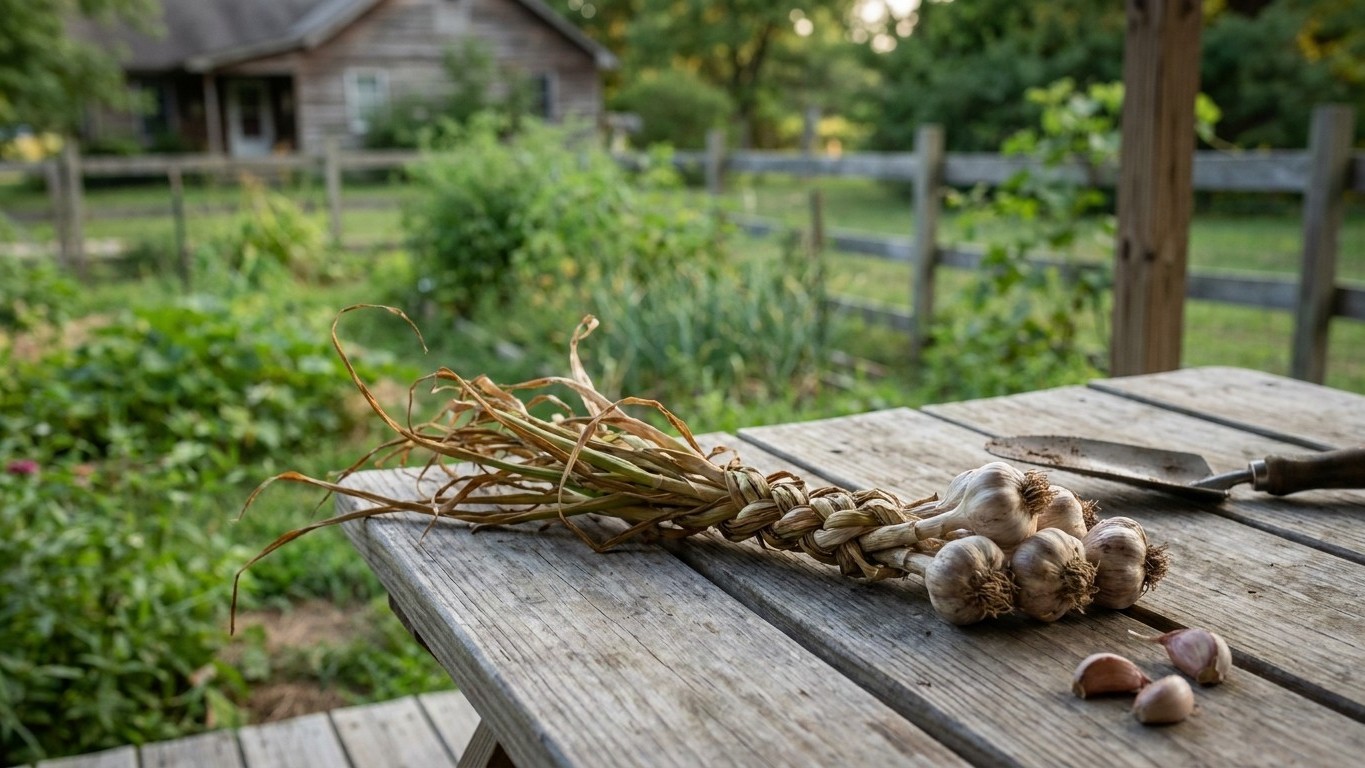

In most of Texas, garlic bulbs come out of the ground between late May and late June, once the lower leaves have browned back but four or five green ones remain up top. The real work starts after that: curing this crop right, in a state where June humidity and July heat both work against you, is what decides whether it lasts to spring or turns to mush in the mesh bag.
When garlic is ready to lift in Texas
Garlic grown in Texas gardens goes into the ground in autumn and comes out the following summer, a nine-month cycle that starts with a fall planting date tied to the first freeze. At Houston’s Bush Intercontinental station (USW00012960), NOAA’s 1991-2020 Climate Normals put the first fall freeze, the date when 32°F is reached with 30-70% probability, somewhere between December 1 and December 19. That’s a midpoint, not a guarantee: in roughly one year out of two, the actual freeze lands later than that window, sometimes well into January.
Texas spans four USDA hardiness zones, and the Houston window above describes the mild Gulf end of the state only. The Panhandle freezes months earlier in fall and stays cold months longer into spring. Hill Country and North Texas sit somewhere in between. Even within the Houston metro, Hobby airport tends to run about two weeks milder than IAH. None of these figures should be read as a statewide planting calendar; a gardener in Amarillo and a gardener in Corpus Christi are working from entirely different clocks.
Reading the plant instead of the calendar
Because fall planting dates shift so much across the state, harvest timing shifts with them. The more reliable signal is the plant itself. Once roughly 40 to 50 percent of the leaves, starting from the bottom, have gone brown or yellow while the upper leaves stay green, the bulb has usually finished sizing up. Pull one test bulb and check it: the cloves should fill out and separate cleanly under a taut skin. Wait too long past that point and the wrappers split, leaving bulbs that won’t cure or store well. Texas summer heat accelerates this last stage compared to cooler-climate garlic regions, so bulbs can go from “almost ready” to “overdue” in less than a week once real heat sets in.
Lift bulbs by loosening the soil with a fork rather than pulling by the neck, which tears the stem plate and shortens storage life. Do this on a dry day if you can manage it. Wet soil clinging to freshly dug bulbs is the first thing working against a clean cure.
Curing it, and where to hang it here
Curing is nothing more than slow, even drying with the wrappers still on, and it typically takes three to four weeks. What makes it tricky in Texas isn’t the concept, it’s the climate. Direct sun on a hot Texas afternoon can scorch bulbs or cook them from the outside in, while the humidity along the Gulf Coast slows drying enough to invite mold before the inner layers finish curing.
The fix is shade with airflow, not sun with none. A garage with the door cracked, a covered porch, a carport, or a barn all work, as long as air moves through and direct light doesn’t hit the bulbs. Bundling stems in small bunches of six to eight and hanging them, or laying bulbs in a single layer on a screen or slatted rack, both let air circulate around every bulb instead of just the top layer. A box fan on low, aimed across the bulbs rather than straight at them, helps enormously in humid stretches.
Curing conditions vary a lot within the state
| Region | Typical challenge | Practical adjustment |
|---|---|---|
| Gulf Coast / Houston area | High humidity slows drying, raises mold risk | Fan-forced airflow, dehumidified space if available |
| North Texas / Hill Country | Hot afternoons, more variable humidity | Shade all day, not just midday |
| Panhandle / West Texas | Lower humidity, drier air | Curing is usually easier and faster |
Garlic is ready to move to storage once the outer wrappers are papery and dry, the necks are tight, and the roots have shriveled. At that point, trim the roots down close to the bulb and cut stems to an inch or two if you’re not braiding, or leave them long if you’re keeping the traditional braid. Brush off loose dirt, but skip washing bulbs before storage; added moisture at this stage undoes weeks of careful drying.
Storing it through a Texas winter
A Texas winter isn’t a hard obstacle for stored garlic the way a Texas summer is, but the state’s mild, humid stretches still work against long storage more than a drier, colder climate would. Garlic keeps best somewhere cool, dark, and dry, with some airflow, roughly a pantry shelf, a closet on an exterior wall, or a garage that doesn’t flood into summer heat once spring arrives again.
The kitchen counter is usually the worst spot in the house for it. Kitchens run warm and humid from cooking, and both conditions push bulbs toward early sprouting or soft rot. A closed plastic bag or airtight container does the same kind of damage by trapping moisture against the skins. Mesh bags, paper bags with a few holes, or open baskets let bulbs breathe while still keeping light off them.
Given how much the state’s climate varies, the “winter” part of storage plays out differently depending on where you garden. In the Panhandle, a genuinely cold, dry winter mostly does gardeners a favor: bulbs stored in an unheated but frost-free space stay dormant and firm. Along the Gulf Coast, winter humidity swings can be higher, and mild spells arrive on and off all season, both of which nudge bulbs toward earlier sprouting than a cellar in a colder, drier state would allow. There’s no published figure here for exactly how many weeks that difference amounts to, so it’s worth checking bulbs every few weeks rather than assuming a fixed shelf life.
Softneck types, which are generally the better performers in Texas heat, also tend to store longer than hardneck types once cured properly, sometimes keeping six months or more under good conditions. Set aside your best, largest, firmest bulbs as seed stock for the next fall planting before you start working through the rest for the kitchen.
What goes wrong here
Most garlic failures in Texas trace back to timing and moisture rather than disease. Curing bulbs in full sun on a covered patio that actually gets afternoon glare is a common one; the bulbs look fine on the outside and turn soft or discolored on the inside a month later. Storing damp bulbs in a sealed container is another, since trapped humidity turns a good harvest into a moldy one within weeks.
On the pest side, Texas A&M AgriLife Extension documents several insects and pests relevant to home vegetable growers in this territory, including root-knot nematodes, fire ants, spider mites, and melon aphid along with other aphid species. Root-knot nematodes in particular can affect bulb crops below ground, causing stunted or misshapen bulbs even when the top growth looks reasonable, so a bed with a known nematode history is worth rotating out of garlic for a season. Fire ant mounds near a garlic bed are more of a harvesting nuisance and safety issue than a threat to the bulbs themselves, but they’re common enough in Texas soil to plan around.
Beyond pests, the single biggest state-specific mistake is treating a Southern-climate crop like it follows a Northern-climate calendar. Frost date guidance built around a single Houston station doesn’t transfer to the Panhandle or even to a garden fifteen miles inland from the coast. For planting windows, soil prep, and variety choices suited to a specific county, Texas A&M AgriLife Extension keeps a local office directory at agrilifeextension.tamu.edu, and that’s a more reliable starting point than any single statewide date.
Common questions
How long does cured garlic keep in Texas storage?
Softneck varieties, which tend to do better in Texas heat than hardneck types, can keep six months or longer once properly cured, provided they’re stored cool, dark, and dry. No figure beyond that general range is published for this territory here.
Can I speed up curing with a fan or dehydrator?
A fan aimed across bulbs to move air, rather than blasting them directly, is a reasonable way to counter Gulf Coast humidity during curing. Using a food dehydrator or applying direct heat isn’t the same process and risks cooking the cloves rather than slow-drying the wrappers.
Why did some of my bulbs sprout early in storage?
Early sprouting usually points to warmth and humidity in the storage spot, a mild spell during a Gulf Coast winter, or bulbs that went into storage slightly under-cured. Moving stock to the coolest, driest space available and checking it every few weeks catches the problem before it spreads through the whole batch.
Does the same harvest timing apply across all of Texas?
No. Because fall planting dates shift by weeks to months across the state’s four USDA zones, from the Panhandle to the Gulf Coast, summer harvest timing shifts with them. Watching the plant’s leaves for the 40 to 50 percent browning signal is a more reliable guide than any single calendar date.