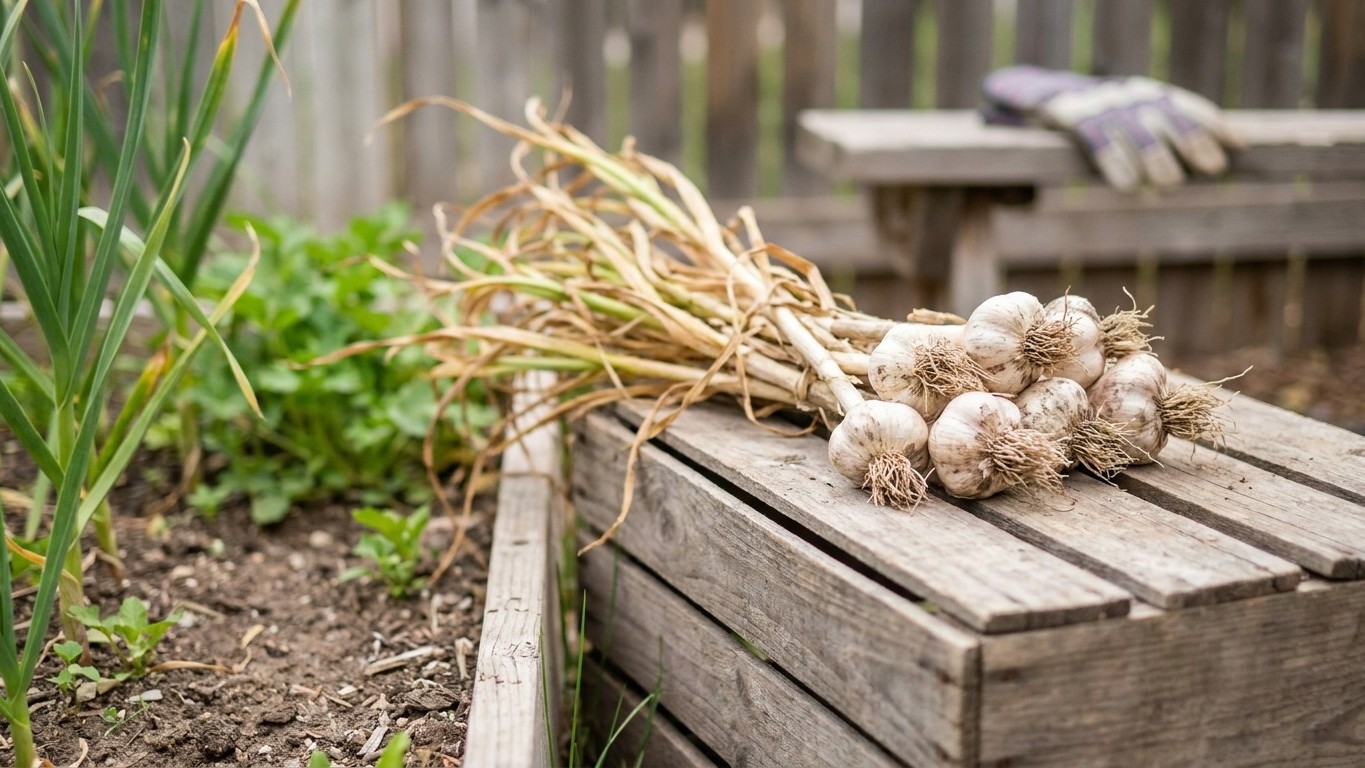

Late September into early October is when garlic cloves go into Utah ground. That window comes from counting three to four weeks back off the Salt Lake City area’s first fall freeze, which typically lands between October 18 and October 29. Varieties like Inchelium Red, Duganski, and German White all key off that same math. Plant early in the window and you lose nothing; wait too long and a hard freeze can catch cloves before they’ve rooted.
The short answer for Utah

Set garlic cloves into the ground in late September to early October. That window is anchored to the first fall freeze recorded at the Salt Lake City station, which NOAA’s National Centers for Environmental Information (NCEI) puts at October 18 to October 29 in its 1991-2020 Climate Normals, the range in which a 32°F freeze is recorded with 30 to 70 percent probability. Count back three to four weeks from that range and you land in the same late-September-to-early-October stretch that seed sources list as the set-out window for the varieties sold into this climate, among them Inchelium Red, Duganski and German White.
The frost date is a midpoint, not a guarantee
In roughly half the years on record, the first freeze at that station falls after October 29. In the other half, it falls before October 18. Planting to the early side of the window costs you nothing. Planting to the late side of it, betting on a mild autumn, means a hard freeze can catch cloves before they have grown roots, and a clove with no root system going into winter is a clove that rots or heaves out of the soil rather than one that sprouts in spring.
Utah’s cold is not the limiting factor
University of Georgia Extension publication C854 sets garlic’s chilling requirement at six to eight weeks with soil temperatures below 40°F, the period needed to split a single clove into the multiple cloves of a mature bulb. Utah winters clear that mark with room to spare, averaging 26.1 weeks below that threshold. The real constraint is root establishment before the ground locks up, which is exactly what the late-September-to-early-October window is built to protect.
Working it out for your own garden
Utah is not one climate, and the date above belongs to one station in one valley. Redo the arithmetic for your own address rather than borrowing the Salt Lake City figure outright, because elevation is the single biggest lever on when your first freeze actually arrives. Add several hundred feet and you are typically looking at an earlier freeze than the valley floor station records.
The arithmetic, step by step
| Step | What it uses | Example using the Salt Lake City figures |
|---|---|---|
| Find your first fall freeze | NOAA’s NCEI 1991-2020 Climate Normals for the nearest long-record station | October 18 to October 29 |
| Count back three to four weeks | The rooting period cloves need before top growth stalls for winter | Late September to early October |
| Check it against catalog figures | The set-out range printed for the cultivar | Matches the late-September-to-early-October range listed for the softneck and hardneck types sold into this state |
A large body of water works the opposite direction from elevation. The Great Salt Lake holds heat into the evening long after the surrounding benches have cooled, which is part of why the reference station near it logs a later average freeze than higher ground nearby. If your garden sits on a bench above the valley floor rather than down near the lake itself, treat the October 18 to October 29 window as a starting point and lean toward the earlier end of the late-September-to-early-October planting range rather than the later end.
None of this arithmetic tells you which cultivar to plant, only when. That decision, covered in Garlic Varieties That Suit Utah Winters, matters more the further your garden sits from the Salt Lake City benchmark, since a variety suited to a milder winter is not the one you want on a cold bench above the valley floor.
What changes across Utah
The Salt Lake City freeze window describes one valley, and Utah runs from low desert to alpine bench inside a single day’s drive. Higher, colder ground pushes the whole calendar earlier, and lower, warmer ground pushes it later, sometimes by weeks rather than days.
Where the date shifts and why
- Northern high valleys and mountain benches (Cache Valley, the Bear Lake basin, the upper benches above Ogden and Logan) sit higher than the Salt Lake City station and pool cold air on clear nights, so the first freeze there typically arrives ahead of the benchmark date. Gardeners in these districts should plant to the earlier end of the late-September window and lean toward hardneck types such as German White, Georgian Crystal and Fall Festival, the more cold-hardy of the two garlic groups.
- The Salt Lake Valley and the immediate Wasatch Front benches, the districts closest to the reference station itself, get some moderation from the Great Salt Lake and generally track the October 18 to October 29 window most closely.
- Southern Utah, the St. George and Dixie corridor, sits at much lower elevation and runs warmer through the growing season, so the first freeze there tends to land later than the Salt Lake City figure, giving gardeners a wider range of softneck types to choose from, including Lorz Italian and Italian Late.
None of these are numbers pulled from an actual southern Utah or Cache Valley weather station. NOAA’s normals for those specific stations will differ from the Salt Lake City figures, sometimes considerably, which is exactly why checking your own county matters more than a single benchmark date.
The mistakes this climate punishes
Two mistakes account for most of the failed garlic beds in this state, and a third has nothing to do with cold at all.
Planting too late for roots to form
Gardeners who plant in late October, betting on the late end of the freeze window, sometimes get away with it. In the years when the first freeze lands on October 18 rather than October 29, though, cloves planted that late go into winter with no root system at all. A clove without roots before hard freeze is a clove that heaves out of the soil or rots rather than one that sprouts in spring. There is no fix for this once the ground is frozen solid. The only correction is planting earlier the following year.
Matching the wrong type of garlic to a cold bench
Softneck types such as Early Red Italian and Italian Late are the ones sold for storage and braiding, and they are also the less cold-hardy of the two groups. Planted on a high bench in Cache Valley or above Logan, where the freeze arrives ahead of the Salt Lake City date, a softneck can take winter damage that a hardneck sailing through the same night would not. On cold ground, the closed list of cultivars sold into this state leans toward hardnecks for exactly this reason, among them Duganski, Georgian Fire and Ivan.
Planting infected stock into a favorable window
September and October, the same months this article recommends for planting, are also two of the five months in which the mean air temperature at this reference station falls inside the 50 to 75°F range the UC IPM Pest Management Guidelines for Onion and Garlic (UC ANR Publication 3453) list as favorable to white rot, caused by the fungus Sclerotium cepivorum. That figure describes air temperature, not the soil temperature the published range was built around, and soil lags air and swings less, so it is not a direct forecast of disease in any given garden. It is also just one station’s average, not a statewide reading. What it does mean is that Utah’s autumn planting window offers this pathogen no climatic reason to fail, so the actual defense is starting with certified disease-free seed garlic and rotating out of ground where onions or garlic have grown recently, rather than counting on the climate to do that work.
Checking this against your county
The Salt Lake City figures in this article come from one NOAA station, and Utah’s counties span low desert to alpine bench well outside that station’s reach. USU Extension maintains county-level offices with local growing information, and calling your county’s office before committing to a planting date is worth doing, especially if your garden sits well above or below the Salt Lake Valley floor. If you have not yet worked out the rest of the garlic timeline, from bed prep through the following summer’s harvest, the full rundown on Growing Garlic in Utah covers the remaining steps.
Common questions
What happens if I miss the fall planting window entirely?
Planting after your local frost window closes gives cloves less time to grow roots before winter dormancy sets in, and bulbs from late-planted cloves tend to come up smaller the following summer. A heavy mulch layer right after planting is the best partial fix, though it will not fully replace the missing weeks of root growth.
Is it bad to Plant Garlic too early, like the start of September?
Planting several weeks ahead of the late-September start risks green shoots pushing up above ground before winter sets in. That is not usually fatal to the plant, but it exposes leaf tips to frost damage and spends stored energy that the clove would otherwise put into roots. Waiting until nearer the recommended window puts that energy where it does the most good.
Do I need to separate the bulb into individual cloves before planting?
Yes. Break the bulb apart just before planting, keep the papery skin on each clove, and set them pointy end up. Cloves planted whole-bulb or without separating rarely sprout evenly.
My county’s frost date isn’t the same as the Salt Lake City one in this article. Now what?
It probably isn’t, and the difference matters most if you garden well above or below the valley floor. Even within a single county, a plot against a heat-holding wall or pavement can run warm enough to shift your practical planting date by a week or more compared to an open field a mile away, so treat any county-level figure as another starting point rather than a final answer.
Some gardeners also time this by the Moon: when to plant garlic by the moon, as almanac tradition rather than fact.