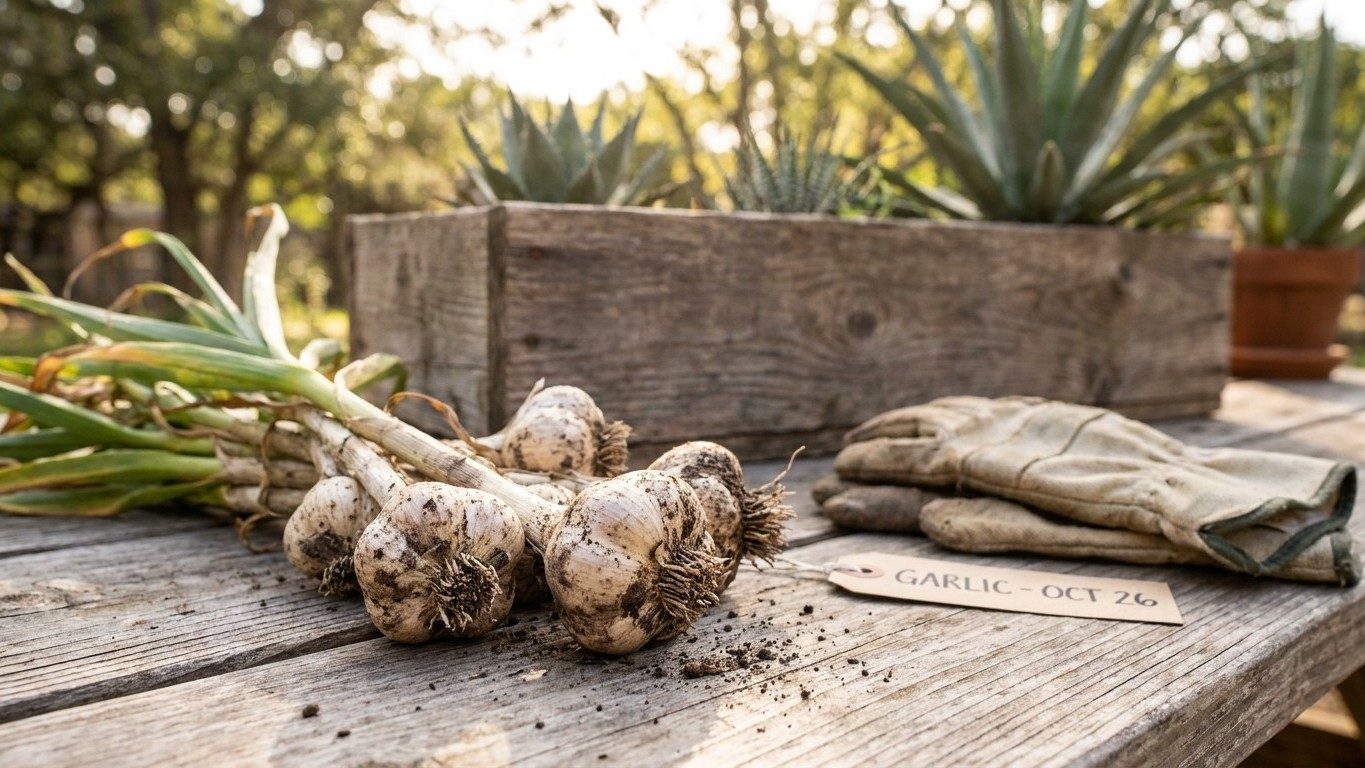

Zero weeks. That’s how much of a Houston winter dips below 40°F under the current climate normals, and it matters because garlic can’t skip that cold and still split into cloves. Six to eight weeks below that mark is what a hardneck bulb needs to divide instead of forming one onion-like round. Amarillo clears it easily. Houston doesn’t come close — and Texas is too wide a state for one answer to cover the Panhandle and the Gulf Coast alike.
Will garlic get the cold it needs in Texas

Garlic is unusual among bulb crops because it needs cold, not warmth, to turn one clove into a head of many. A period of chilling after planting triggers the plant to divide its growing point into the separate cloves you expect at harvest. Skip that chilling and you lift a single round, onion-like bulb instead, edible but not what you planted for.
At Houston, the station NOAA’s National Centers for Environmental Information uses for this part of the Gulf Coast, the 1991-2020 climate normals show 0.0 weeks of the growing season with air temperatures below 40°F. University of Georgia Extension publication C854 puts garlic’s chilling requirement at six to eight weeks below that mark. Houston does not clear it. Not close. Compare that to a colder state like Utah, where winter reliably supplies those chill hours and hardneck garlic goes into the ground with no pretreatment at all.
This is a Houston-area figure, not a Texas one. Texas spans four USDA hardiness zones, and the Panhandle freezes months earlier and colder than the Gulf Coast, while Hill Country and North Texas sit somewhere between the two extremes. Checking When to Plant Garlic in Texas by region is a useful first step, since a grower in Amarillo or Lubbock is very likely to see enough cold hours for hardneck garlic to divide normally, while a grower in Houston, Corpus Christi, or the Rio Grande Valley almost certainly will not, and even within the Houston area, Hobby Airport runs about two weeks milder than the Bush Intercontinental station used here.
Two options work around the shortfall in mild parts of the state. The first is pre-chilling the seed cloves in a refrigerator, separated but not peeled, for six to eight weeks before planting, mimicking the winter the ground will not supply. Keep them away from apples and other ethylene-producing fruit while they chill, since that gas can trigger premature sprouting. The second, simpler option is to plant a softneck variety, and checking Garlic Varieties That Suit Texas Winters is a good place to start. Softnecks evolved in warmer parts of the world and divide reliably with far less chilling than hardnecks demand, which is exactly why they dominate commercial garlic production in California’s Central Valley.
Neither option is a consolation prize. Gulf Coast growers who pre-chill hardneck stock, or who simply plant softneck varieties bred for the job, get a full head of cloves most years. What does not work is planting untreated hardneck seed and hoping the winter cooperates. It generally will not, at least not on the coastal plain.
When to put the cloves in
Garlic wants time to grow roots before the ground turns cold but not so much warmth that it pushes a lot of leaf growth, since a plant that grows tall too fast is a plant that gets stung when a real freeze arrives. The catalog planting window for every variety in this territory, from Inchelium Red to German White, is early November to late November, and that window is built around Houston’s frost timing.
NOAA’s 1991-2020 climate normals put Houston’s first fall freeze at 32°F somewhere between December 1 and December 19, a window with a midpoint of roughly the second week of December. Planting in the second half of November, a few weeks ahead of that midpoint, gives the clove enough time to root into the soil before any hard cold arrives, without pushing enough top growth to expose new leaves to frost damage.
That window shifts around the state. Coastal counties close to the Gulf, and any site with a large body of water nearby, buffer against early cold and can push planting a bit later. Higher ground inland, and any site further from the moderating effect of water, tends to cool faster in the fall and rewards planting a little earlier within that same November window. Elevation matters too: a garden on a rise drains cold air away overnight, while a low spot collects it and frosts first.
Houston’s own frost timing is not uniform. Hobby Airport, closer to the coast, runs about two weeks milder than the Bush Intercontinental station NOAA uses for this figure, and a garden anywhere between the two will land somewhere in that gap. Treat the November planting window as a starting point, watch the extended forecast for your own address as the month closes, and get cloves into the ground before a hard cold snap arrives, not during one.
Which types suit Texas
Softneck and hardneck garlic are not simply two flavors of the same crop, they are two different responses to winter. Hardneck varieties evolved in genuinely cold climates and produce a hard central stalk, or scape, along with generally larger and more strongly flavored cloves. They also demand a real cold season to divide properly, the same six to eight weeks below 40°F that Houston’s climate does not reliably provide, per NOAA’s normals and University of Georgia Extension’s C854 threshold. Softneck varieties evolved in milder regions, skip the central stalk, braid easily, and divide well with far less chilling.
On the Gulf Coast, softneck is the reliable default. Early Red Italian, Italian Late, Lorz Italian, and Inchelium Red all set out early November to late November here and all tolerate a mild winter without special handling. Inchelium Red in particular is known for large bulbs and a milder flavor than most hardnecks, and it also stores longer in the pantry than any hardneck variety will, an advantage that matters more in a state where garlic often needs to hold through a hot summer.
Hardneck varieties are not off the table, but they need help. Bavarian Purple, Blue Music, Chesnok Red, Duganski, Fall Festival, Georgian Crystal, Georgian Fire, German Red, German White, and Ivan all carry the same early November to late November window on the label, but on the coastal plain that label assumes a winter colder than the one Houston actually delivers. Pre-chilling the cloves for six to eight weeks before planting, as described above, is what makes these varieties viable this far south. Gardeners in Maryland, by contrast, plant the same hardneck stock straight into the ground, because their winters do the vernalizing without any help from a refrigerator.
| Variety | Type | Set-out window |
|---|---|---|
| Early Red Italian | Softneck | Early Nov to late Nov |
| Inchelium Red | Softneck | Early Nov to late Nov |
| Italian Late | Softneck | Early Nov to late Nov |
| Lorz Italian | Softneck | Early Nov to late Nov |
| Bavarian Purple | Hardneck | Early Nov to late Nov |
| Blue Music | Hardneck | Early Nov to late Nov |
| Chesnok Red | Hardneck | Early Nov to late Nov |
| Duganski | Hardneck | Early Nov to late Nov |
| Fall Festival | Hardneck | Early Nov to late Nov |
| Georgian Crystal | Hardneck | Early Nov to late Nov |
| Georgian Fire | Hardneck | Early Nov to late Nov |
| German Red | Hardneck | Early Nov to late Nov |
| German White | Hardneck | Early Nov to late Nov |
| Ivan | Hardneck | Early Nov to late Nov |
Soil and bed preparation
Garlic sits in the same patch of ground for seven to nine months, through whatever rain the Gulf Coast delivers over a Texas winter and spring, so the single most important prep step is drainage. A raised bed or a mounded row beats a flat bed on heavy clay soil every time, because standing water around a clove rots it out long before any fungus or cold gets the chance. If your garden holds a puddle for more than a few hours after a hard rain, raise the bed by at least a hand’s width before you plant, using compost and coarse material worked into the top layer rather than just piled on top.
Work compost or well-rotted manure into the bed a few weeks ahead of planting, not the same day, so it has time to settle and start feeding the soil biology rather than sitting as a raw layer around the clove. Garlic is a heavy feeder over its long season, and Gulf Coast soils, whether sandy near the coast or heavy clay further inland, both benefit from that organic matter, for opposite reasons: sand needs it for water and nutrient retention, clay needs it for structure and drainage.
Check your soil pH before you commit a bed to seven months of garlic. Most sources put garlic’s preferred range on the slightly acidic to neutral side, and a simple soil test through your county extension office will tell you where your bed stands and what, if anything, to add. Avoid a bed that grew onions, garlic, or other alliums in the last two to three years, since that rotation gap is what keeps soil-borne problems like white rot and basal rot from building up in one spot season after season, a concern covered in more detail below.
What the climate here favours, and what it does not
UC IPM Pest Management Guidelines for Onion and Garlic, UC ANR Publication 3453, publishes the temperature ranges in which four common garlic diseases are active. Those thresholds are measured as soil temperature, not air temperature, and soil lags behind air and swings less over the course of a day, so what follows is a tendency built from monthly average air temperatures, not a soil reading and not a diagnosis.
Fusarium basal rot and white rot
Fusarium oxysporum f. sp. cepae, the fungus behind basal rot, has a published range of 59 to 90°F. On the Gulf Coast reference station used for this territory, the mean air temperature falls inside that range in eight months of the growing season, September through November and again March through July, with one of those months landing at the pathogen’s published optimum. That is most of the garlic-growing calendar sitting inside the range where basal rot can be active, which is exactly why the drainage and rotation steps above matter as much as they do.
White rot, caused by Sclerotium cepivorum, has a narrower published range of 50 to 75°F, and the mean air temperature here falls inside it for seven months, October through April, including two months at the pathogen’s optimum. That window lines up closely with the entire period garlic spends in the ground on the Gulf Coast, from planting through the coldest part of winter.
Pink root and southern blight
Pink root, caused by Setophoma terrestris, has a published optimum of 75 to 85°F, and the mean air temperature here sits inside that optimum for four months: September, and May through July, which brackets the front and back ends of the garlic season rather than the middle. Southern blight, caused by Sclerotium rolfsii, has a published optimum of 86 to 95°F, and no month of the growing season reaches a mean air temperature inside that range at this reference station. That does not mean southern blight cannot show up. It means the climate here runs cooler than the pathogen’s preferred range most of the year, and infected planting stock can still bring the disease in regardless of what the thermometer says.
Getting it through the winter
A layer of mulch protects the clove less from the cold on the Gulf Coast than it does inland or upstate, since Houston’s winter rarely delivers the hard, repeated freezes that heave shallow-planted cloves out of the ground. Even so, mulch is not optional here. Straw, shredded leaves, or pine straw laid three to four inches deep over the row does the real work of holding soil moisture steady and suppressing winter weeds through a season that still gets plenty of rain between cold fronts.
Plant each clove root-down, pointed end up, with the tip roughly two inches below the soil surface. A clove planted too shallow is the one that heaves when the soil freezes and thaws in the same week, a bigger risk in North Texas and the Panhandle than on the coastal plain, but cheap insurance everywhere. If you do see a clove pushed partway out of the ground after a cold snap, press it back down and add a bit more mulch rather than replanting it.
Pull the mulch back gradually in late winter as new green growth pushes through, rather than stripping it off in one go. Leaving mulch too thick too long in spring holds moisture against the emerging shoot and invites the same rot problems the drainage work in the bed was meant to prevent. A thin layer left in place through spring still suppresses weeds without smothering the new growth, and it can be pulled the rest of the way once the plants are a few inches tall and clearly growing.
Harvest and curing here
Read the leaves, not the calendar. Garlic is ready to lift when the lower third to half of the leaves have turned yellow or brown while the top few leaves are still green, generally the same visual cue used across the country regardless of planting date. Pulling too early costs you bulb size, pulling too late lets the wrapper split and the cloves separate in the ground, which ruins storage life even if the flavor is fine.
- Lower leaves yellow or brown, upper leaves still green: ready to check
- Most leaves brown and papery: overdue, lift now
- All leaves still deep green: too early, leave it another week or two and check again
Lift the bulbs with a fork rather than pulling by the stalk, since a snapped neck on a bulb you plan to cure and store is a bulb that will not keep. Shake off loose soil but do not wash the bulbs or scrub the wrappers, and do not trim the roots or tops yet.
Curing on the Gulf Coast means fighting humidity, not heat. A shaded, open-sided space with a fan moving air across the bulbs works far better here than the dry barn or garage that curing guides written for the desert Southwest describe, because still, humid air over freshly pulled garlic invites mold before the wrappers have a chance to dry down. Hang or lay the bulbs in a single layer with space between them, keep them out of direct sun and out of rain, and check every few days for any bulb going soft, pulling it out before it spreads mold to its neighbors. Do not cure garlic in a closed container or a plastic bag at any stage, on the coast or anywhere else, since trapped moisture is what turns a curing bulb into a rotting one.
Local help
Frost dates, soil types, and disease pressure all shift across a state this size, so the figures here, anchored to Houston, are a starting point rather than a local forecast. Contact your county office of Texas A&M AgriLife Extension for planting dates calibrated to your own county, along with soil testing that will tell you your actual pH and nutrient levels before you commit a bed to seven months of garlic. Find your local office through the AgriLife Extension directory.
Common questions
Can I Plant Garlic in spring instead of fall in Texas?
No. Garlic planted in spring skips the cold period it needs to divide into cloves and rarely bulbs up properly before summer heat shuts the plant down. Plant in fall, in the November window described above, and lift the following summer.
Can I use garlic cloves from the grocery store?
You can, but it is a gamble. Grocery garlic is often a variety not suited to your climate, may carry soil-borne disease, and is sometimes treated with a sprout inhibitor that also slows or prevents the root growth garlic needs after planting. Certified seed garlic from a known cultivar costs more but removes that guesswork.
What happens if I plant a hardneck variety without chilling it first?
You will most likely harvest a single round bulb instead of a head of separate cloves, since the plant never gets the cold signal it needs to divide. The bulb is still edible, it just is not the multi-clove head you were expecting, and it will not replant into more cloves the following year.
Do I need to cut the scape on hardneck garlic in Texas?
Yes, if you are growing a hardneck variety like Chesnok Red or German Red. Cutting the scape once it curls redirects the plant’s energy into bulb growth instead of the top growth, and it also gives you an edible bonus crop weeks before the bulbs are ready.
Can I save cloves from this year’s harvest to replant next fall?
You can, as long as the bulbs were healthy and free of soft rot or discoloration at harvest. Save the largest, cleanest bulbs, store them in a cool, dry spot separate from your eating garlic, and break them into cloves right before the November planting window rather than months ahead.