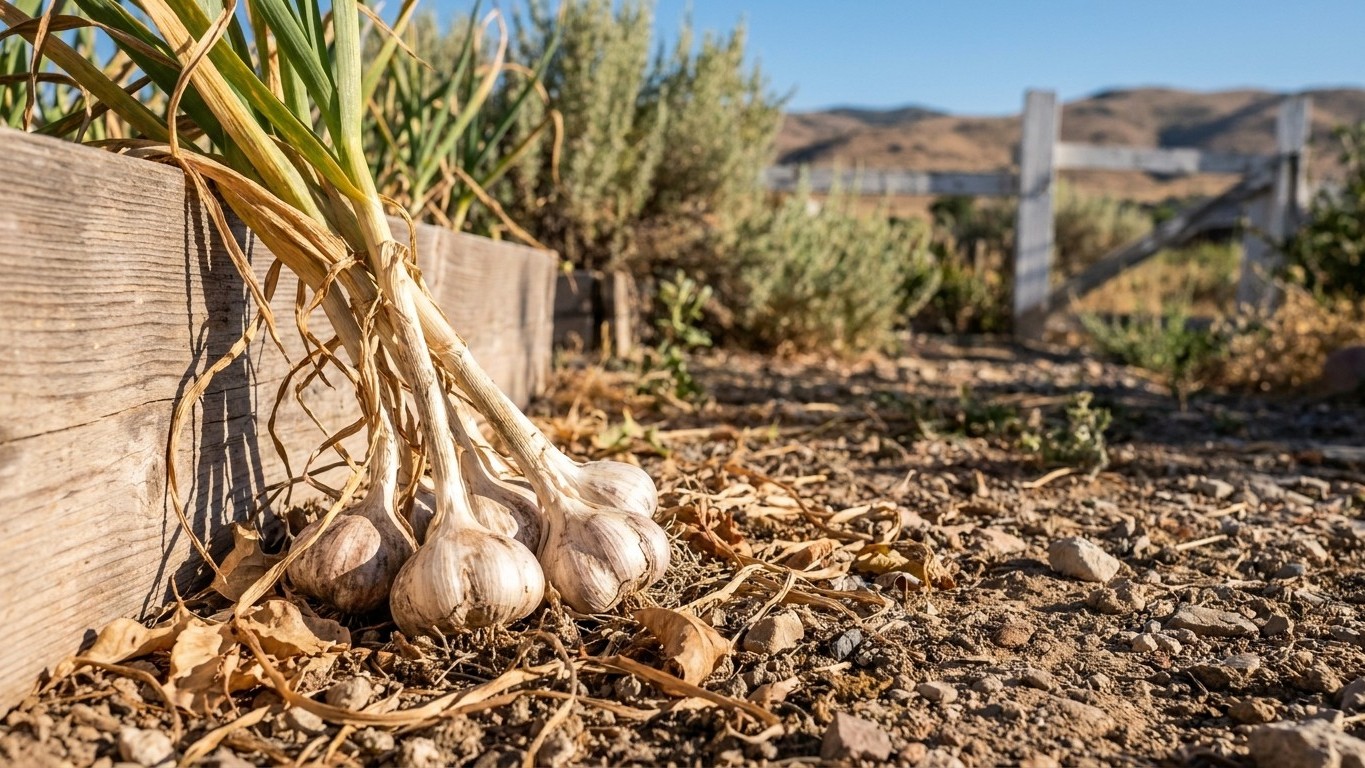

Can any garlic actually make it through a Utah winter? Yes — pretty much all of it, hardneck and softneck alike, because the cold here runs so far past what garlic needs that survival was never really in question. The winter here holds 26.1 weeks below 40°F, several times the six to eight weeks a clove needs to split and become a bulb. So plant your cloves 2 inches deep in late September to early October, mulch them, and let the cold do what it’s already more than capable of doing.
The short answer for Utah

Both hardneck and softneck garlic do well across the state, and the cold that decides which one thrives is not remotely a limiting factor here. University of Georgia Extension’s figure of 26.1 weeks below 40°F is more than three times the six to eight weeks garlic needs after planting to trigger the clove split that turns one seed clove into a full bulb. That surplus means the choice between hardneck and softneck comes down to flavor, storage life and kitchen preference, not to whether the winter is cold enough.
The planting date itself is anchored on the first fall freeze. NOAA’s 1991-2020 climate normals put that freeze at the Salt Lake City area station (USW00024127) between October 18 and October 29. That is a range, not a day, and it is a midpoint: in one year out of two, the first freeze arrives later than this window, sometimes well past it. Every variety in the list below carries the same planting window for that reason, late September to early October, set several weeks ahead of the freeze so roots have time to establish before the ground locks up.
| Variety | Type | Planting window |
|---|---|---|
| Early Red Italian | Softneck | Late September to early October |
| Inchelium Red | Softneck | Late September to early October |
| Italian Late | Softneck | Late September to early October |
| Lorz Italian | Softneck | Late September to early October |
| Bavarian Purple | Hardneck | Late September to early October |
| Blue Music | Hardneck | Late September to early October |
| Chesnok Red | Hardneck | Late September to early October |
| Duganski | Hardneck | Late September to early October |
| Fall Festival | Hardneck | Late September to early October |
| Georgian Crystal | Hardneck | Late September to early October |
| Georgian Fire | Hardneck | Late September to early October |
| German Red | Hardneck | Late September to early October |
| German White | Hardneck | Late September to early October |
| Ivan | Hardneck | Late September to early October |
Hardneck types such as German Red and Duganski tend to produce fewer, larger cloves and a hotter, more complex flavor, but they generally hold in storage for a shorter stretch than softnecks like Inchelium Red or Lorz Italian. Utah’s winter cold does not favor one type over the other, so the deciding factor is what you want in the kitchen, not what will survive the ground.
Working it out for your own garden
The planting window above is built by counting backward from the first fall freeze, and you can rebuild it for your own ground using the same two numbers.
The arithmetic
NOAA’s 1991-2020 climate normals put the Salt Lake City area’s first freeze between October 18 and October 29. Garlic wants roughly three to four weeks of root growth in the soil before that freeze locks the ground, so counting back that stretch from the earliest date in the window, October 18, lands in late September, and counting back the same stretch from the latest date, October 29, lands in early October. That window comes from a date range in the first place, so narrowing it down to a single day would throw away the uncertainty the range is built to describe.
Why elevation and the lake move it
A state is not one climate, and Utah proves that more than most. Elevation changes the freeze date fastest: gain a few thousand feet and the first freeze can arrive two weeks earlier or later than the Salt Lake City normal, depending on which direction you moved. The Great Salt Lake works the opposite way close to its shoreline, holding warmth into fall and softening the first freeze for benches right above it, while gardens only a short drive inland or upslope lose that buffer entirely.
The simplest way to sharpen this for your own yard is to keep a record. Note the date of the first hard freeze in your own garden for two or three years running, not the nearest airport’s, and compare it against the Salt Lake City normals above. If your yard consistently freezes a week or two ahead of the city, shift your planting window earlier the following fall. If it lags behind, as some sheltered, south-facing beds do, you can plant a few days later without losing root-establishment time.
The same backward count works for any spot in the state once you know its own local frost window. The full county-by-county version of this calculation, including how to find your own station’s normals, is laid out in When to Plant Garlic in Utah: Counting Back From the First Frost.
What changes across Utah
Northern valleys run colder and earlier than the Salt Lake City figures used above. Cache Valley, at higher elevation and latitude near the Idaho border, typically freezes ahead of the capital, and gardeners there do better to treat the late September start as a deadline rather than an opening date. The Uinta Basin and other high desert valleys in eastern Utah cool the same way: clear skies let heat radiate out fast on autumn nights, and cold air draining down from the surrounding mountains pools on the valley floor, so low-lying gardens there often see frost before benches only a few hundred feet higher.
Southern Utah runs the other direction. Washington County, around St. George, sits at much lower elevation and latitude than Salt Lake City, and its growing season runs longer as a result. Gardeners there can often hold off past early October without much risk, though without a station-specific NOAA normal for that county, any date should still be checked against local frost history rather than assumed.
Even within the Salt Lake Valley, the Great Salt Lake’s effect is uneven. Benches and foothill neighborhoods above the valley floor often stay a degree or two warmer on clear, still nights, because cold air sinks past them into the low ground, while gardens right on the valley floor, especially low spots with poor air drainage, can frost earlier than the city-wide normal suggests.
Mountain valleys such as Heber Valley and the area around Park City sit at considerably higher elevation than the Salt Lake City station, and short, cool summers there mean frost risk on both ends of the season. Gardeners at that elevation should lean toward the earliest end of the late September window and toward the hardier end of the cultivar list, rather than assume the capital’s calendar applies unchanged.
The mistakes this climate punishes
If you have not yet chosen a site or prepped the bed, the basics are covered in Growing Garlic in Utah. From there, two specific mistakes cost a Utah crop more than any other.
Planting too late or too shallow
Because Utah’s cold season is already long and reliable, the mistake here is rarely picking a variety that needs more chill than it gets. It is planting too late in the window, or too shallow, and losing the crop to the ground itself rather than to any pest. Cloves set after the first freeze arrives, per NOAA’s Salt Lake City normals of October 18 to October 29, do not have time to grow roots before the soil freezes solid, and an unrooted clove heaves toward the surface with every freeze-thaw cycle through winter. Planting roughly 2 inches deep and mulching heavily once the soil starts to cool is the standard defense, and skipping either step is the single most common way to lose a fall planting here.
Seed stock and disease timing
The other mistake is planting seed garlic of unknown origin instead of certified, disease-free stock. UC IPM’s guidelines for onion and garlic (UC ANR Publication 3453) put white rot‘s active range at 50°F to 75°F, and across Utah’s growing season the mean air temperature falls inside that range in five months: September, October, April, May and June. That overlap covers both the fall planting window and the spring months when an infected planting shows it. The published figures are soil temperatures, not air temperatures, and a monthly average hides plenty of daily swing above and below it, so this is a possibility count, not a forecast, and it does not mean the disease is absent in other months either.
Fusarium basal rot follows a similar pattern. UC IPM’s published range of 59°F to 90°F for Fusarium oxysporum f. sp. cepae overlaps Utah’s growing season mean in four months, September, May, June and July, one of them at the pathogen’s published optimum. Neither figure describes any single county precisely, since both come from published thresholds crossed against one general climate profile rather than a Utah-specific station. Both point the same direction, though: buy garlic sold as certified seed stock, not grocery store bulbs, and rotate beds instead of replanting saved cloves from ground that struggled the year before, since white rot’s resting bodies can persist in soil for years once established.
Checking this against your county
Every figure above comes from one weather station near Salt Lake City, and Utah’s terrain guarantees your county reads differently. USU Extension is the state’s land-grant extension service, and its county offices track local frost data and can tell you how far your garden’s dates drift from the capital’s normals. Start at USU Extension and search for your county’s horticulture or master gardener office before committing to a planting date, especially if you garden at high elevation, along the Wasatch benches, or anywhere temperature inversions are a known local pattern. A short call to that office is worth more than any statewide average, since it can tell you what actually froze in your own area last fall.
Common questions
Can I plant garlic in spring instead of fall in Utah?
Not with good results. Garlic on this list is planted in autumn and lifted the following summer, and the fall planting is what gives cloves the weeks of cold they need to split properly before bulbing starts. A spring-planted clove skips most of that cold period and typically bulbs small or not at all.
What happens if I miss the late September to early October window?
You can still plant into November in a pinch, but expect smaller bulbs the following summer, since the roots have less time to establish before the ground freezes. If you miss the window by more than a few weeks, it is usually better to wait for the next fall than to push a very late planting or try for spring instead.
Does Utah’s dry climate change which type I should grow?
Not really, since irrigation, not winter cold, is what carries garlic through Utah’s growing season regardless of type. Softneck varieties like Inchelium Red do tend to store longer in a dry pantry, which matters more to how you use the harvest than to how the crop performs in the ground.
Do I need to pull back the mulch in spring?
Yes, once green shoots start pushing up through it. Leaving a thick mulch layer on too long past that point can trap moisture against the shoots and slow growth, so thin it back to a light layer as soon as you see consistent sprouting across the bed.