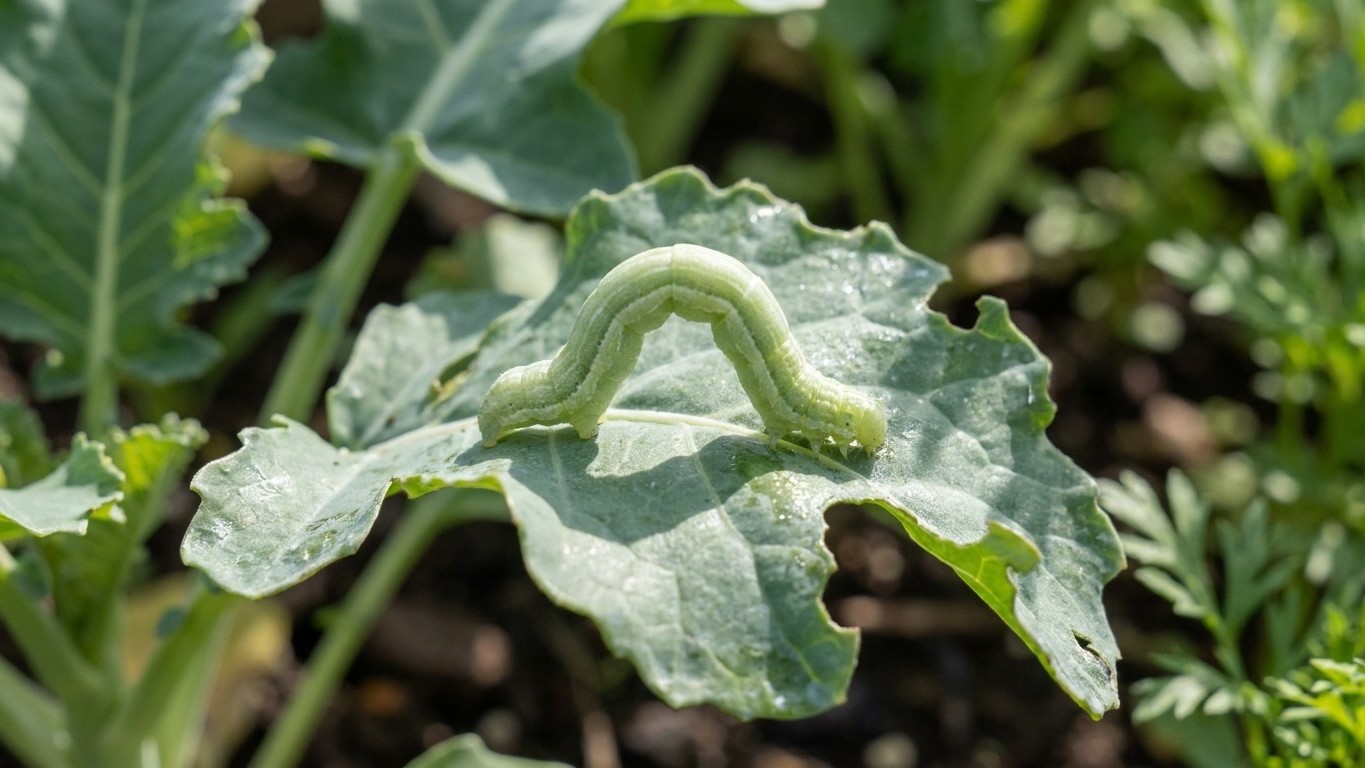

Cabbage loopers turn up in Utah gardens from early June through late September, with populations peaking in July and August when cole crops are putting on their heaviest growth. They don’t survive Utah’s cold winters as a resident population in most of the state, so the moths that start the trouble each year are migrants blown or flown in from warmer regions to the south, then their offspring build up fast once the weather turns reliably warm. The fix that actually works for home growers is a layered one: physical exclusion before eggs get laid, Bacillus thuringiensis (Bt) sprays for young larvae, and garden cleanup that denies the next generation a place to pupate.
Identifying a Cabbage Looper (and Why Gardeners Mix It Up)

The adult moth is easy to overlook. It’s a mottled grayish-brown moth, roughly an inch and a half across, with a small silvery mark on each forewing that looks like a comma or a figure eight. It flies at dusk and at night, which is why most Utah gardeners never see the moth itself and instead find the caterpillar chewing through their broccoli.
The larva is the giveaway. It’s pale green, tapered at both ends, with faint white stripes running down its sides, and it moves in a distinctive looping motion, arching its back to bring the rear end up to meet the front legs. That happens because the caterpillar is missing a set of middle prolegs that most caterpillars have, so it can’t crawl in a straight line the normal way.
Utah gardeners frequently confuse it with two other cabbage pests. The imported cabbageworm, larva of the white cabbage butterfly, is fuzzy, solid green, and crawls normally without looping. The diamondback moth larva is smaller, wriggles violently when disturbed, and often drops off the leaf on a silk thread. All three show up on the same plants at the same time of year, so a mixed infestation is common along the Wasatch Front.
When Cabbage Loopers Show Up in Utah
Timing depends heavily on where in the state you’re gardening. Utah’s growing regions span a wide elevation range, and that changes the pest calendar more than people expect.
Elevation and Region Change the Timeline
In the Salt Lake Valley, Utah County, and Davis County, first significant looper activity generally shows up in early to mid-June, with a second and sometimes third generation cycling through by September before frost ends the season. In the St. George and Washington County area, the warmer, longer season means loopers can appear as early as May and keep producing generations into October. Higher-elevation gardens in places like Park City, Cedar City, or the Cache Valley run cooler and see a compressed, later window, often starting in late June and tapering off by early September.
Because the moths migrate in rather than overwintering locally in most of the state, the exact start date shifts year to year depending on spring wind patterns and how early migrant moths arrive from source populations farther south. That’s different from a pest that overwinters as pupae in the soil, where timing tracks local soil temperature more predictably.
What Damage Looks Like on Cole Crops
Cabbage loopers feed on the same crop family that gives them their name: cabbage, broccoli, cauliflower, kale, and Brussels sprouts, along with lettuce and occasionally tomato foliage when populations are heavy. Young larvae chew small, ragged holes in leaves, often skeletonizing the tissue between veins on lower or outer leaves first. As they grow, the holes get larger and irregular, and heavy feeding can strip a plant down to its ribs within a couple of weeks if it goes unchecked.
The most costly damage happens when larvae bore into the developing head of cabbage or the curd of cauliflower and broccoli. Once a caterpillar tunnels into a head, it leaves behind frass (caterpillar droppings) that contaminates the crop even after the pest itself is gone, which is often what actually ruins a harvest rather than the leaf damage alone. That’s the detail that trips up a lot of first-time growers who only check the outer leaves and assume their crop is fine.
What Actually Stops Cabbage Loopers in Utah Gardens
Control works best as a sequence rather than a single product. Waiting until you see chewed leaves and then reaching for a spray misses the window when control is easiest, since eggs and very young larvae are far more vulnerable than mature caterpillars.
Biological Controls That Work
Bt, specifically the kurstaki strain (Btk), remains the standard organic treatment and is widely used across Utah’s cooperative extension recommendations for cole crop pests. It works by disrupting the larva’s gut after ingestion, and it’s most effective against small, young caterpillars, which means timing the spray for early detection matters more than the product itself. Spinosad is another organic-approved option that performs well against loopers and has a different mode of action, useful for rotating products so resistance doesn’t build up.
Natural enemies already present in Utah landscapes help more than most gardeners realize. Parasitic wasps in the Trichogramma and Cotesia groups lay their eggs inside looper eggs or larvae, and a garden with diverse flowering plants nearby tends to support more of these beneficial insects. Avoiding broad-spectrum insecticides preserves this natural pressure, which is one reason repeated blanket spraying often backfires by wiping out the predators that would otherwise keep populations in check.
Physical Barriers and Garden Habits
Floating row covers installed at planting, before moths start laying eggs, are one of the most reliable tools for home gardens. Since the adult moth has to land on the plant to lay eggs, a properly sealed cover blocks that step entirely. Covers need to come off before flowering on crops that require pollination, but for cabbage, broccoli, and kale, they can often stay on through most of the season.
Handpicking remains effective on a small scale, particularly in backyard plots where a daily five-minute check of the undersides of leaves catches egg clusters and young larvae before they spread. Crop rotation, avoiding planting cole crops in the same bed year after year, reduces the odds that pupae overwintering in Utah’s milder valley pockets reestablish quickly nearby. Fall garden cleanup, removing old plant debris and tilling the soil, exposes overwintering pupae to cold temperatures and to birds, which measurably cuts down the following year’s early population in a given bed.
A short list of what tends to make the biggest difference in practice:
- Row covers installed before moth flight begins in your region
- Btk or spinosad applied while larvae are still small
- Weekly leaf checks during peak season (July and August along the Wasatch Front)
- Fall tillage and debris removal to disrupt pupation sites
- Diverse flowering plants nearby to support parasitic wasps
Deciding How Much Looper Damage Warrants Action
Not every looper sighting means treatment is necessary. A few caterpillars scattered across a healthy stand of mature broccoli rarely threaten the harvest, and outer leaf damage on cabbage that will be trimmed away at harvest anyway doesn’t justify spraying. The threshold that matters most is head or curd penetration, since that’s the damage that actually costs a gardener the usable crop.
Young transplants are the exception. A handful of loopers on a seedling with only four or five true leaves can stunt or kill the plant outright, so early-season vigilance on new transplants matters more than watching mature plants later in summer. Checking transplants twice a week during the first three weeks after setting them out catches problems while a quick handpicking or a single Btk application can still fix things, well before the population has a chance to build toward the kind of late-summer surge that hits Utah gardens hardest in August.