
Utah State University Extension names onion thrips as the most injurious insect pest of onions in the state and Corn earworm in Utah as the most destructive pest of sweet corn, based on figures tracked near Salt Lake City. The rest of the state’s home garden pest pressure, from squash bugs to spider mites, follows a fairly predictable seasonal order once you know what to watch for. Start scouting your plants twice a week from the time seedlings go in the ground, since most of these pests do the bulk of their damage in the two weeks before anyone notices them.
What Utah gardens actually deal with

What’s actually eating your garden depends on the week, not just the crop. Early on it’s flea beetles punching tiny holes in seedlings, Aphids in Utah clustering on tender new growth, and Slugs in Utah leaving slime trails overnight; by midsummer it’s Squash bug in Utah gardens, Cucumber beetles in Utah growers spot chewing on vine crops, Spider mites in Utah that growers dread, and thrips working in the heat; late summer brings the Tomato hornworm in Utah gardens and Grasshoppers in Utah that gardeners know well. Walk your rows twice a week starting the day seedlings go in, checking leaf undersides and flower centers, since most of the damage happens in the two weeks before you’d otherwise notice anything wrong.
Flea beetles

These Flea beetles in Utah show up as soon as soil warms in early spring, riddling seedling leaves with small round shot holes. Adults jump the moment you approach, which is itself a decent field ID. Row cover over transplants for the first few weeks stops most damage before it starts.
Imported cabbageworm, cabbage looper and diamondback moth

All three feed on cabbage-family crops through spring and into summer, chewing ragged holes in leaves and boring into developing heads. Imported cabbageworm in Utah is often confused with Cabbage looper in Utah, the pest gardeners spot most often, which gives itself away through green fecal pellets on the leaves, since the caterpillars themselves blend in well. Bacillus thuringiensis applied while larvae are still small handles all three.
Aphids

Green peach, potato, melon and cabbage aphids all cluster on the undersides of new growth in the cool flush of spring, then again in fall. Heavy colonies curl leaves and coat them in sticky honeydew that draws ants and grows sooty mold. A strong water spray knocks down light infestations.
Slugs and snails

Cool, moist spring conditions bring these out at night, leaving ragged holes in leaves and slime trails as the giveaway sign. Many gardeners rate them the worst pest they deal with, mostly because damage appears overnight with no visible culprit come morning.
Cucumber beetles

These arrive as cucurbit seedlings emerge in early summer, chewing holes in leaves and flowers and spreading bacterial wilt as they feed. Their stripes or spots make them easy to spot once you know to check flower centers.
Squash bug

Adults and nymphs feed through summer, sucking sap that causes leaves to wilt, blacken and collapse even with adequate soil moisture. Egg clusters, laid in neat rows on the underside of leaves, are the easiest life stage to catch and crush before hatching.
Spider mites
Hot, dry midsummer weather is exactly what these need. Leaves take on a stippled, bronze cast well before the fine webbing becomes obvious.
Onion thrips
Peak numbers hit onions in the heat of midsummer, feeding inside leaf folds and leaving silvery streaks and small black flecks of excrement. Left unchecked, they stunt bulb size significantly.
Grasshoppers
Outbreak years bring these in from dry field edges to strip garden leaves down to the veins. Numbers build through summer and peak in late summer when adults are largest and hungriest.
Leafminers
Spinach, beet and chard leaves show winding pale tunnels through summer as larvae feed between the leaf surfaces, invisible from outside except for the trail they leave.
Tomato and tobacco hornworms
Mid to late summer brings these large caterpillars, which strip whole branches of foliage in a couple of nights. Their size makes them dramatic but easy to hand-remove once spotted.
Corn earworm
This is the pest USU Extension names as the most destructive to sweet corn in Utah, arriving as ears begin to silk in late summer and feeding straight down into the kernels at the tip, where damage stays hidden until husking.
Telling damage apart

Matching the damage pattern to a cause is the step that decides whether you reach for Bt, insecticidal soap, a fungicide, or just the hose. Chewing damage, meaning ragged holes or missing leaf edges, points to caterpillars, beetles or grasshoppers, and you can usually find frass (small dark droppings) nearby. Stippling with fine webbing is spider mites, not disease. Sticky leaves with black sooty mold underneath mean aphids have been feeding and excreting honeydew, even if you can’t see the insects themselves at first glance.
Ruling out watering and disease
Wilting is the trickiest symptom because it has three separate causes that look almost identical from a distance. A squash bug or vine borer problem wilts a plant despite moist soil, while underwatering wilts a plant with visibly dry soil and shows up on the whole plant evenly rather than in one section. Fungal wilts tend to move up one side of the plant or start at the base of the stem. Check the soil moisture and the stem base before you treat for insects, since spraying an insecticide on a watering problem wastes money and does nothing for the plant.
| Symptom | Likely cause | Confirm by |
|---|---|---|
| Ragged holes, chewed edges | Cabbageworms, loopers, hornworms, grasshoppers | Check for caterpillars or fecal pellets on leaves |
| Bronze stippling, fine webbing | Spider mites | Tap a leaf over white paper and look for moving specks |
| Sticky leaves, black sooty mold | Aphids | Check leaf undersides and new growth for clusters |
| Silvery streaks, black flecks | Onion thrips | Pull back leaf folds and look for pale slender insects |
| Winding pale tunnels inside the leaf | Leafminers | Hold the leaf up to light |
| Sudden wilting, soil still moist | Squash bug or vine borer | Check the base of the stem for boring holes or nymph clusters |
| Wilting, soil dry to the touch | Water stress, not a pest | Check soil moisture before treating for insects |
What actually works
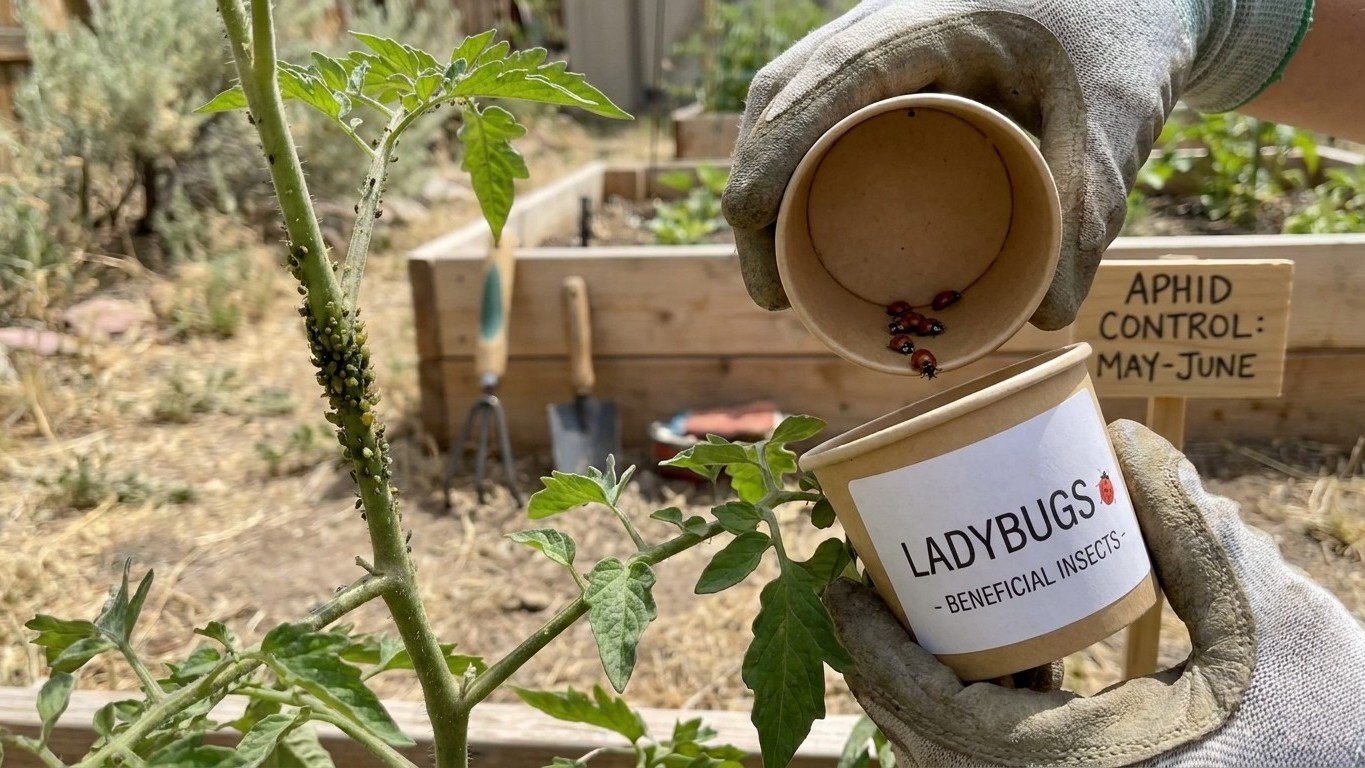
Prevention beats intervention for nearly every pest on this list, mostly because it costs less and doesn’t wait until damage is already visible. Crop rotation matters most for squash bug and cucumber beetle, since both overwinter in garden debris and reinfest the same bed the following year if cucurbits go back in the same spot. Timing row cover before adults lay eggs, not after damage appears, is the single change that does the most for cabbage-family and cucurbit crops, though it has to come off during bloom on any crop that needs pollinators to set fruit. Encouraging lady beetles and lacewings with a few flowering plants nearby helps keep aphid numbers down without any product at all.
When a spray is warranted
Insecticidal soap knocks down aphids and spider mites on contact but has to hit the insect directly, so thorough leaf-undersides coverage matters more than the product itself. Bt (Bacillus thuringiensis) works on cabbageworms, loopers, hornworms and corn earworm, but only if larvae actually eat it while still small, since it does nothing to eggs or adult moths and loses effectiveness against caterpillars past about an inch long. Spinosad covers thrips and caterpillars with a similar timing requirement. Iron phosphate slug and snail bait works slowly but reliably and is safer around pets than metaldehyde-based products.
A few widely repeated remedies don’t hold up. Garlic or hot pepper sprays repel almost nothing once diluted by irrigation or dew, marigolds planted nearby have no measurable effect on squash bug or aphid numbers, and ultrasonic pest repellers have no documented effect on any insect. Coffee grounds scattered around slug-prone beds show inconsistent results at best. Gardeners dealing with grasshopper pressure in dry years will recognize a pattern shared across the Mountain West, where outbreak years follow the same drought-driven cycle.
What control costs
Hand picking costs nothing but time, and it’s genuinely the most effective option for hornworms, squash bug egg masses and slug patrols, since a five-minute check every morning during peak season catches problems before they spread. It doesn’t scale well once an infestation is already established across a whole bed.
Comparing the main approaches
Row cover is a one-time material cost that pays off over several seasons of reuse, but it demands labor at both ends: installing it before pests arrive and removing it once flowers need pollinators. Biological and targeted controls like Bt, spinosad and iron phosphate bait cost more per application than hand picking and need repeating roughly every one to two weeks, or sooner after rain or overhead irrigation washes residue off. Broad-spectrum sprays such as pyrethroids often need similarly frequent reapplication, and they carry a hidden cost: killing the aphid predators and pollinators along with the target pest, which can trigger a rebound in aphid or mite numbers within a few weeks.
For a typical home garden, hand picking combined with well-timed row cover is the cheapest route by a wide margin, since it avoids repeat product purchases entirely. Sprays make more sense once an infestation covers more plants than a gardener can realistically check by hand each day. Gardeners comparing notes with warmer, more humid states will find the cost tradeoffs shift too, since fungal-driven pest complexes common in places like Alabama demand a different mix of sprays than Utah’s dry-climate insect pressure.
Local help
Utah State University Extension runs the Plant Pest Diagnostic Lab, which identifies unfamiliar insects and tracks outbreak patterns across the state. Anyone unsure what’s chewing on their tomatoes can send in a sample or photo through their local county office, listed at USU Extension. For more on gardening across the region, our Utah guides cover frost timing and other seasonal questions county by county.
Where to Go Next for Specific Pests
Once you’ve got a feel for how Utah’s seasons shape pest pressure in general, it helps to zoom in on the insects most likely to actually show up in your yard. Timing is everything with pests — miss the window and you’re either too early to see damage or too late to stop it. That’s especially true with aphids, which follow a predictable rhythm tied to new growth and shifting temperatures rather than showing up at random.
If you’ve noticed curled leaves on fruit trees or roses in spring, or a sudden sticky mess on plants come fall, that’s not a coincidence — it lines up with when aphids are most active and most likely to build up fast. Knowing the pattern ahead of time means you can watch for the early signs instead of reacting after populations have already exploded. Start there, get a sense of the seasonal cycle, and use that same thinking as you work through whatever else is turning up in your garden this year.
Common questions
Do I need to spray if I only see a few bugs?
No, in most cases. A handful of aphids or a couple of flea beetle holes rarely justify a spray, and treating too early kills off the predators that would otherwise keep numbers down on their own. Watch the trend over a few days rather than reacting to the first sighting.
Are store-bought ladybugs actually worth buying?
Usually not. Released ladybugs tend to fly off within a day or two if the garden doesn’t already have enough aphids to hold their interest, so the money is often wasted. Planting a few flowering herbs to keep native lady beetles and lacewings around works better over a full season.
Why did my tomato leaves disappear overnight?
That’s almost certainly a hornworm, since they feed heavily at dusk and through the night and can strip a branch before morning. Look for dark green or black droppings on the leaves below the damage, then check the plant again after dark with a flashlight if you don’t spot the caterpillar during the day.
Can I just use what works for pests back east?
Not directly. Approaches built around a humid climate often assume fungal-driven pest and disease complexes that barely occur in Utah’s dry air, while dry-climate pests like spider mites and grasshoppers get far less attention in those guides. Match the product and timing to the pest you’ve actually identified rather than a routine from somewhere wetter.