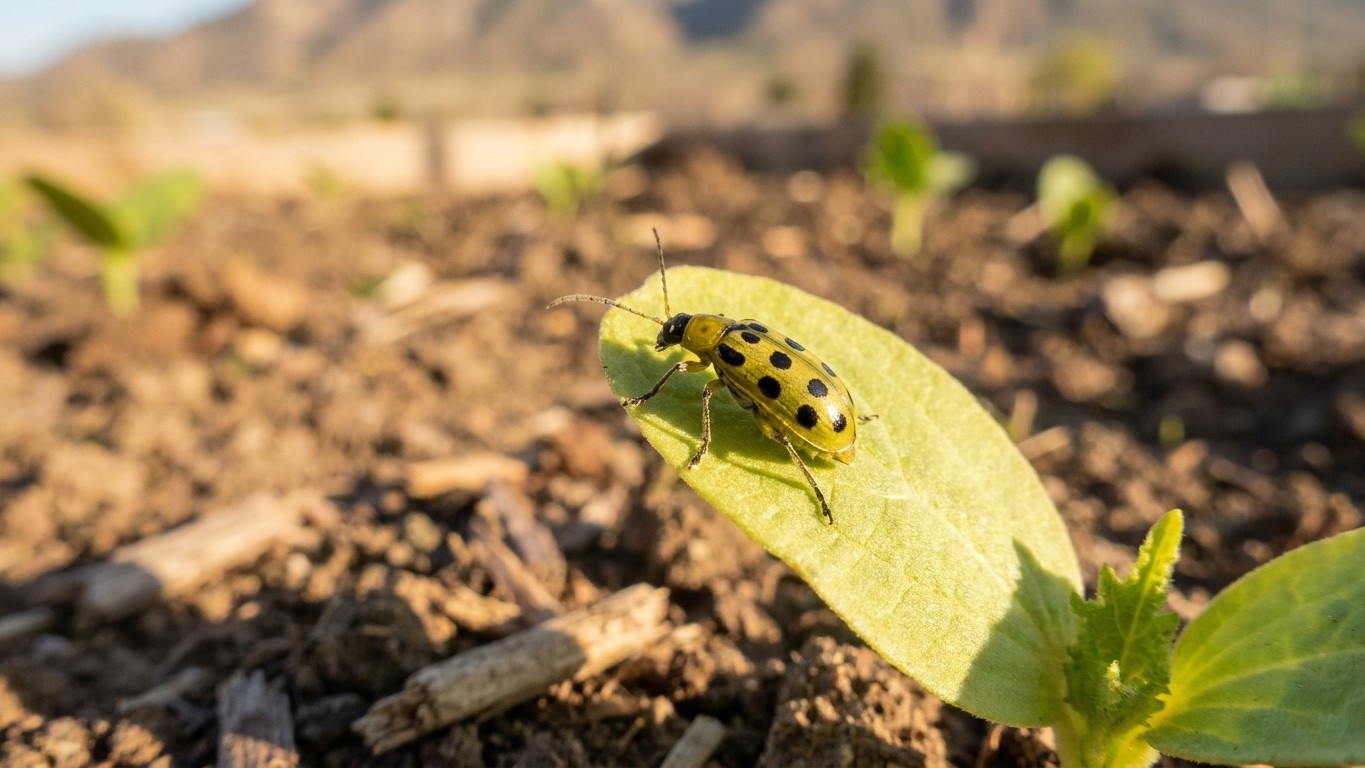

Cucumber beetles start showing up in Utah gardens as soon as soil temperatures climb past the mid-50s, which usually means late April in the warmer valleys around St. George and early-to-mid May everywhere else, including the Wasatch Front and higher-elevation towns like Park City or Cedar City. The pests overwinter as adults in plant debris and soil, so the first warm stretch after the last frost is when they emerge and head straight for young cucurbit seedlings. Stopping them comes down to a combination of row covers during the vulnerable seedling stage, prompt removal of infected plants, and, when populations spike, targeted insecticide applications timed to when beetles are actually active.
Which Cucumber Beetles Live in Utah

Two species cause most of the trouble here. The western spotted cucumber beetle (a regional cousin of the more widely known spotted cucumber beetle) is the one Utah gardeners run into most often, especially west of the Rockies. It’s about a quarter-inch long, yellowish-green with a dozen black spots across its back, and it looks almost cheerful compared to the damage it causes.
The striped cucumber beetle shows up too, though less consistently in Utah than in wetter Midwestern states. It has three bold black stripes running down a yellow body instead of spots. Both species feed on cucumbers, squash, melons, and pumpkins, and both can carry the same bacterial disease that makes them more than a cosmetic nuisance.
Adult beetles are the ones gardeners spot crawling on leaves and flowers, but the larvae matter too. They live in the soil and chew on roots, which weakens plants from below while the adults are working on them from above. A plant under that kind of double assault often collapses faster than the visible leaf damage would suggest.
When They Show Up in Utah, Season by Season
Timing tracks soil warm-up, and Utah’s elevation range means that varies a lot within a single state. In the Dixie region around St. George, where spring arrives weeks ahead of the rest of Utah, beetle activity can start in mid-to-late April. Along the Wasatch Front, from Ogden down through Provo, the first wave typically arrives in the first half of May, right around when most home gardeners are setting out cucumber and squash transplants.
Higher-elevation gardens, think Heber Valley, Cedar City, or anywhere above 5,500 feet, run two to four weeks behind the valley floor. That delay is actually useful information: if you know beetles hit Salt Lake gardens in early May, you can reasonably expect a similar generation to reach a mountain garden by late May or early June.
A second generation often builds through July and August, particularly in years with a mild, extended fall. This second wave tends to be smaller than the spring emergence but can still do real harm to late-planted squash or a second succession of cucumbers, since by midsummer plants are also stressed by heat and irrigation demands.
Why the Seedling Stage Is the Danger Window
Cucumber beetles do the most damage to plants under six inches tall, before they’ve developed the leaf mass to tolerate some feeding loss. A cucumber seedling with two true leaves can be defoliated by a handful of beetles in a matter of days, while a mature vine with a dozen leaves barely notices similar feeding pressure. That’s why the two- to three-week window right after seedlings emerge or transplants go in the ground is the period that determines whether a beetle problem stays minor or turns into a lost crop.
The Real Risk: Bacterial Wilt
Leaf damage from cucumber beetles is annoying but rarely fatal on its own. The bigger threat is bacterial wilt, caused by Erwinia tracheiphila, a pathogen that cucumber beetles carry in their gut and spread through their feeding wounds. Once a plant is infected, there’s no cure. Vines wilt during the day, seem to recover overnight, then wilt again, and within one to two weeks the whole plant collapses.
Cucumbers and muskmelons are highly susceptible to this disease. Squash and pumpkins are more resistant in most varieties, which is one reason Utah gardeners sometimes see beetles all over their zucchini with no wilt symptoms, while a cucumber patch a few feet away dies off in a matter of weeks. If you’re growing both, prioritize beetle control on the cucumbers and melons specifically.
A simple field test confirms the disease: cut a wilted stem near the base and slowly pull the two halves apart. If you see a thin, milky, sticky thread stretching between them, that’s bacterial ooze, and the plant is infected. Pull it immediately rather than hoping it recovers, since infected plants serve as a source that beetles can spread to neighboring healthy plants.
What Actually Stops Cucumber Beetles in Utah Gardens
Row Covers Timed to the Seedling Stage
Floating row covers are the single most reliable tool for home gardens, and Utah’s dry climate makes them easier to manage than in humid regions where fungal issues under cover are more of a concern. Lay covers over seedlings or transplants immediately after planting and seal the edges with soil or garden staples. The catch is timing removal: cucurbits need pollinators once they start flowering, so covers have to come off when blossoms appear, typically three to five weeks after planting depending on variety and local temperatures. That means covers protect exactly the window when beetles do the most damage, then step aside when the plant can better tolerate some feeding.
Delayed Planting and Trap Crops
Pushing planting dates back by one to two weeks after the typical local emergence window reduces the overlap between vulnerable seedlings and the peak beetle population. This works especially well in valley gardens where the spring emergence is predictable enough to plan around.
Trap cropping, planting a small block of an attractive squash variety like Blue Hubbard a couple weeks ahead of the main crop, draws beetles away from the plants you actually care about. Gardeners then concentrate control efforts, whether that’s hand-picking or targeted spraying, on the trap crop itself rather than treating the entire garden.
Cultural Cleanup
Since adults overwinter in plant debris and loose soil at the edges of gardens, fall cleanup matters more than most gardeners assume. Removing old cucurbit vines, tilling under crop residue, and clearing weedy borders in October reduces the overwintering population that emerges the following spring. This is a low-cost step that pays off months later.
Crop rotation helps too, though less than in-season timing does. Moving cucurbits to a different part of the yard each year, even a modest 15- to 20-foot shift, makes it harder for emerging beetles to find host plants immediately.
Monitoring With Yellow Sticky Traps
Cucumber beetles are strongly attracted to yellow, which is why yellow sticky traps placed at plant height near cucurbits work as an early warning system. Checking traps twice a week starting in late April in warmer regions, or mid-May in valley and mountain gardens, gives a heads-up before damage becomes visible on the plants themselves. A sudden jump in trap counts is the signal to act, whether that means reapplying row covers, hand-picking beetles in the cool morning hours when they’re sluggish, or moving to an insecticide application.
Targeted Insecticide Use
For heavier infestations, especially once flowering has started and row covers are off, spinosad-based products offer control while remaining relatively gentle on bees if applied in the early morning or evening when pollinators aren’t actively foraging. Kaolin clay, applied as a spray that coats leaves in a fine white film, physically deters beetles from feeding and landing, and it’s an option some Utah gardeners prefer for its low toxicity profile. Whatever product is used, applying it in the evening after bees have finished for the day reduces collateral harm to pollinators that cucurbits depend on for fruit set.
One detail that surprises a lot of first-time vegetable gardeners in Utah: beetle pressure tends to be noticeably lower in gardens surrounded by pavement, gravel, or xeriscaping, since the adults overwinter in organic litter and loose soil rather than hardscape. A garden tucked next to a wild grassy lot or an unmanaged fence line will typically see beetles days or weeks earlier than one bordered by rock mulch, which is worth factoring in if you’re deciding where on the property to put next year’s cucumber bed.