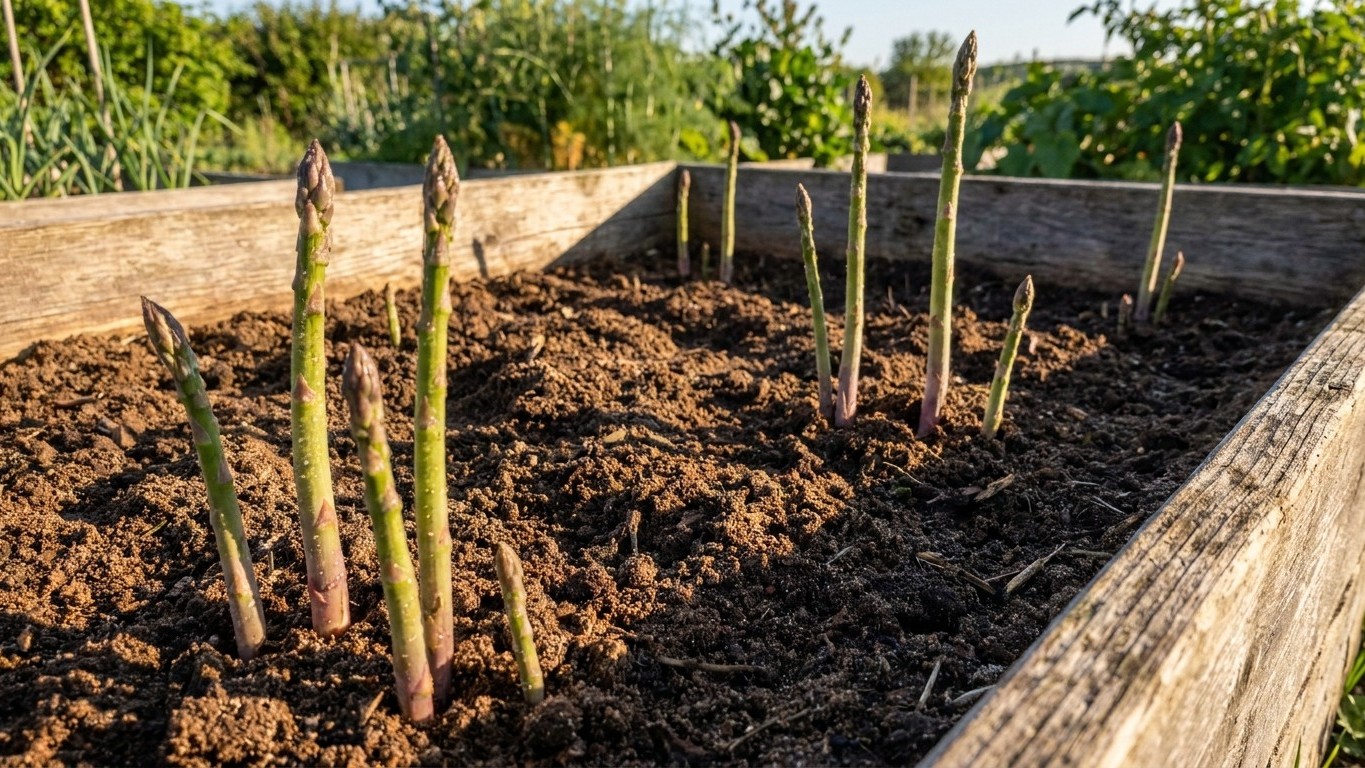

Stop cutting when most of the spears coming up are thinner than a pencil. A young bed gets about four weeks of cutting, then six, then eight in later seasons, but the pencil check overrules the calendar. The spears you did cut keep best just above freezing, in air close to saturated, with the cut ends in water. Above 50°F they toughen fast. Below about 31°F they freeze. A home refrigerator needs some tuning to land in that narrow window.
Keeping it, and for how long
A cut spear is still alive. It keeps losing water through the cut end and the skin, and its tissue keeps firming up into fiber. Storage is a matter of slowing both processes, and the UC Davis Postharvest Technology Center gives the numbers in its produce fact sheet on asparagus.
What temperature and humidity keep asparagus spears best?
UC Davis puts the optimum temperature at 0°C to 2°C, which is 32°F to 35.6°F. The optimum relative humidity is 95 to 100 percent. The sheet calls high humidity essential to prevent desiccation, and that is the part most home storage gets wrong.
Both edges of the window bite. The same fact sheet reports that spear toughening occurs rapidly above 10°C (50°F), so a warm counter or a hot car ruins tenderness within hours. At the cold end, freezing injury is likely at -0.6°C (30.9°F) or lower. Frozen spears look water-soaked and then go extremely soft.
| Temperature | What happens to the spears |
|---|---|
| 30.9°F or lower | Freezing injury: a water-soaked look, then extreme softening |
| 32°F to 35.6°F | Optimum range, paired with 95 to 100 percent humidity |
| Above 50°F | Spears toughen rapidly |
How long will cut asparagus last?
Any shelf life you see quoted is a ceiling. It assumes the spears sit at the optimum temperature in near-saturated air from the moment they are cut. A kitchen rarely delivers that. Each degree above the window and each point of lost humidity takes days off the ceiling, and a spear that has already dried or toughened does not recover.
The garden has one advantage over the grocery store. Spears from your own bed can go from knife to water in minutes, while store spears have often spent days in trucks and on display. Treat cut spears as something to eat soon, and the closer to the cutting, the better they taste.
Where in the house that actually is
A domestic refrigerator is usually set warmer than the optimum window, and the door runs warmer still because it meets room air every time it opens. Butter and eggs belong there. Asparagus does not. Without a thermometer you are guessing, and a cheap fridge thermometer settles the question in an afternoon.
Which fridge shelf comes closest to the right temperature?
The lower shelves toward the back are generally the coldest and steadiest zone in most refrigerators. That is the best spot for a jar of spears. The crisper drawer works too if it has a humidity vent you can close, since a closed drawer holds moisture better than open shelf air.
One warning applies to the very back. If the rear wall frosts over or sits near the cooling vent, spears pressed against it can drop below 30.9°F and freeze. Keep them a few inches off the wall. If you find glassy, water-soaked tips, the shelf is too cold.
How do you get 95 percent humidity in a home kitchen?
You cannot dial it in, so you build it. Water under the cut ends does most of the work, because the butts lose moisture faster than any other part of the spear. Stand the cut ends upright in an inch or two of water in a jar or tall container. Skipping that step means the spears wilt, shrivel and turn stringy even in a cold fridge.
Then slow the loss from the tips. Drape a loose plastic bag over the jar, or wrap the butts in a damp paper towel and slip the bundle into a bag. Leave the bag loose enough that air moves in and out a little. Change the water if it clouds. If a jar will not fit on your lower shelf, lay the spears on a damp towel in a bag, though they hold up better standing.
When do you stop cutting asparagus in Vermont?
The first question is how many years you wait. Utah State University Extension describes crowns planted in 8-inch furrows in early spring, with no harvest until the third year. After that comes a short season: about four weeks, then six, then eight as the bed matures. A healthy bed then produces for 10 to 15 years. Cutting earlier than the third year means taking spears the crowns need to build themselves up, and no number of spears taken lightly is a safe one. The furrow itself gets filled in gradually over the first year rather than all at once.
The stopping rule after that is a spear you can hold up next to a pencil. Early in the season, spears come up thick. As the weeks pass and the crowns spend their stored energy, more of them come up thin. When most of what is emerging is thinner than a pencil, quit cutting and let every spear grow into a fern. The ferns feed the crowns for next year. Cutting past that point trades one more meal for a weaker bed.
Local weather shifts where the season falls. At Burlington, on Lake Champlain, NOAA NCEI climate normals put the last spring frost between April 30 and May 10. Burlington is the mildest corner of the state, and the Green Mountains and the Northeast Kingdom run substantially shorter. Spring arrives later there, so a bed in the hills will start and end its cutting later than one by the lake. Count the spears, not the date.
Does the bed need water after the last cut?
The ferns grow through summer, and they need steady moisture. NOAA NCEI normals for the Burlington station show about 11.9 inches of rain across June, July and August, out of 37.5 inches for the year. June brings 4.26 inches, July 4.06, and August, the driest month, 3.54. These are what a region can usually expect, not a forecast, and a slope, a rain shadow or a town can change them. A rain gauge on your own plot tells you what actually fell.
Soil changes what the rain does. Vermont’s state soil is the Tunbridge series, a sandy, well-drained soil. USDA records its surface layer as 79 percent sand. Sandy ground lets rain through within the day, so a wet summer can still leave the bed dry a few days later. Heat adds to it. Days at or above 90°F pull water out fast, and a single thunderstorm mostly runs off. Water the bed during dry spells.
A well-drained soil suits a bed that stays put for 15 years, and Tunbridge sits on the right side of that. It is the soil that represents the state, though, and your yard may be river bottom, hillside, or ground a builder scraped and filled. Wet, heavy ground is a decision you cannot undo here, so pick another site or build the bed up above it. A soil test and a look at Will Vermont Soil Hold an Asparagus Bed for Fifteen Years? will tell you more. Pests also feed on ferns through summer, which is covered in What Eats Asparagus in Vermont, and When, and the full planting picture is in Growing Asparagus in Vermont.
Common questions
Can I cut any spears in the first or second year?
No. Utah State University Extension says to wait until the third year. Spears left alone in the first two years become the ferns that fill the crowns with stored energy for a long run of harvests.
How do I know it is time to stop cutting this season?
Look at what is coming up. When most of the new spears are thinner than a pencil, stop and let them fern out. A few thin spears early in the season are normal. A bed full of them means the crowns are tired.
Can I keep asparagus on the counter or in the fridge door?
Neither is a good choice. UC Davis reports that spears toughen rapidly above 50°F, and a counter in a warm kitchen is easily past that. The fridge door is warmer than the shelves, so it is a poor second. Use a lower shelf, with the butts in water.
Does the variety change when I should stop cutting?
Utah State University Extension lists named asparagus cultivars, some all-male and some with male and female plants. It says nothing else about them, so go by the pencil check whichever you planted.