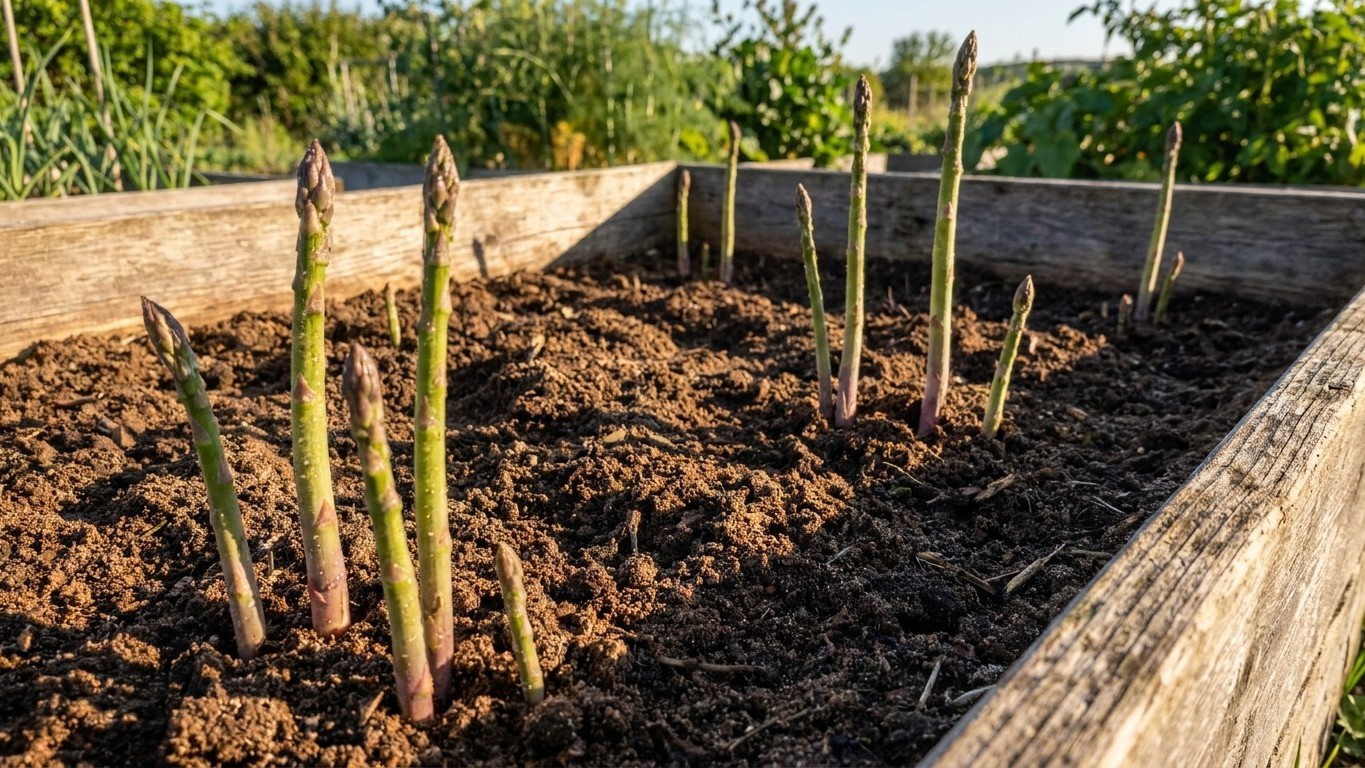

The Tunbridge series, Vermont’s official state soil, is well drained by USDA’s own description, and “well drained” is the one soil requirement Utah State University Extension attaches to an asparagus planting. That clears the biggest hurdle for a bed meant to sit undisturbed for 10 to 15 years. But the same survey data that grants the pass also flags a strongly acid surface and a texture built almost entirely of sand, and neither of those numbers should be taken as a description of any one backyard.
The short answer
Start with the mechanics, because a fifteen-year bed is unlike anything else in the garden. Crowns go into furrows dug about 8 inches deep. There is no harvest at all in year one or year two. Year three brings a first cutting window of about 4 weeks, year four stretches to 6 weeks, and from year five onward the planting can be cut for about 8 weeks each spring. The stopping point every season is not a date on a calendar but a look at the spears themselves: when most of what’s coming up is thinner than a pencil, the cutting stops and the fern is left to grow and feed the crown for next year. The furrow itself isn’t filled in at planting. It’s backfilled gradually, roughly 2 inches every other month across the first year, so the crown is never buried all at once.
That’s a long runway to commit to a single patch of ground, which is exactly why drainage matters more here than in an annual vegetable bed. A heavy, slow-draining soil is an inconvenience you can amend every spring with a tomato or a squash. With asparagus, you’re deciding for a decade and a half whether that spot ever sees standing water in a wet March.
On paper, the Tunbridge series answers that question well: it’s classed as well drained, with a texture that runs 79 percent sand and 21 percent clay and no measurable silt in the surface layer USDA sampled. Sand-heavy ground like that tends to shed water quickly rather than sit soggy, which is the trait asparagus crowns actually need. The surface pH recorded for that series, however, is about 3.5, strongly acid, and the organic-matter figure sits near 75 percent. That last number is a tell: it’s the mark of a natural forest floor under conifers, not a worked garden bed, and no cultivated plot will carry organic matter anywhere close to that once it’s been dug, planted, and mulched for a season.
None of this is a verdict on any particular yard. The Tunbridge series is the soil chosen to represent Vermont broadly; it says nothing about a river-bottom lot, a filled house site, or ground a builder graded flat before pouring a foundation. What it does tell a gardener is the tendency worth checking for: does water pool here an hour after a hard rain, or does it disappear? If it pools, the practical fix isn’t a different location necessarily, it’s a raised bed or mounded row that lifts the crowns above the slow-draining layer. A simple soil test, not the state soil profile, is what tells a gardener their own pH and their own drainage before the crowns ever go in the ground.
Will the summer here water it for you?
An Asparagus Bed has a two-stage thirst. For its first two growing seasons, while the crown is still building the root mass that will feed it for years, it wants roughly 1 to 2 inches of water every other week. Once it’s established, that eases to about 1 to 2 inches every three weeks. Whether the sky handles that job or the gardener does depends on what a Vermont summer actually delivers.
- The seasonal total: the 1991-2020 climate normals for the reference station put summer rainfall at about 11.9 inches across June, July and August combined, out of 37.5 inches for the year.
- Month by month: June averages 4.26 inches, July 4.06 inches, and August, the driest of the three, comes in at 3.54 inches.
- Set against the bed’s need: spread evenly, that August figure works out to somewhere near an inch a week, which sounds close to covering even the demanding first-two-years schedule. But rain rarely spreads evenly. A summer thunderstorm can drop half an inch in twenty minutes and most of it runs straight off a sandy surface rather than soaking down to where the crown’s feeder roots sit.
- What that means in practice: a young bed can go through a stretch of August with no meaningful rain at all even in a summer that averages out fine on paper, and a sandy, fast-draining soil (the kind the state soil sample represents) holds moisture for a shorter window than a heavier soil would.
- The only real answer: a rain gauge staked next to the bed. These are 1991-2020 normals for one reference station, not a forecast and not a promise for a particular hillside or valley garden. A gardener who tracks actual rainfall against the every-other-week target for two seasons will know, better than any normal can tell them, whether they need to drag out a hose.
When to put the crowns in
Crowns go into the ground in early spring, while they’re still dormant and before new growth has broken. Anchor that to soil, not the calendar. Digging an 8-inch furrow into ground that’s still saturated with snowmelt does more harm than waiting an extra week or two for it to firm up.
For a workable target, the mean last spring frost recorded for the reference station falls somewhere around April 30 to May 10. That’s an average built from three decades of freeze probabilities, not a guaranteed date, and it should be read as “around” rather than exact. It also comes from a station on Lake Champlain, the mildest corner of the state; the Green Mountains and the Northeast Kingdom run their frost-free window substantially shorter, so a gardener working higher ground should expect that mean date to arrive later and shift their planting accordingly.
Crowns are the faster route to a producing bed, since they skip the two extra years seed would need just to reach transplant size. Seed is the alternative where crowns aren’t available or where a gardener wants to raise their own from a known source, but it adds those years onto the front of an already long timeline before the first real harvest in year three.
On variety, the published record is narrower than a lot of garden advice implies. Utah State University Extension names four varieties and attaches nothing to them beyond which flowers they carry. No flavor comparison, no yield claim, no stated reason to prefer one over another is published by that source, and this article won’t invent one.
| Variety | Sex |
|---|---|
| Jersey Giant | All-male |
| Jersey Knight | All-male |
| UC 157 F1 | Male and female |
| Purple Passion | Male and female |
All-male types are often chosen because they don’t spend energy on seed production, but that’s a general horticultural point, not a claim carried by the cited source, and no nursery or supplier is named here.
Common questions
Is the Tunbridge series’ pH of 3.5 something I need to fix before planting?
That figure describes the surface of a mapped, uncultivated series under conifers, not a garden bed, and the cited source is silent on what pH asparagus actually wants. The right move is a soil test on the specific bed, not adopting the state soil’s number as a target.
Can I harvest a few spears in year two if the bed looks strong?
No. The published schedule has no harvest in years one or two, a roughly 4-week window in year three, 6 weeks in year four, and about 8 weeks from year five onward. There’s no early exception in the source.
How do I know when to stop cutting each spring?
Not by counting weeks. Stop when most of the spears coming up are thinner than a pencil; that’s the signal the crown needs its energy to grow fern instead.
My soil doesn’t drain well. Do I need to find a different spot?
Not necessarily. A raised or mounded bed that lifts the crowns above a slow-draining layer solves the same problem without requiring a different piece of property, provided a soil test confirms drainage is genuinely the issue.