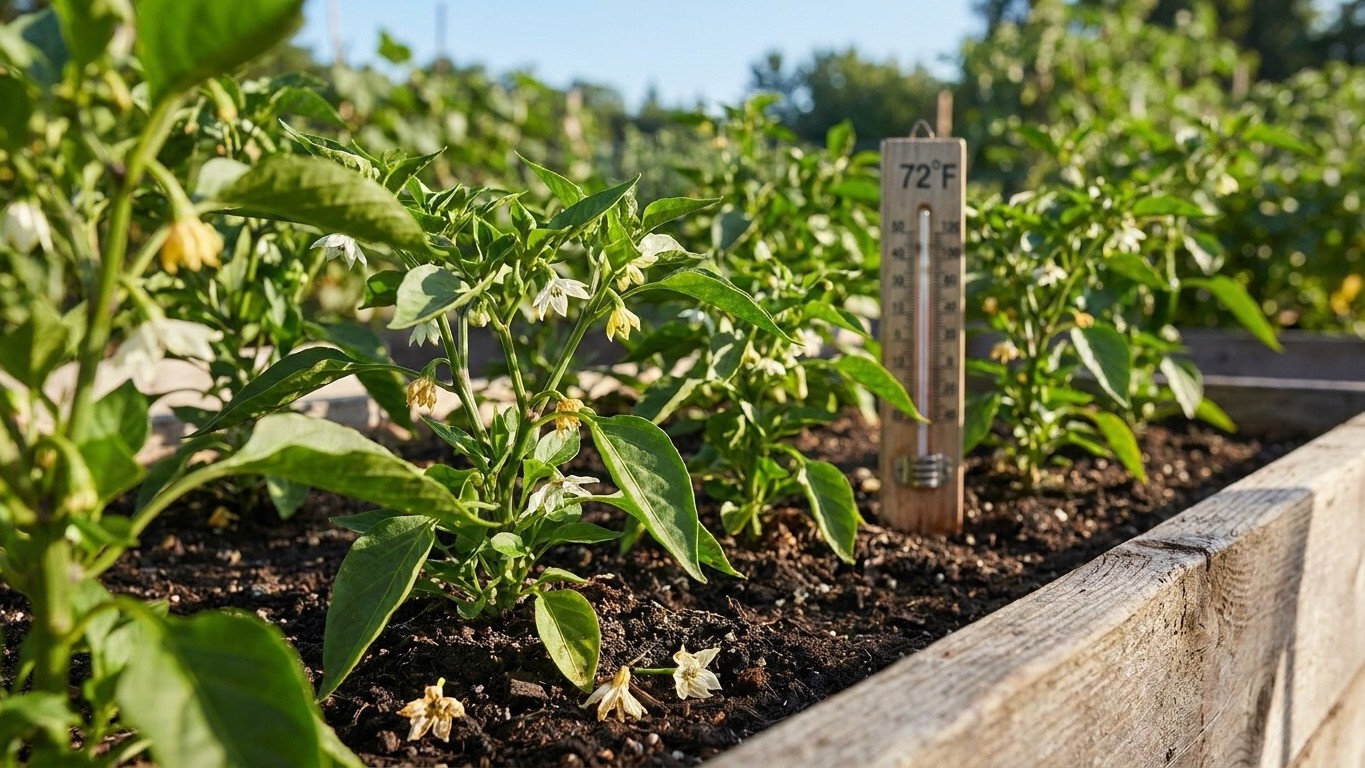

In Vermont, start pepper seed indoors 8 to 10 weeks before you plan to move transplants outside. Since the state’s last spring frost lands between April 30 and May 10 depending on where you live, and since peppers also need soil that has warmed to 60°F, most Vermont gardeners land on a seeding window somewhere in mid to late March. The exact week still depends on your county’s frost date and how fast your particular garden bed warms up that spring.
The short answer
Start with the heat side of the equation, because that’s the number this site actually tracks for Vermont. At the Burlington reference station, NOAA’s 1991-2020 Climate Normals put the average at 5.4 days a year reaching 90°F or higher. That’s a low heat load compared to states further south or inland, and it matters directly for pepper fruit set, because pepper flowers stop setting fruit once daytime temperatures climb above 90°F. With barely more than five days a year crossing that line, Vermont growers face relatively little risk from heat-driven blossom drop, but “little” isn’t “none.” A run of unusually warm days in July or August, especially with a transplant sitting in a black plastic pot on a south-facing deck, can still push local temperatures past that threshold even when the regional average stays low.
The other end of the fruit-set window is nights below 55°F, and here the picture gets more complicated for a Vermont gardener. Cold nights stop pepper flowers from setting fruit just as reliably as hot days do, sometimes more reliably, because Vermont’s climate is shaped as much by cool, clear nights as it is by summer heat. The problem is that this site does not carry summer night minimum data for Vermont or any other state. There’s no published figure here to hand you for “how many nights in your town drop below 55°F in June,” and guessing at one from latitude or from January’s average low would be worse than saying nothing at all, since low-elevation valleys near Lake Champlain and high ground in the Green Mountains or the Northeast Kingdom can differ by several degrees on the same June night.
What that means practically: watch your own thermometer once plants are outside, particularly through late May and early June when a clear, calm night can still dip cooler than the daytime forecast suggests. A raised bed against a south wall, a row cover pulled over young plants at dusk, or simply delaying transplant by a week or two if the extended forecast shows a cold stretch, all address the cool-night failure point that no regional average can predict for your specific yard.
When to start seed here
- Set your transplant date. Peppers go outside after your last frost and once soil temperature has reached 60°F. In Vermont, the last spring frost falls between April 30 and May 10 for the Burlington area, the mildest corner of the state thanks to the moderating effect of Lake Champlain. If you garden in the Green Mountains or the Northeast Kingdom, expect your frost-free date to run measurably later than that Burlington window, so use your own local frost record rather than the Burlington figure if you’re gardening at higher elevation or further from the lake.
- Check soil, not just the calendar. Air temperature crossing the frost line doesn’t mean the soil has caught up. Soil in Vermont often lags behind the air by a week or more in spring, so use a soil thermometer pushed a few inches into the bed rather than relying on the frost date alone. If your soil is still in the 40s or low 50s after frost has passed, hold the transplants a bit longer, even if it means potting them up once indoors.
- Count back 8 to 10 weeks. Utah State University Extension’s guidance on peppers puts the indoor head start at 8 to 10 weeks before transplant. If your working transplant date is early June (a reasonable target for a Burlington-area garden once both frost and soil temperature line up), counting back 8 to 10 weeks lands you on a seeding date in late March to early April. If you garden somewhere colder and expect to transplant closer to mid-June, shift your seeding date later by the same amount, rather than starting seed earlier and holding overgrown transplants indoors.
- Redo the math for your county, not the state average. Because Vermont’s frost dates and soil-warming pace vary so much between the lake shore and higher ground, the safest approach is to identify your own area’s typical last frost, add however many days your soil usually takes to reach 60°F after that, and count back 8 to 10 weeks from that combined date. That gives you a seeding date tailored to your actual garden instead of a blanket date for the whole state.
What goes wrong here
- Blossom drop in a hot spell. Even with Vermont averaging only 5.4 days a year at or above 90°F, a short, sharp heat spell in midsummer can still push flowers past the point where they’ll set fruit, especially on plants in containers or against a heat-reflecting wall. The remedy is shade cloth over the plants during the hottest afternoon hours of a heat spell, and consistent watering so the plant isn’t fighting drought stress on top of heat stress; flowers lost to a short spell are usually followed by new ones once temperatures ease.
- Blossom drop from a cool night. Because peppers also stop setting fruit when nights fall below 55°F, and because this site doesn’t publish summer night-minimum data for Vermont, the practical fix is to track your own nighttime lows on the ground rather than assume the season is safely warm just because daytime highs look fine. If a cold, clear stretch is forecast, cover young plants in the evening or delay setting late transplants out until the overnight pattern warms back up.
- Sunscald on fruit. Where the sun is strong and a plant’s leaf canopy is thin, whether from pruning, wind damage, or a plant that never bushed out well, exposed fruit can develop pale, papery patches from direct sun exposure. Letting the plant grow a fuller natural canopy, avoiding heavy pruning during fruiting, and using light shade cloth on the sunniest exposures during peak summer both reduce the risk.
- Blossom-end rot. This shows up as a dark, sunken patch on the bottom of the fruit and traces back to inconsistent watering that disrupts calcium uptake, not to a soil calcium shortage in most cases. Even, regular watering, particularly during dry spells or right after a heavy rain followed by a dry stretch, is the most reliable fix, along with mulch to keep soil moisture from swinging too widely between waterings.
Common questions
Can I start pepper seed earlier than 8 weeks to get a head start in Vermont’s shorter season?
Starting earlier than 8 to 10 weeks before transplant usually backfires. Peppers held too long indoors get root-bound and stressed, and an oversized, stressed transplant often performs worse once it’s outside than a younger, properly timed one. It’s better to time the seeding date around your realistic transplant date than to start earlier and hold plants longer indoors.
Does Vermont’s cool climate mean I should choose a faster-maturing pepper variety?
Utah State University Extension’s pepper guidance names several varieties but doesn’t attach a maturity length, heat rating, or size to any of them, so no figure from that source can be used to compare varieties here. What the same guidance does confirm is that flowering to fruit set typically runs 35 to 45 days once flowering begins, which is a separate clock from the 8 to 10 week seed-to-transplant window and worth keeping in mind when you estimate your first harvest date.
My peppers are flowering but not setting fruit in Vermont, is that heat or cold?
It could be either, since fruit set fails at both ends, above 90°F or below 55°F. Vermont averages only 5.4 days a year at or above 90°F, so heat is the less likely culprit here unless you’re in the middle of an unusual hot stretch. Cold nights are the more probable cause in Vermont’s climate, but since this site doesn’t track summer night minimums, checking your own overnight temperatures with a thermometer is the only way to confirm it.
Should I use the Burlington frost date if I garden elsewhere in Vermont?
Only as a starting reference. Burlington sits on Lake Champlain, which moderates temperatures and gives it one of the mildest, earliest frost-free windows in the state. Gardens in the Green Mountains or the Northeast Kingdom typically see later last-frost dates and should adjust their transplant and seed-starting timeline later than the April 30 to May 10 window recorded for Burlington.