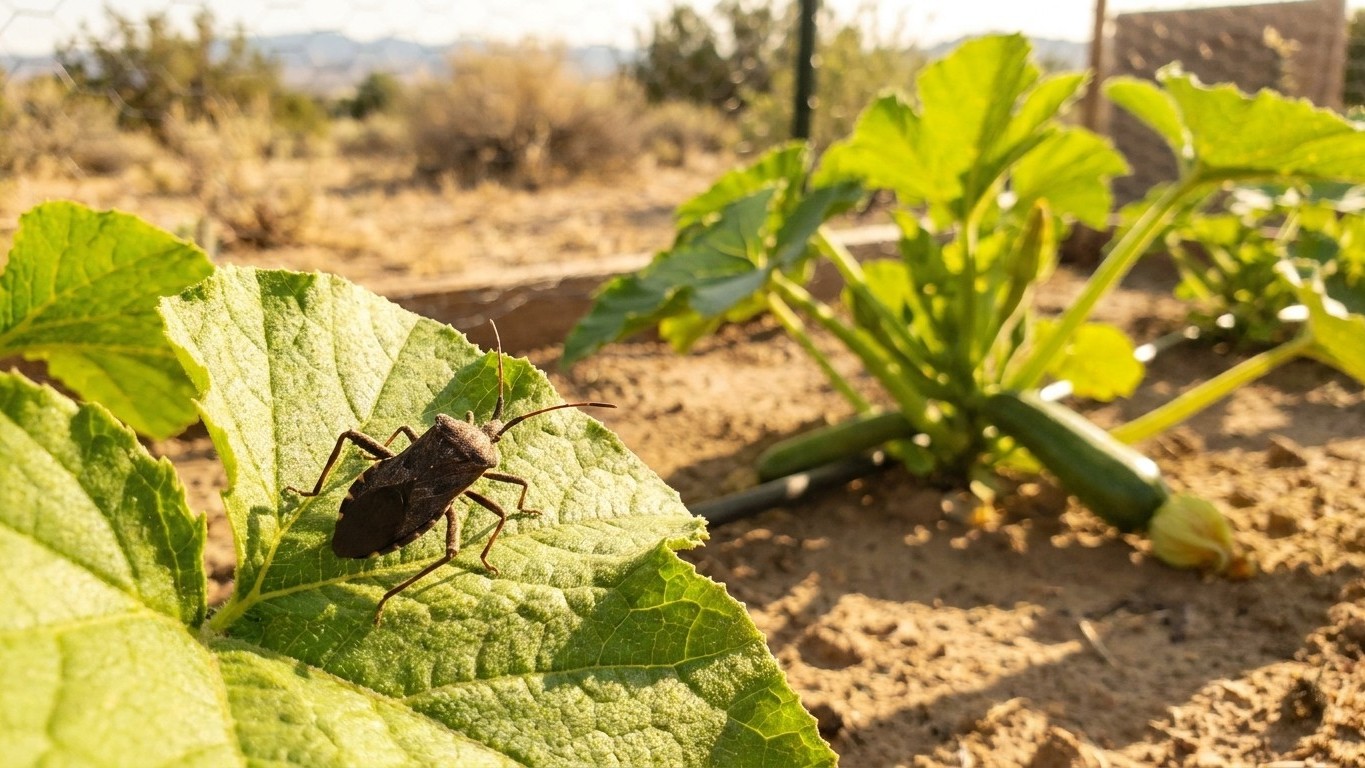

Only three of the pests University of Vermont Extension tracks statewide actually go after summer squash, and they show up in a fixed order tied to the growing season, not the calendar month. Flea beetles hit seedlings first, Japanese beetles arrive with the hot stretch of summer, and green stink bugs move in on the fruit as the season winds down toward frost.
Which pests attack summer squash in Vermont
University of Vermont Extension documents thirteen pests across the state’s home gardens and landscapes: Asian jumping worms, boxelder bug, Colorado potato beetle, dark-winged fungus gnats, European chafer, flea beetles, green stink bug, leek moth, oriental beetle, spongy moth, spotted wing drosophila, Swede midge, and white grubs (Japanese beetle). That’s the full documented list for this territory, and it doesn’t get padded here.
Most of that list has nothing to do with a squash plant. Asian jumping worms churn through soil organic matter but don’t feed on living leaves or fruit. Boxelder bugs feed on boxelder and maple seeds, not vegetables. Colorado potato beetle wants nightshades, tomatoes, potatoes, eggplant, not cucurbits. Dark-winged fungus gnats are a houseplant and greenhouse potting-mix problem, not a field crop. European chafer grubs chew turf roots and the adults browse tree leaves. Leek moth is an onion-family specialist. Oriental beetle grubs also live in turf and ornamental beds. Spongy moth caterpillars strip oak and other hardwood canopy. Spotted wing drosophila targets thin-skinned soft fruit like raspberries and cherries. Swede midge is a brassica pest, cabbage and its relatives. None of these belong on a squash damage checklist, and naming them there would be wrong.
That leaves three: flea beetles, green stink bug, and white grubs in their Japanese beetle adult stage. Flea beetles chew seedling leaves. Japanese beetle adults skeletonize foliage and can chew flowers. Green stink bugs feed on the fruit itself, piercing the skin and leaving scars. Whether any of the three actually shows up in a given garden depends on the year and the site, but these are the only ones with a documented feeding relationship to summer squash in this state. The frost-free window that runs roughly April 30 to May 10 through October 3 to October 13 sets the outer edges of when any of them can do damage at all.
When each one shows up, and what it does first
Flea beetles are the early problem. They’re active as soon as squash seedlings are up and the soil has warmed past the last frost date, and the first sign is a scatter of tiny, ragged holes across the cotyledons and first true leaves, sometimes called shot-hole damage, before the vines have started to run. A light case looks cosmetic. A heavy one on a young seedling can slow it down enough to matter.
Japanese beetle adults come later, once the vines are established and flowering. Their activity tracks the hottest part of the season, and Vermont’s reference station averages 5.4 days a year at or above 90°F, which is a short but real stretch of heat load that lines up with peak beetle feeding. What shows up first is skeletonized leaf tissue, the veins left standing while the softer material between them is chewed away, usually starting near the top of the canopy where beetles cluster in the sun. They’ll also chew on open flowers if the population is heavy.
Green stink bugs are the last to arrive, moving in once fruit has set and holding on into the weeks before the first fall frost. What shows up first isn’t leaf damage at all, it’s small, sunken, corky-looking dimples on the surface of the young fruit where the insect has pierced the skin to feed. A squash that looked clean a few days earlier can develop these marks fast once stink bugs find the planting, and the damage tends to concentrate on fruit closest to the ground.
None of this runs on a fixed date. It runs on how far the season has progressed relative to that frost-free stretch, which is why a garden in the Champlain Valley and one up in the Northeast Kingdom can see the same pest at noticeably different points in the summer.
Telling the damage apart from everything else
A chewed leaf or a marked-up squash isn’t automatically an insect problem, and guessing wrong wastes a season. The gesture that actually decides it is looking closely before treating anything, since several of the culprits below look alike from a few feet away.
| Symptom | Likely cause | What distinguishes it |
|---|---|---|
| Tiny, ragged holes in young leaves | Flea beetles | Holes are pinhead-sized, clustered on new growth, and small dark beetles jump when the leaf is disturbed at dawn |
| Leaf tissue skeletonized, veins left behind | Japanese beetle adults | Metallic green-and-copper beetles are visible feeding in clusters on the upper leaves during daylight hours |
| Sunken, corky dimples on fruit skin | Green stink bug feeding | Marks are scattered and pinpoint, unlike the single flat, dark patch at the blossom end typical of a calcium or watering problem |
| Sudden wilting of a whole vine | Water stress, given that summer rainfall here averages under 12 inches across June through August | Check soil moisture at the row first; if the soil is damp and the vine still wilts, that points away from drought and toward something worth a call to the extension office |
| Uniform yellowing without chew marks | Nutrient deficiency or waterlogged soil after a heavy rain | No holes, no scarring, no insects present, just fading color across the whole leaf |
The table sorts likely causes, not a diagnosis. A photo and a soil check go further than a guess, and University of Vermont Extension exists specifically to take that next step when the picture isn’t clear.
What actually works here, and what is a waste of time
Timing beats product on a growing season this short. Floating row cover installed right at transplanting keeps flea beetles off seedlings during the vulnerable early weeks, and it works because it’s a physical barrier, not a chemical one. The cover has to come off once flowers open, since squash needs pollinators to set fruit and a sealed row produces flowers that never turn into anything. That single timing decision, cover early, remove at bloom, does more for a home garden than most sprays.
Japanese beetles respond better to hand removal than to blanket treatment. Knocking them into a bucket of soapy water in the cool of early morning, when they’re sluggish, thins a population fast without touching pollinators working the same flowers a few hours later. Green stink bugs are helped less by any single tactic and more by garden sanitation, clearing plant debris where they overwinter reduces the population that shows up the following year.
What wastes time is spraying before identifying the problem. A product aimed at a chewing beetle does nothing for a piercing-sucking stink bug, and vice versa, so guessing burns money and a growing season that’s already short. It also risks harming pollinators the squash needs to produce fruit in the first place. This site doesn’t recommend specific products or active ingredients, because what’s legally registered for use in Vermont changes and only the state’s extension service tracks that accurately.
Where to check this for your own county
University of Vermont Extension is the source for everything above, and it’s also the right first call for anything that doesn’t match the patterns here. The service runs county-level offices, and a local office can look at a photo or a sample and say whether what’s showing up on a particular plant lines up with one of these three pests or with something else entirely.
Statewide documentation doesn’t mean even coverage. A pest confirmed somewhere in Vermont can be common in the Champlain Valley and rare sixty miles east in the Green Mountains, or the reverse. The hardiness zone range across the state runs 3b to 5b, and that spread by itself signals how different one county’s growing conditions can be from another’s, which is exactly the kind of variation a statewide pest list can’t capture.
The practical next step is a visit to University of Vermont Extension online or a call to the county office covering the garden in question, ideally with a photo of the damage and a note on when it first appeared relative to transplanting. That combination, timing plus a clear image, is usually enough for extension staff to confirm or rule out one of the three pests documented here.