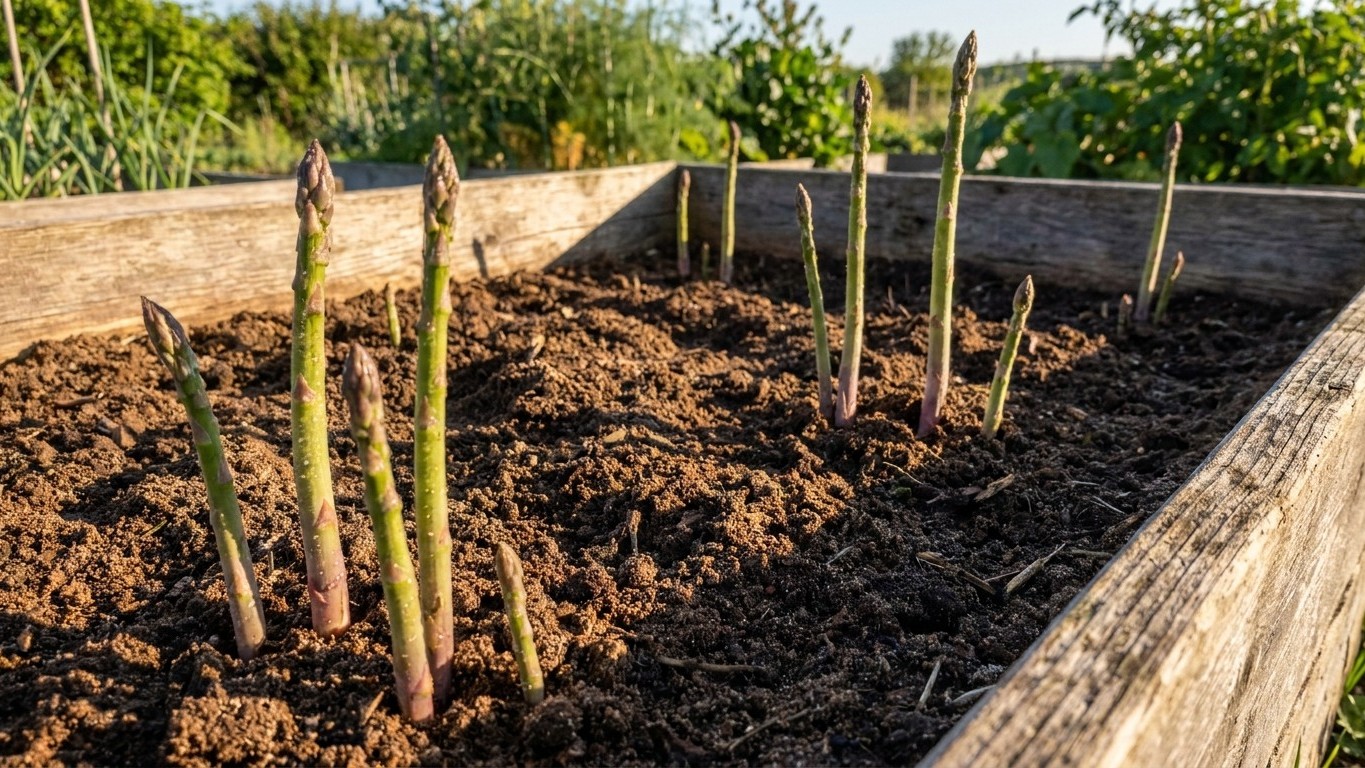

Yes, in most cases: a fifteen-year asparagus bed can work in West Virginia, but the deciding factor is drainage, not fertility or frost. The state’s representative soil, the Monongahela series, is described as moderately well drained loam and silt. That’s a workable starting point for a permanent bed, though it’s a description of one soil series across the state, not a reading of any single backyard.
The short answer
A commitment this long changes how a gardener should think about soil. Every other vegetable on this site gets replanted or rotated within a season or two, so a heavy, slow-draining patch is an annoyance you fix next year. Asparagus doesn’t work that way. Once the crowns go in, that ground is spoken for a decade and a half, and the crop’s only published requirement, according to Utah State University Extension, is that the soil drains. Nothing else in the source narrows the choice.
West Virginia’s state soil, the Monongahela series, gives a useful baseline for what the region’s ground tends to do. Sampled surface horizons run about 27 percent sand, 18 percent clay and 54 percent silt, a loam-to-silt mix, with organic matter around 3.0 percent and a surface pH near 5.0. USDA NRCS classifies drainage on this series as moderately well drained. That’s a reasonable sign for a long-lived bed: not sandy enough to dry out fast, not clay-heavy enough to sit wet through a wet spring.
The pH figure is worth flagging for what it is and isn’t. It’s the representative surface reading for the Monongahela series as mapped, not a number that applies to a working garden bed, and the source on asparagus itself says nothing about a preferred pH. Don’t treat 5.0 as a target or a warning; treat it as one data point about the region’s parent material, and confirm your own plot with a soil test rather than assuming the state figure describes your dirt.
If the spot doesn’t drain
Moderately well drained is the state average, not a guarantee. River bottoms, compacted building lots and low corners of a yard can all hold water longer than the mapped series suggests, and a bed that sits wet through late winter is exactly the situation asparagus tolerates poorly over fifteen years. The fix isn’t complicated: raise the bed six to eight inches above grade, work in coarse compost to open up a silty structure, or simply pick higher ground on the property before the crowns go in the furrow. This is a decision to make once, correctly, rather than one to patch later.
Will the summer here water it for you?
The crop’s water schedule is specific and doesn’t shift much for climate: Utah State University Extension calls for 1 to 2 inches every other week for the first two years, then a lighter routine of watering every three weeks once the bed is established. West Virginia’s summer rainfall, drawn from NOAA’s 1991-2020 normals at station USW00013866, runs about 13.8 inches across June, July and August combined, broken down as:
- June: 4.72 inches of normal rainfall
- July: 5.38 inches, the wettest of the three summer months
- August: 3.75 inches, the driest summer month on the calendar
Spread evenly, that’s roughly 1.1 to 1.3 inches a week across the summer, which lines up reasonably well with the every-other-week target for an establishing bed in June and July. August is the month to watch. At 3.75 inches for the whole month, the average works out closer to 0.9 inches a week, below what a two-year-old bed wants, and that’s before accounting for how rain actually falls. A single thunderstorm that drops half an inch in twenty minutes runs off a silty surface rather than soaking into the root zone, so the monthly total can look adequate on paper while the bed still goes short.
The practical takeaway: don’t assume West Virginia’s summer rainfall covers the bed on its own, especially in August or during any stretch without a soaking rain. A rain gauge staked next to the bed is the only way to know what actually reached the ground that week, and it costs less than replacing crowns that dried out in year one. Once the bed matures past year two and moves to the every-three-weeks routine, the region’s normal rainfall carries more of the load, but a dry August still calls for a hose.
When to put the crowns in
Crowns go into the ground in early spring, and for West Virginia that means working around the region’s typical last freeze rather than a fixed date. NOAA’s 1991-2020 normals put the state’s 30 to 70 percent probability window for a 32F freeze at around April 9 to April 23, based on station USW00013866. That’s a mean, not a promise, so treat it as the window to aim for rather than a date to circle. Gardeners at higher elevation should expect that window to run later, since a river-valley station like this one warms earlier than the ridges and higher ground across the state.
The planting method itself is straightforward: crowns are set in 8-inch furrows. Rather than filling the furrow all at once, the soil goes back in gradually over the season, about two inches every other month, so the developing crown is covered in stages instead of buried immediately under a full furrow of soil. Seed is the other route into an Asparagus Bed, and it’s the slower one; the source treats crowns as the standard planting method and doesn’t detail a seed-starting timeline, so a gardener choosing seed should expect an extra season of growth before those plants reach crown size.
Choosing among named varieties
Utah State University Extension names four varieties, distinguished only by sex, with no notes on flavor, yield or a reason to prefer one over another:
| Variety | Sex |
|---|---|
| Jersey Giant | All-male |
| Jersey Knight | All-male |
| UC 157 F1 | Male/female |
| Purple Passion | Male/female |
All-male varieties tend to be favored in home gardens because they don’t spend energy on seed production, but the source doesn’t rank them on any other trait, so that choice is left to the gardener.
Patience matters more than the planting date. There’s no harvest at all in the first two years. Year three brings a first, short harvest window of about four weeks. The year after that stretches to six weeks, and the year after that to eight. Regardless of the calendar, the rule for stopping each season’s harvest is the same: stop cutting once most of the spears coming up are thinner than a pencil, a sign the plant needs its foliage to rebuild the crown for next year rather than keep producing.
Common questions
How do I check if my own soil drains well enough for asparagus?
Dig a hole about a foot deep, fill it with water, and time how long it takes to drain. Standing water after several hours suggests a site better suited to a raised bed than an in-ground fifteen-year planting.
Does the state soil’s pH of 5.0 mean I need to add lime?
That figure is a representative reading for the Monongahela series’ surface horizon, not a measurement of your bed, and the source on growing asparagus doesn’t specify a preferred pH at all. Test your own soil rather than adjusting based on the state figure.
Can I water less once the bed is a few years old?
Yes. The every-other-week, 1-to-2-inch schedule applies to the first two years while the bed establishes. After that, the routine eases to watering roughly every three weeks.
Is there a winter chilling requirement I should plan around?
That figure isn’t published in the source used here, and turning a hardiness zone into a chilling number would be a guess rather than documented information. Plan around the frost dates and watering schedule given above instead.