
Collards in Virginia split into two very different plants depending on where you garden. Along the coast, a mild enough winter turns them into a standing crop you pick leaf by leaf into March. Inland and in the mountains, they’re strictly an autumn crop, planted for one harvest before a hard freeze ends the season.
When the soil is warm enough in Virginia

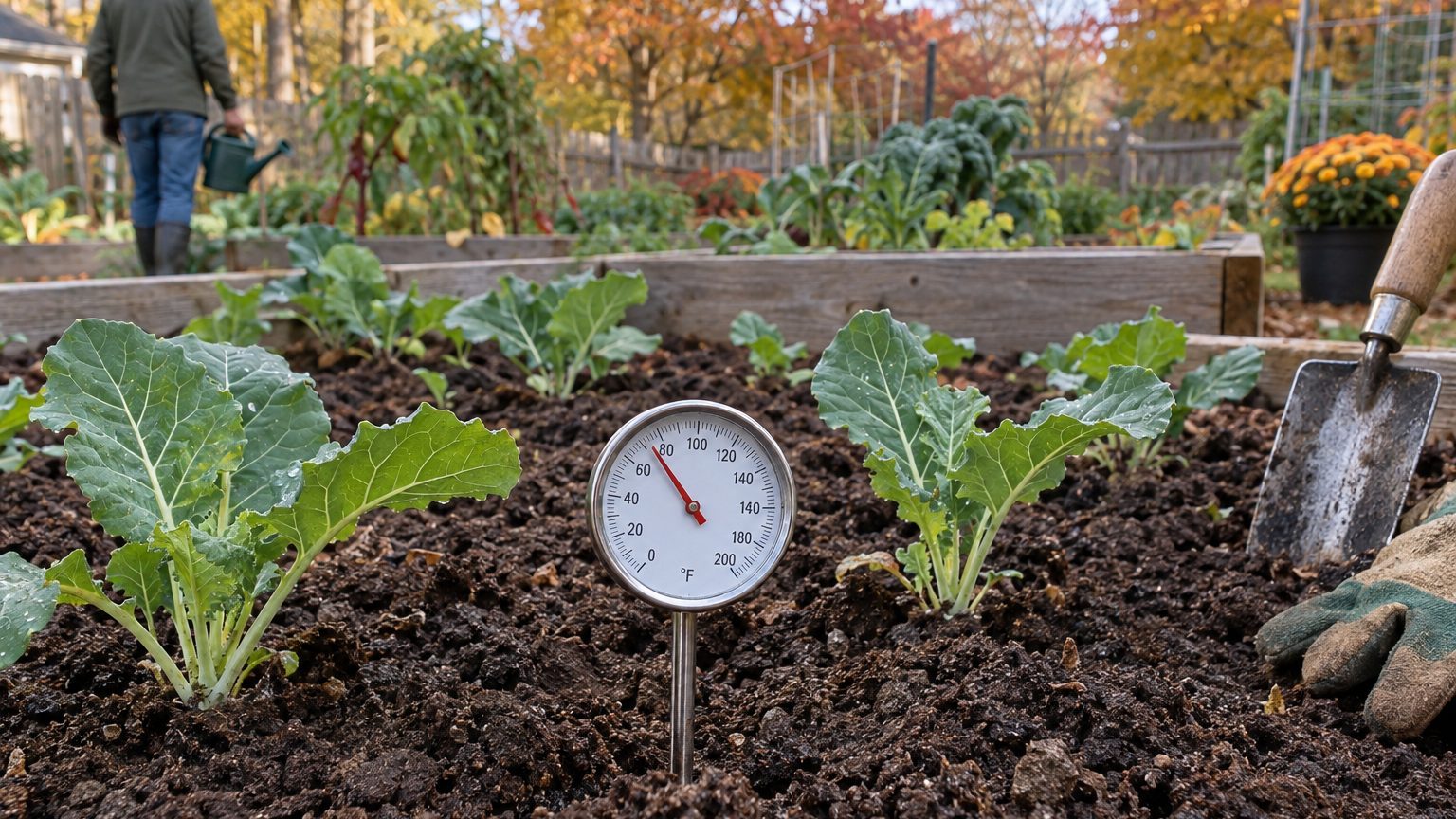
The calendar answer to “when do I plant collards” is always the same shape: after the last frost. But frost is a stand-in for the number that actually matters, which is soil temperature, and soil doesn’t warm the moment the air clears 32°F overnight. It lags behind by days, sometimes weeks, especially in a bed that’s shaded or still holding winter moisture.
For coastal Virginia, NOAA’s 1991-2020 Climate Normals put the last spring frost at station USW00013769 (NAS Oceana) in a window of March 20 to April 3, based on the 30-70% probability band for a 32°F freeze. That’s a probability, not a promise: some years the last frost lands earlier, some years later, and this range simply marks when the odds tip in your favor. Soil worth planting into typically catches up a week or two after that window closes.
This is the mild end of the state. Virginia Beach sits at the warm edge of a very wide territory, and the caution attached to this data matters: the Blue Ridge and southwest Virginia run weeks later in spring and weeks earlier in fall. A gardener in Roanoke or Abingdon should treat the Oceana window as a starting reference, then check their county’s extension office for a local adjustment rather than assume the coastal date applies to their yard.
Collards tolerate a light frost better than most spring vegetables, which is why many gardeners start transplants a few weeks ahead of the last frost date indoors, then harden them off before moving them to the garden. Direct-seeded beds do better waiting until the soil has genuinely warmed, not just until the frost risk has technically passed.
One more thing worth carrying into bed planning: collards are brassicas, in the same family as turnip, rutabaga, cabbage, kale and mustard, and they share the same soil-borne pests and diseases. Planting collards into a bed that grew any of those crops last season isn’t a rotation, it’s the same risk repeated. A proper rotation plan belongs on its own page, and it’s worth reading before you pick this year’s bed.
How long the season lasts here
Put the two frost dates from the Oceana record together and you get the shape of the growing window, not just its start. At the tightest reading, using the latest last-spring-frost date (April 3) against the earliest first-fall-frost date (November 10), the frost-free stretch runs about 221 days. At the most generous reading, pairing the earliest spring date (March 20) with the latest fall date (November 24), it stretches to roughly 249 days. Either way, that’s close to seven months, and for a reference point right on the coast, it’s a long season by Virginia standards.
What that length allows is the real question. A window this size leaves room for a spring or summer sowing followed by a second sowing timed to mature as the weather cools, which is exactly the kind of planning covered in a succession sowing guide. Collards handle a second planting well because they’re one of the few greens that actually improve in flavor after a light frost, so a fall-timed sowing isn’t a consolation prize, it’s often the better crop.
Move inland or up into elevation and this math changes fast. Where spring frost lingers weeks longer and fall frost arrives weeks sooner, as the caution on this data explicitly flags for the Blue Ridge and southwest, that seven-month window can shrink toward five. At that length, the first sowing often becomes the only sowing worth the effort, and it shifts the transplant decision too: with less season to spare, a gardener has less room to recover from a bad batch of starts, which makes checking transplant roots for girdling or rot before they go in the ground worth the extra five minutes.
The practical takeaway is that “how long is the season” doesn’t have one Virginia answer. It has a coastal answer and a mountain answer, and the gap between them is measured in weeks that matter.
Heat and water in Virginia

This page doesn’t have a station-level count of days above 90°F or a summer rainfall total to draw on, so rather than guess at numbers that aren’t sourced, it’s worth focusing on the figure that actually decides how collards get grown here: winter cold.
At the coastal reference station, the coldest month’s average daily minimum runs 31.6°F, sitting right at the freeze line rather than well below it. That single number is the hinge the whole growing plan turns on. Where winters stay that mild, collards behave as a standing crop: planted in late summer or early fall, they sit in the garden through the cold months and get picked leaf by leaf from November into March, regrowing from the center as outer leaves are harvested. Where the coldest month runs colder than that, collards are an autumn crop with a firm endpoint, planted for one harvest that finishes when a hard freeze knocks the plant down for good.
The USDA hardiness zone range for Virginia, 5a to 8b under the current Plant Hardiness Zone Map, tells the same story from a different angle. That’s a huge spread for one state, and it’s built on average annual extreme minimum temperatures rather than a typical winter, but it lines up with the coastal-versus-inland split described above.
| Region | Frost pattern | Approximate hardiness zone | Collard growing style |
|---|---|---|---|
| Coastal Virginia (reference: Virginia Beach) | Last frost Mar 20-Apr 3; first fall frost Nov 10-Nov 24 | Toward 8b | Standing winter crop, picked through the cold months |
| Blue Ridge and Southwest Virginia | Spring frost weeks later; fall frost weeks earlier | Toward 5a | Autumn crop ending at first hard freeze |
Without rainfall figures for this page, the honest guidance is to watch the bed rather than a chart: a summer that runs cool and damp tends to slow ripening and invite mildew on brassica leaves, and that risk applies whether or not this page can quote you an exact rain total. Good spacing for airflow does more for a humid Virginia summer than any calendar date.
Which collards suit Virginia
Rather than name a specific collard cultivar, the honest answer here is to choose by type and then let a local source fill in the name, because the varieties that actually perform in a given Virginia county are the product of trials this page doesn’t have access to.
A short growing season, the kind found in the Blue Ridge and southwest, favors the earliest-maturing types, since every week saved at the front end is a week of insurance against an early fall frost. A long, mild season near the coast can afford a slower type bred to stand through winter, since the whole point of that garden bed is holding leaves in the ground for months, not racing to harvest.
Heat changes the calculation differently. In a Virginia summer, plants given generous spacing for airflow and a bit of afternoon shade at the root zone tend to hold up better through the hottest stretch than those crowded together, regardless of which type they are. And because humidity is a given across most of the state, disease resistance, particularly against the mildews and leaf spots that hit brassicas in wet years, becomes the first thing worth asking about when choosing seed, ahead of taste or leaf size.
The one recommendation this page can make with confidence is where to find the rest of the answer: Virginia Cooperative Extension at ext.vt.edu publishes variety trial results by region, and that’s the list built from actual Virginia soil, not a generic national one. A gardener in Norfolk and a gardener in Wise County are working with different frost dates, different winter lows, and different disease pressure, so the seed packet that makes sense for one may be the wrong choice for the other.