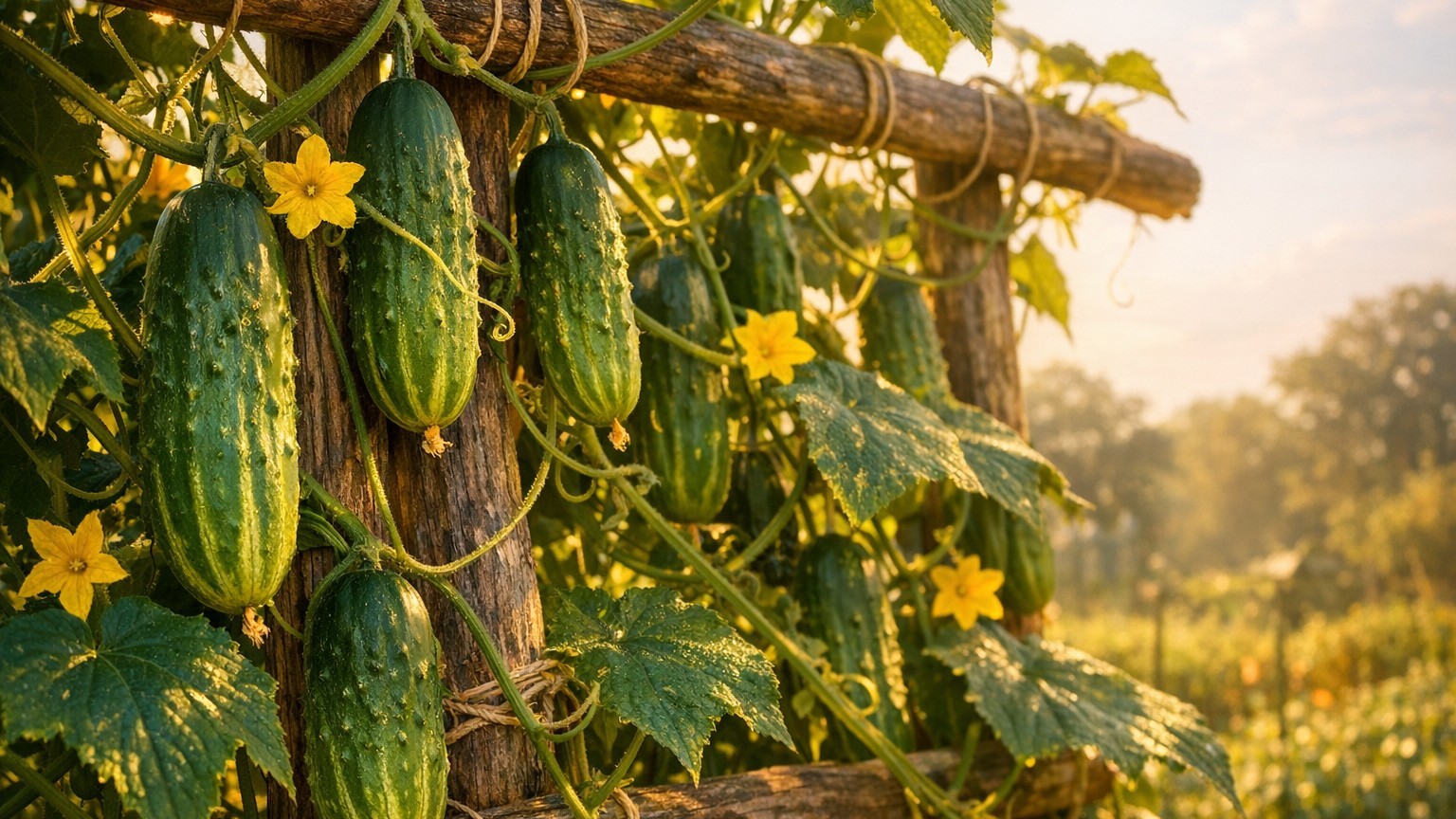

Virginia’s frost-free window runs long enough near the coast for almost any type of cucumber to mature comfortably, but that answer shifts fast once you move inland or climb in elevation. The starting point isn’t a variety name, it’s a category: pickling or slicing, bush or vining, and how much disease resistance the local humidity demands. From there, the county extension office fills in what’s actually been trialled nearby.
The short answer for Virginia
Pick by type first, cultivar second. Along the coastal plain, where the reference climate station at NAS Oceana in Virginia Beach shows a frost-free stretch running from a last spring frost between March 20 and April 3 to a first fall frost between November 10 and November 24, gardeners have somewhere between roughly 220 and 250 days without freezing temperatures in a typical year. That’s a genuinely long season by East Coast standards, and it’s plenty of time for slower-maturing vining slicers as well as quick pickling types, with room to reseed a second pickling crop in midsummer if the first one gets tired.
Heat load matters here too, but it’s moderate rather than extreme. The same coastal station averages 26.0 days a year at or above 90°F, according to NOAA’s 1991-2020 climate normals. That’s enough heat to stall flowering and turn fruit bitter if watering is inconsistent, but it’s not the sustained furnace that some Deep South gardens deal with for two straight months. In practical terms, it means heat tolerance is a secondary filter here, not the first one.
The bigger local variable is moisture and humidity. Summer rain averages about 15.0 inches across June, July and August, with June the driest month at 4.15 inches, July at 5.76 inches and August at 5.09 inches. That rain rarely falls evenly. It tends to arrive as thunderstorms, which means long dry stretches between soakings and high humidity lingering in between. For cucumbers, a crop that’s shallow-rooted and prone to fungal disease on wet foliage, that combination favors vining types trained upright on a trellis over sprawling bush types left flat on damp soil, and it favors selections bred for resistance to powdery and downy mildew over ones that aren’t. Parthenocarpic types, which set fruit without needing pollination, are also worth asking your local extension about if a humid stretch tends to knock back pollinator activity or if you’re growing under any kind of cover.
None of this points to one winning variety. It points to a short list of traits, disease resistance, upright growth habit, and a maturity window that fits the frost dates on your end of the state, then a conversation with Virginia Cooperative Extension about which named varieties have actually performed well in trials near you.
What will not work here

Long-season vining slicers that need the full run of a coastal growing window are a poor bet away from the coast. The frost dates above come from the mild end of the state. Inland and at higher elevation, both ends of the season arrive earlier in fall and later in spring, which can shave weeks off that 220-to-250-day window without warning. A cucumber that needs every one of those coastal days to finish simply won’t get there in the mountains.
Watering on a fixed weekly schedule
A once-a-week watering routine fails against the way Virginia summer rain actually falls. With June averaging just 4.15 inches and that total often arriving in a handful of thunderstorms rather than steady drizzle, a cucumber bed can go bone dry for a week and then get soaked all at once. Add in 26.0 days a year of 90°F-plus heat driving evaporation, and shallow cucumber roots dry out between storms even in a month with decent rainfall on paper. Bitter fruit and blossom drop are usually the first signs the watering interval, not the total rainfall, was the problem.
Tight spacing and sprawling on bare, damp soil
Packing vining cucumbers close together and letting them sprawl works fine in a dry climate. It’s a liability in one where summer humidity sits high enough to average 15.0 inches of rain over just three months. Dense foliage close to the soil stays wet longer after each storm, and that damp, still air is exactly what powdery and downy mildew need to spread. Vertical trellising, which lifts leaves into moving air and morning sun, does more to prevent disease here than any spray schedule.
Direct-seeding too early is the other common misstep. With the coastal last-frost date running as late as April 3 in some years, and considerably later inland, soil that looks workable in March is often still too cold for cucumber seed, which tends to rot rather than sprout below roughly 60°F. Waiting for the soil itself to warm, not just the calendar, avoids a frustrating reseed.
What changes across Virginia
Virginia is not one garden, and the numbers make that obvious. The state spans USDA Hardiness Zone 5a to 8b, one of the widest ranges of any state on the East Coast. That’s the gap between the mountain highlands of the far southwest, where winter extreme lows regularly drop well below zero, and the Tidewater and coastal plain, where they rarely get close. A range that wide means there is no single planting date, no single season length, and no single answer to “which cucumber type fits” that holds for the whole state.
All the frost-date and heat figures cited above come from the Oceana station in Virginia Beach, which sits at the mild, coastal end of that range. That’s a deliberate caution built into the data itself: the Blue Ridge and southwest Virginia run weeks later for the last spring frost and weeks earlier for the first fall frost. A gardener working at elevation in those regions should assume a meaningfully shorter frost-free window than the one described here, favor quicker-maturing pickling and bush types over long-season slicers, and treat any midsummer succession planting as a race against an earlier fall cutoff rather than a leisurely second crop.
Heat load shifts too, generally dropping with elevation, which can ease the bitterness and blossom-drop pressure that coastal and Piedmont gardeners deal with in a typical Virginia summer, but it also means the growing window for warmth-loving cucumbers opens later in spring. The right move for figuring out where a specific garden falls in that 5a-to-8b spread isn’t guesswork. It’s checking the current USDA Plant Hardiness Zone Map directly against a home address, since zone boundaries can shift within a few miles depending on elevation and terrain.
Where to check this for your own county
Virginia’s state-level pattern rests on a single coastal reference station. That’s useful for understanding the general pattern, but it is not a substitute for a county-level recommendation, and Virginia Cooperative Extension exists specifically to fill that gap. Their statewide portal is ext.vt.edu, and from there the site routes to local unit offices for every Virginia county and city.
Two things are worth looking for once there. The first is a local planting calendar, which will reflect the actual frost dates for that specific county rather than the coastal averages used here, an especially important correction for anyone in the Blue Ridge, the Shenandoah Valley, or the far southwest highlands where the season runs measurably shorter than at Virginia Beach. The second is any list of cucumber varieties that county agents or nearby university trial programs have actually grown and evaluated locally, including notes on which selections held up against powdery mildew or downy mildew in a wet year, since that’s exactly the kind of humidity-driven disease pressure this state deals with most summers.
A state-level page like this one can point toward the right category of cucumber and explain why the coast and the mountains behave differently. It can’t tell a gardener in Wise County or Lee County, hundreds of miles from the reference station and a full hardiness zone or more colder, exactly when their own soil will be warm enough to seed. That’s a county-level answer, not a state one, and county extension offices are built to give it.
Checking this against your own garden
Every date here is an average built from decades of station data, and averages describe a typical year, not this year. The garden itself gives better information, and it does that through three signs that don’t require any equipment beyond attention.
Soil warmth by feel comes first. Cucumber seed wants soil that feels warm to bare skin at planting depth, not just air that feels warm at midday. Soil that still feels cool or damp-cold an inch or two down, even after a few sunny days, is a sign the local microclimate is running behind the general seasonal pattern, whatever the calendar says.
The first flush of male flowers is the second signal. Cucumbers typically produce a wave of male blossoms before the female flowers, the ones with a tiny swollen bulge behind the petals, appear and start setting fruit. A long gap between the two, or male flowers dropping without any females following, often points to heat or moisture stress rather than a timing problem, and it’s worth checking watering consistency before blaming the variety.
The first true leaves, the serrated ones that follow the smooth seed leaves, tell a third story: how the plant is handling its actual conditions versus the ones assumed by a seed packet’s maturity estimate. Slow, pale true-leaf growth in soil that should be warm enough usually means something specific to that spot, drainage, compaction, or shade, is holding the plant back more than the regional climate ever would.