
Winter squash goes into Virginia ground once the soil has warmed past the last frost risk, typically late April through May depending on where you garden in the state, and the crop runs until the first fall frost cures the vines. Between those two points, heat, humidity and rainfall decide which types of winter squash actually finish and store well.
When the soil is warm enough in Virginia

NOAA’s climate normals put the last spring frost for coastal Virginia between March 20 and April 3, based on 1991-2020 data from station USW00013769 at NAS Oceana. That’s a 30-70% probability band, not a guarantee, and it’s worth saying plainly: a frost date is a statistical likelihood, not a promise the ground will be safe on that exact day. Some years you’ll get a cold snap after it. Most years you won’t.
Frost date and soil temperature are two different things
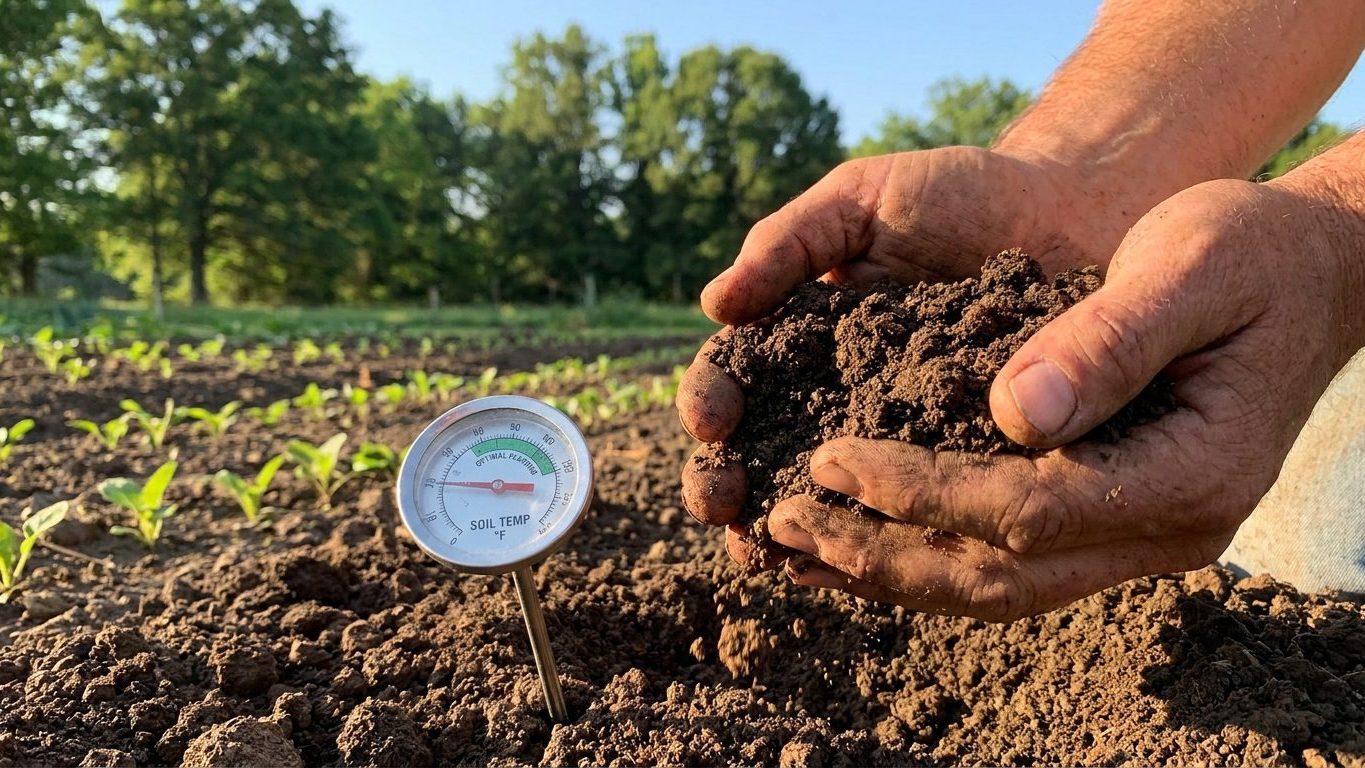
Here’s the part gardeners often skip past: the frost date tells you when freezing air becomes unlikely, not when the soil is warm enough for squash seed to germinate reliably. Winter squash seed sits and rots in cold, wet soil rather than sprouting, so the practical move is to wait one to two weeks past the local last-frost window before direct-seeding or setting out transplants. Push a bare hand into the soil a few inches down. If it feels cool and damp rather than sun-warmed, give it more time.
That March 20 to April 3 window applies to the Oceana station on the coast, which sits at the mild end of Virginia’s climate range. The Blue Ridge and the southwest corner of the state run weeks behind that coastal timing in spring, and their growing conditions shift earlier into fall as well. A gardener in Roanoke or in the mountains west of Staunton should treat the Oceana dates as a starting reference, not a local forecast, and check their own county’s extension data before committing seed to the ground.
Virginia’s USDA hardiness zones span 5a to 8b across the state, a range built entirely on winter’s extreme minimum temperature rather than spring timing. It’s a different measurement than the frost dates above, useful mainly for choosing perennial plants, but it underlines the same point: this is one state with genuinely different growing calendars from the coast to the mountains, and a single planting date does not serve all of it.
How long the season lasts here
Using the coastal reference station’s normals, the frost-free window runs from as short as about 221 days (a late last frost on April 3 paired with an early first frost on November 10) up to roughly 249 days (an early last frost on March 20 paired with a late first frost on November 24). That’s somewhere between seven and eight months of workable ground, depending on the year and depending on which end of that probability band actually shows up.
What that length allows you to do
A window stretching toward 249 days gives real room for a second sowing of a fast-maturing type after an early planting fails or gets eaten by squash bugs, or for staggering harvests so storage squash doesn’t all come in during the same crowded week. A window sitting closer to 221 days is tighter: it still fits nearly every winter squash type through to maturity, but it makes the first sowing the one that has to work, since a failed planting has less room to be replanted and still mature before frost cures it on the vine.
That distinction also affects whether transplanting makes sense. Winter squash resents root disturbance, so direct-seeding is usually preferred where the season is generous enough to absorb the week or two a transplant needs to recover in the ground. In a shorter local window, especially at higher elevation where the effective season runs closer to that 221-day figure, starting seed indoors under cover and transplanting out carefully can buy back the days a direct-sown crop would otherwise lose to a late frost or a slow spring. For the mechanics of staggering plantings across a season like this, the succession sowing guide on this site walks through timing a second round without crowding out the first.
Heat and water in Virginia

The reference station at Virginia Beach logs an average of 26.0 days a year at or above 90°F. That’s a moderate heat load, not the sustained triple-digit stretch you’d see farther south or west, and it matters because winter squash is the crop where the whole season has to add up correctly: the fruit needs to mature and harden fully on the vine before frost, and a squash pulled green neither cures properly nor keeps through winter storage.
Rain that arrives, but doesn’t always soak in
Summer rainfall at the same station averages about 15 inches across June, July and August, broken down as 4.15 inches in June, 5.76 in July and 5.09 in August. That’s a reasonably wet summer by national standards, and June’s lower figure means the driest stretch usually falls right when young vines are establishing, so a dry spell early on is the one to watch for rather than assume rain will cover it.
That 15 inches never reads alone, though. It usually arrives as scattered thunderstorms rather than steady soaking rain, and a hard downpour on clay soil runs off before it penetrates, while the same storm on sandy soil drains through within a day. Add in 26 days of 90-degree heat driving evaporation, and a garden can still need supplemental watering during a week that technically got an inch of rain. A rain gauge staked in the actual garden bed is the only way to know what’s landing there, since a slope, a rain shadow or a nearby building can shift totals from what the reference station recorded.
The bigger risk in Virginia’s climate isn’t drought stress, it’s the combination of humidity and rainfall sitting on leaves through a warm, muggy summer. Powdery mildew and downy mildew both thrive in exactly those conditions, spreading fastest where foliage stays damp and airflow is poor. Watering at the soil level instead of overhead, spacing vines to let air move through the planting, and pulling spent or infected leaves as the season progresses all reduce that pressure without reaching for a fungicide at all.
Which winter squash suit Virginia
Given a season that runs 221 to 249 days and a summer that’s humid more than it is scorching, the reasoning points in a specific direction. Types on the shorter end of maturity, such as acorn-type or delicata-type squash, hedge against a mountain garden’s tighter window or a year when spring drags. Types that need the full length of the season, like hubbard-type or larger kabocha-type squash, do best where the coastal window’s longer end is realistic, and where the gardener is prepared to give them the space and airflow that Virginia’s humidity makes worth prioritizing over yield alone.
Disease resistance first, everything else second
In a state where mildew pressure is the recurring problem rather than heat stress or drought, disease tolerance matters more when choosing a type than days-to-maturity claims or fruit size. Butternut-type squash, for instance, tends to shrug off vine borers better than some other types thanks to its solid stem, which is a real advantage in a humid mid-Atlantic garden regardless of how it performs elsewhere.
What this page won’t do is hand over a specific variety name. Seed companies trial dozens of named cultivars within each of these types every year, and which ones actually perform well against Virginia’s particular mildew pressure and season length changes as breeding programs release new resistant lines. Virginia Cooperative Extension, through Virginia Tech’s extension service, publishes the variety trial results for the state’s actual growing conditions, broken down by region where the data supports it. That’s the source built to answer the cultivar question honestly, because it’s tested locally and updated as new trials come in, which a general gardening page simply is not.