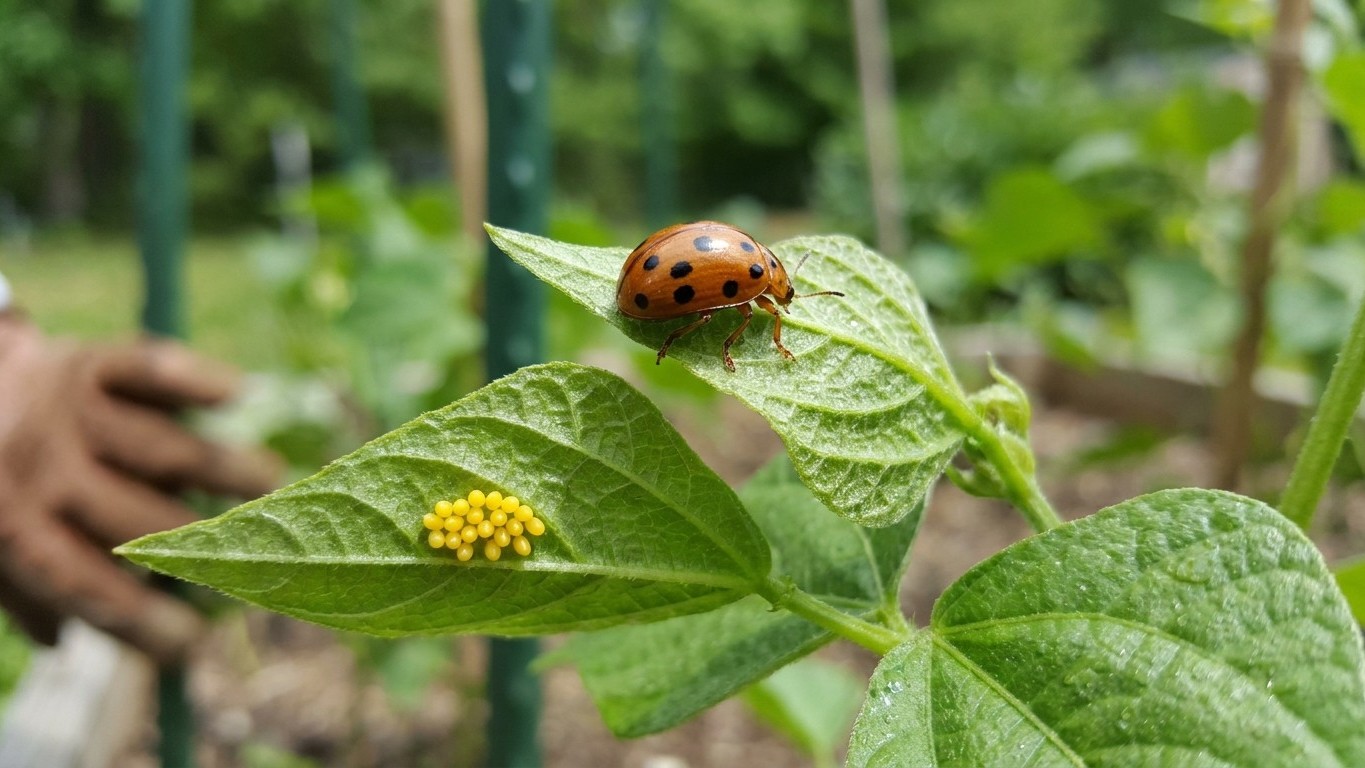

Mexican bean beetle shows up in Virginia gardens in late April through May, when overwintered adults crawl out of leaf litter and head straight for young bean plants. The beetle produces two to three generations before frost, with populations peaking in July and August across most of the state. Stopping it means combining early scouting, a parasitic wasp that specifically targets this pest, and timing your planting to dodge the worst of the pressure.
This isn’t some exotic invader that snuck in last year. Virginia growers have dealt with Epilachna varivestis for generations, and the insect’s habits are well documented by land-grant researchers across the mid-Atlantic. What trips people up is the disguise: it looks enough like a beneficial ladybug that half the damage gets done before anyone notices the culprit.
Life Cycle and Timing in Virginia

The Mexican bean beetle overwinters as an adult, tucked into leaf litter, under garden debris, or along fence rows near last year’s bean patch. Soil temperature and day length trigger emergence, and in Virginia that typically lines up with the last frost date, roughly late April in the Tidewater region and mid-to-late May in the mountains west of Roanoke.
Once active, females lay clusters of yellow eggs on the undersides of bean leaves, usually 40 to 75 eggs per cluster. Eggs hatch in five to fourteen days depending on temperature, and the spiny yellow larvae feed for two to five weeks before pupating right on the plant. A full generation, egg to adult, takes about a month in warm weather. That’s why a garden can go from “a few beetles I’ll deal with later” to “skeletonized leaves” in under three weeks.
Why Late Summer Is the Danger Zone
Virginia typically sees two full generations and the start of a third before the season ends. The first generation feeds on spring plantings in June. The second, usually the worst one, builds through July and August on snap beans, lima beans, and soybeans. By the time gardeners notice lacy, skeletonized foliage, that second generation is often already laying eggs for a third round that will overwinter as adults and start the cycle again next spring.
Soybean fields matter here too. Backyard growers often blame their own garden for a beetle surge, but Mexican bean beetle moves freely between garden beans and nearby soybean acreage. In counties with heavier soybean production, like parts of the Shenandoah Valley and the Southside region, that back-and-forth traffic can push populations higher than in areas without commercial bean crops nearby.
Telling It Apart From the Ladybug You Actually Want
Adult Mexican bean beetles are coppery-brown or yellowish-bronze, about a quarter inch long, with sixteen black spots arranged in three rows across their wing covers. That’s the giveaway detail: sixteen spots, not the fewer and more scattered spots you’d see on a lady beetle. They’re also noticeably rounder and more domed than most beneficial lady beetle species found in Virginia gardens.
The larvae are the part most people misidentify. Bright yellow and covered in branching spines, they look almost otherworldly and get mistaken for some kind of caterpillar or even a beneficial predator. They’re not. Both larvae and adults feed on the underside of bean leaves, chewing between the veins and leaving a distinctive lace-like skeleton where only the veins remain. Heavily damaged plants drop yield fast because photosynthesis takes the hit right when pods are trying to fill.
What Actually Stops Mexican Bean Beetle
No single tactic handles this pest on its own. Effective control in Virginia gardens and small farms combines timing, biological control, and targeted intervention rather than reaching for a sprayer at the first sighting.
Pediobius foveolatus: The Wasp That Does the Heavy Lifting
Pediobius foveolatus is a tiny parasitic wasp that lays its eggs inside Mexican bean beetle larvae, and it’s become the backbone of biological control programs in the mid-Atlantic. The wasp doesn’t overwinter successfully in Virginia’s climate, so it has to be released fresh each season, typically once the first bean beetle larvae appear in June. Growers who time releases correctly, usually two applications about two to three weeks apart, can see parasitism rates high enough to knock down the second generation before it does real damage. Several state extension programs have run cost-share release programs for exactly this reason, since one homeowner releasing wasps in isolation gets less benefit than a neighborhood or community garden coordinating together.
Row Covers and Planting Timing
Floating row covers placed over young bean plants at germination keep overwintered adults from finding the first tender leaves. The covers need to come off once plants flower so pollinators can reach the blossoms, which does leave a window of vulnerability, but it delays the first infestation long enough for plants to establish stronger growth.
Staggering plantings changes the math too. An early crop planted as soon as soil warms will take the brunt of the first-generation feeding but often gets harvested before the second generation peaks in late July. A second planting timed for a fall harvest can sometimes dodge the worst pressure entirely if it goes in after the second generation’s egg-laying has slowed. This isn’t foolproof, but it spreads the risk instead of putting every bean plant in the yard on the same schedule.
Hand-Picking and Sanitation
For a backyard garden with a manageable number of plants, checking the undersides of leaves every few days and crushing egg clusters and larvae by hand remains one of the most effective, zero-cost tactics available. It sounds tedious, and it is, but a five-minute check twice a week during June and July catches egg masses before they become a feeding army.
Fall cleanup matters just as much as summer scouting. Adult beetles overwinter in plant debris, so clearing bean plants, pulling stakes, and turning under old foliage after harvest removes the shelter they need to survive Virginia winters. Gardens that leave dead bean vines in place through winter tend to see heavier beetle pressure the following spring, simply because the overwintering population had somewhere comfortable to hide.
Resistant Varieties and Trap Crops
Some bush bean varieties show measurably lower feeding damage than others, though resistance is relative rather than absolute. Soybean has historically been used as a trap crop in research plots, planted early to draw beetles away from garden beans, then treated or removed once beetles concentrate there. This works better on a farm scale than in a small backyard plot, but community gardens with shared plots sometimes coordinate a sacrificial planting for the same effect.
Organic and Chemical Options, Used Selectively
Neem oil and insecticidal soap can reduce larval feeding when applied directly to the undersides of leaves, where the larvae actually live, but timing matters more than the product itself. Spraying after larvae have matured into the tougher late instars gets weaker results. For larger plantings facing heavy pressure, pyrethrin-based products labeled for bean beetle offer a faster knockdown, though they’ll also kill the Pediobius wasps if released populations are active nearby, which undercuts the biological control investment. Extension agents generally recommend reserving chemical treatment for situations where beetle numbers have overwhelmed cultural and biological measures, not as a first response.
Regional Differences Across Virginia
Timing shifts noticeably by region. In Hampton Roads and the Eastern Shore, overwintered adults tend to emerge earlier, often by late April, and three overlapping generations are more common because the growing season runs longer. In the Piedmont, from Richmond up toward Charlottesville, emergence usually lands in early-to-mid May with two clear generations and a partial third. Up in the mountains and western valleys, cooler spring soil delays emergence into late May or even early June, compressing the pest into essentially two generations before fall temperatures slow reproduction.
These shifts matter for anyone timing a Pediobius wasp release or planning a staggered planting schedule, since a strategy tuned for Virginia Beach won’t line up with what works in Wise County. Local extension offices track degree-day models for exactly this reason, and checking with the nearest office before ordering biological control agents saves both money and a wasted release.
One detail that surprises a lot of home gardeners: Mexican bean beetle populations can vary sharply from one year to the next based on winter severity. A hard, prolonged freeze reduces overwintering survival meaningfully, while a mild winter followed by an early warm spring often sets up a rougher bean season by July. Watching the winter weather isn’t just idle curiosity for a bean grower, it’s a rough preview of how aggressive scouting needs to be come June.