
Mexican bean beetles start showing up in Tennessee gardens as early as late April in the western part of the state, and as late as mid-May in the higher elevations of East Tennessee. Once they arrive, they don’t leave much behind: lacy, skeletonized bean leaves are the calling card. The good news is that a combination of garden cleanup, biological controls, and well-timed sprays keeps populations from wrecking a bean crop, even in years with heavy pressure.
Identification: The Ladybug That Eats Your Garden Instead of Protecting It

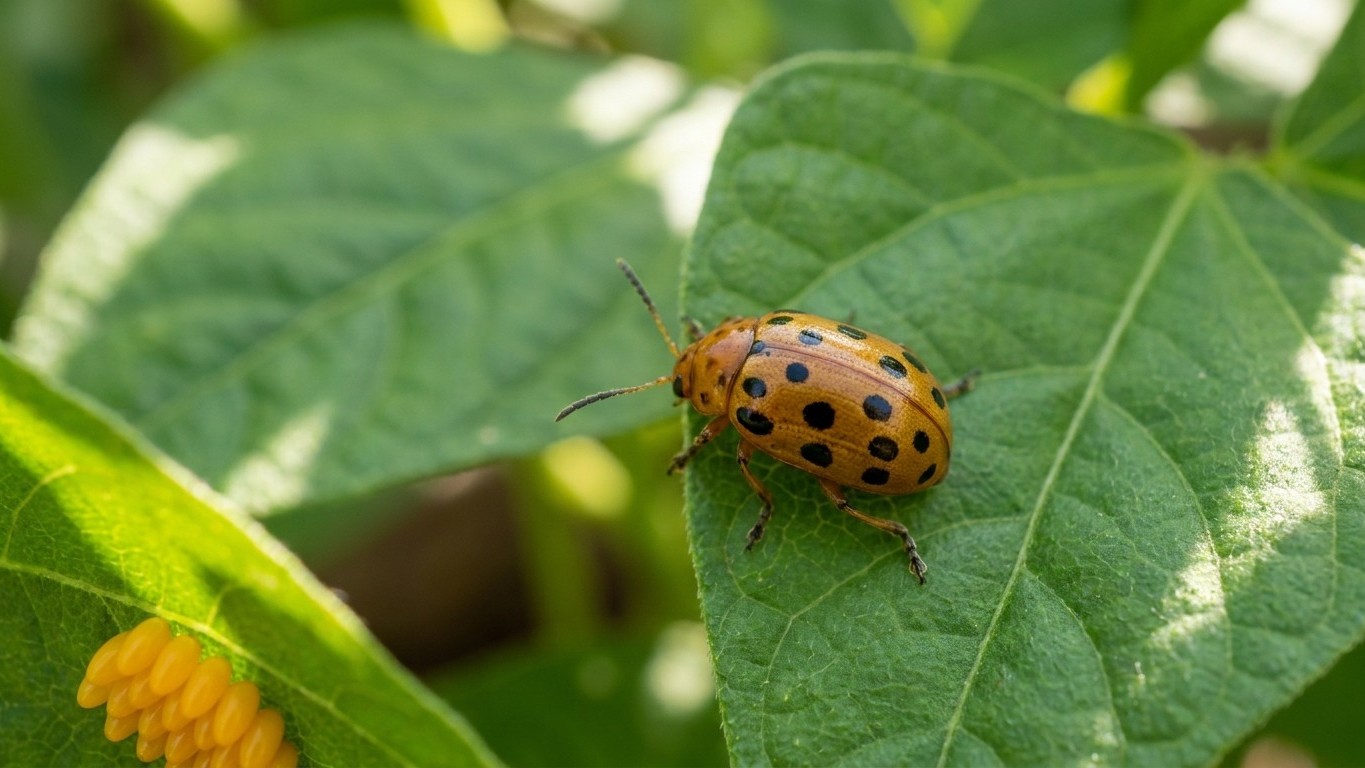
Most people see a Mexican bean beetle and assume it’s a helpful ladybug. That mistake costs a lot of bean plants. The adult is copper-yellow to golden-brown, oval-shaped, and roughly the size of a pencil eraser, with 16 black spots arranged in three neat rows across its back. It’s actually a member of the lady beetle family, one of the few in North America that feeds on plants instead of aphids.
The larvae look nothing like the adults. They’re pale yellow and covered in branching spines, giving them the appearance of tiny, soft-bodied sea urchins crawling across the underside of a leaf. Eggs are bright yellow-orange, laid in tight clusters of 40 to 60 on the leaf underside, usually starting in late spring. Spotting eggs early, before they hatch into the hungrier larval stage, gives a gardener the best shot at controlling a population before it explodes.
When Mexican Bean Beetles Show Up in Tennessee
Timing in Tennessee depends heavily on geography. The state stretches across three distinct growing regions, and the beetle’s schedule shifts with each one.
West and Middle Tennessee
In the Mississippi River bottomlands and around Memphis, soil warms faster in spring, and overwintering adults emerge from leaf litter and garden debris once daytime temperatures hold steady in the mid-60s, typically the last week of April. Nashville and the Middle Tennessee basin usually lag a week or two behind. Because the growing season runs longer here, this region often sees three generations of beetles between spring and first frost, with the second and third generations doing the most visible damage in July and August.
East Tennessee and the Appalachians
Higher elevations around Knoxville, the Tri-Cities, and the Smokies stay cooler longer, pushing beetle emergence into mid-May some years. Growers here typically deal with two generations instead of three, which sounds like good news until you realize the compressed season means both generations often overlap with the plant’s most vulnerable growth stage. A cool, wet spring can actually concentrate the damage into a shorter window rather than spreading it out.
The Damage: What to Look for in Your Bean Patch
Adults chew small, ragged holes in leaves, but it’s the larvae that do the real structural damage. They feed on the leaf’s lower surface, skeletonizing the tissue between veins and leaving behind a lacy, brown, net-like pattern that eventually causes the leaf to dry up and drop. A garden that looked healthy on a Saturday can look scorched by the following weekend once a larval generation hits its peak feeding stage, which lasts about two to four weeks.
Snap beans, lima beans, and soybeans are the primary targets in Tennessee gardens, though the beetle will feed on cowpeas and other legumes when preferred hosts run short. Heavy infestations don’t just thin out leaves. They reduce pod set and can cut yields by more than half in unmanaged plots, according to extension entomologists who track the pest across the Southeast. Pods themselves sometimes show feeding scars too, though leaf damage almost always shows up first and serves as the early warning sign.
What Actually Stops Mexican Bean Beetles
No single tactic wipes out a Mexican bean beetle population on its own. What works is layering a few methods so the beetle never gets a clean run at the crop.
Start With the Overwintering Sites
Adult beetles spend winter tucked into leaf litter, mulch, and plant debris at the edge of gardens and fence lines. Clearing out old bean plants and nearby debris right after harvest, rather than waiting until spring cleanup, removes a huge chunk of the overwintering population before it ever gets the chance to lay eggs the following year. Crop rotation helps too. Moving beans to a different part of the garden each season forces emerging adults to search harder for a host plant, buying time for natural predators to catch up.
Bring in Biological Control
The single most effective biological tool against this pest is a tiny parasitic wasp called Pediobius foveolatus. It doesn’t sting people or bother other garden insects. It lays its eggs inside Mexican bean beetle larvae, and the wasp offspring eventually kill the host. Some university extension programs in the mid-South make this wasp available for release in home gardens and small farms during early summer, timed to coincide with the first larval generation. It won’t survive Tennessee winters on its own, which means it has to be reintroduced each season, but where it’s used consistently, it can knock down populations dramatically by the second generation.
Handpicking eggs and larvae works too, especially on a small home garden scale. Checking the undersides of leaves once a week starting in early May, and crushing egg clusters before they hatch, is tedious but genuinely effective when caught early.
Row Covers and Resistant Varieties
Floating row covers placed over young bean plants in early spring block adult beetles from laying eggs in the first place, though covers need to come off once plants start flowering so pollinators can reach them. Some snap bean varieties show measurably less feeding damage than others, though resistance varies enough by region and season that it shouldn’t be the only line of defense.
When a Spray Is Worth It
For gardeners who reach a point where cultural and biological controls aren’t keeping pace, insecticidal soap or neem oil applied directly to the leaf undersides controls light to moderate larval infestations without harming most beneficial insects. Timing matters more than the product choice. Spraying when larvae are young and small, rather than waiting for adults to show up, hits the beetle at its most vulnerable stage. For heavier infestations, a pyrethrin-based product applied in the early morning or evening (to avoid harming pollinators active during the day) knocks back both larvae and adults. Reapplication is often necessary every 7 to 10 days during peak generations, particularly in West Tennessee where three generations can overlap.
One detail that surprises a lot of Tennessee gardeners: the same beetle that skeletonizes a bean patch by July can nearly disappear by September, not because it’s been controlled, but because the last generation of adults simply goes looking for winter shelter instead of laying more eggs. That seasonal lull is exactly when cleaning up bean debris does the most good, since it’s removing the beetles that would otherwise restart the whole cycle next spring.
Related guides
- Mexican bean beetle in Virginia: When It Shows Up and What Stops It
- Mexican bean beetle in Georgia: When It Shows Up and What Stops It
- Mexican bean beetle in Wyoming: When It Shows Up and What Stops It
- Mexican bean beetle in Alabama: When It Shows Up and What Stops It
- Mexican bean beetle in Delaware: When It Shows Up and What Stops It