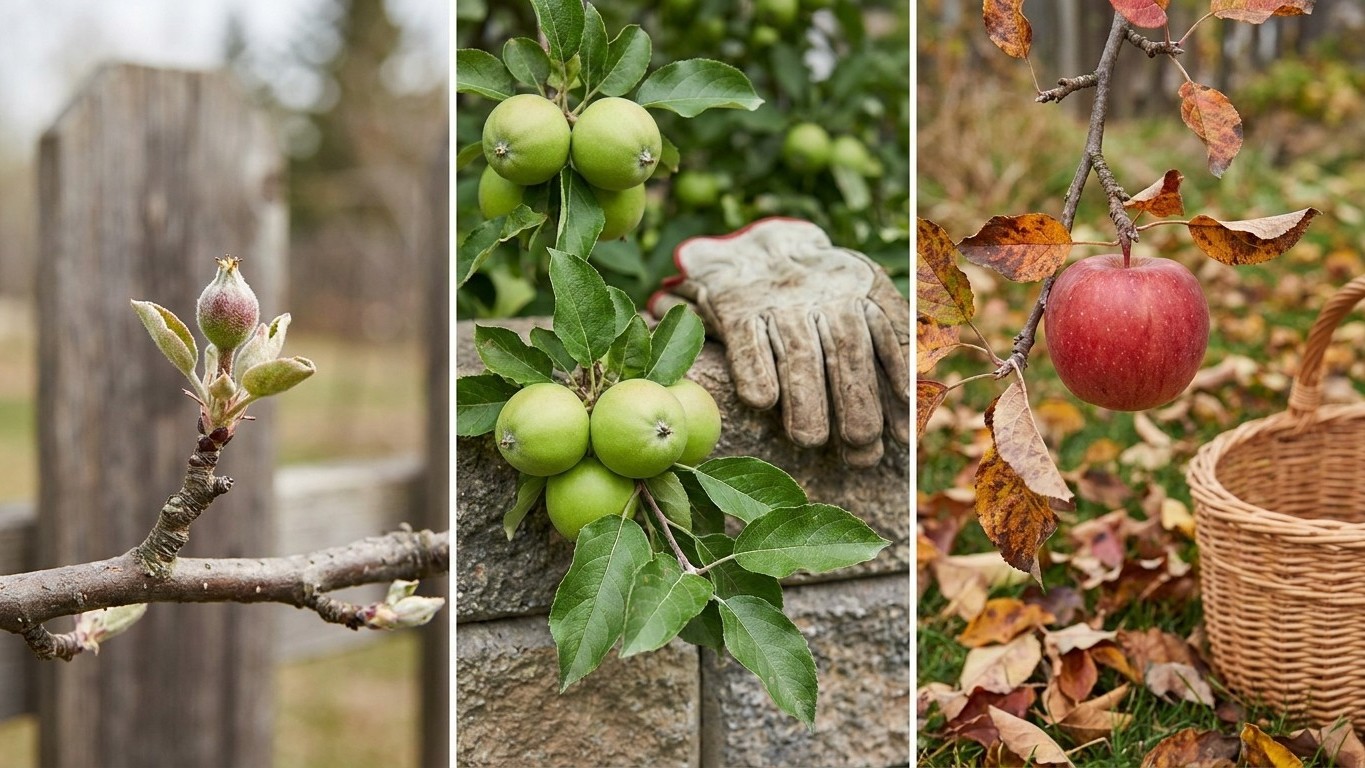

Alberta’s apple calendar runs on seven tree stages, not on the calendar month: dormancy, green tip, pink, bloom, petal fall, fruit set, and harvest. Anchored to Calgary, Environment and Climate Change Canada’s 1981-2010 normals put the average last spring frost at May 21 and the average first fall frost at September 16, and bloom in most years lands close to that spring date. The one thing to do before you spray, prune, or thin: check the bud stage on your own tree against these dates rather than trusting the month on the wall calendar.
The short answer for Alberta
Near Calgary, apple trees typically sit dormant into early spring, move through green tip and pink in April, and reach bloom around the same window as the average last spring frost of May 21, a figure from Environment and Climate Change Canada’s Canadian Climate Normals 1981-2010 at the Calgary Int’l A station. Fruit set follows within a couple of weeks of petal fall, and cold-hardy cultivars finish ripening from late summer into early fall, well ahead of the average first fall frost of September 16 from the same ECCC dataset.
That answer depends on two things the calendar alone cannot tell you. The first is which cultivar is in the ground: an early-blooming apple reaches the danger stage while frost risk is still high, while a later-blooming one buys a safety margin at the cost of a shorter finish to the season. The second is where in the province the tree actually sits. Calgary’s normals describe one station on one prairie plain. A site at higher elevation, in a river valley that pools cold air, or well north toward the Peace region will run its own calendar, usually later in spring and earlier in fall than what Calgary records.
It also helps to remember that May 21 and September 16 are means, not guarantees. Environment and Climate Change Canada’s own definition means that in roughly half of all years, frost arrives after the spring date and before the fall date given here. Treat both figures as the midpoint of a risk window, not a green light or a red light on a single day. A grower who has not yet chosen a cultivar should start with The Best Apple Varieties for Alberta before working through the stages below, since the stage timing shifts by cultivar.
Working through it

Each stage below is described by what the buds and blossom look like on the tree, because that is what actually drives the decision, not the date on a wall calendar. The Calgary-based frost normals from ECCC are used throughout to show where each stage typically falls relative to frost risk, but the stage itself, read off the tree, is what should govern any spray, prune, or protection decision.
Dormancy

The tree is bare, buds tight and closed, and this is the stage for structural pruning and for dormant oil or copper treatments if disease pressure warrants them. It runs from leaf fall through late winter and ends the moment the first bud scales begin to loosen, which on a Calgary-area tree is usually well before the May frost date, so dormancy itself is not at frost risk.
Green tip

A sliver of green leaf tissue shows at the bud tip. This is the last safe point for any remaining dormant spray, since tissue exposed after this stage is far more sensitive to both chemical injury and cold. Green tip typically arrives in April in the Calgary area, still a month or more ahead of the average last frost, so a late cold snap at this stage rarely does lasting harm.
Pink

Flower buds show colour but have not opened. This is the stage most growers watch closely, because pink tissue is markedly more frost-tender than green tip and the stage often falls close enough to the average May 21 frost date that a late cold spell can still catch it.
Bloom

Petals are fully open. This is the pollination window, and it usually lands within days of the Calgary area’s average last frost of May 21, which is exactly why an early-blooming cultivar is a gamble here: a frost during open bloom can wipe out the flowers a tree needs to set any fruit at all that year.
Petal fall

Petals brown and drop, leaving a small green fruitlet at the base. Frost sensitivity drops sharply once petals fall, and by this point most years are already past the mean frost date, though not always, which is the entire reason the mean should never be read as a guarantee.
Fruit set

Fruitlets swell from pea to marble size over the following weeks. This is the stage for thinning, and it is also the point where growth should be watched rather than pushed: heavy nitrogen feeding now produces soft, sappy growth that has no time to harden off before the first fall frost.
Harvest
Fruit reaches full size and colour. For the cold-hardy cultivars suited to this climate, that generally happens in late summer to early fall, comfortably ahead of the Calgary area’s average first fall frost of September 16, though a cultivar bred for a longer season can push right up against that date or past it in a cool year. This is where the choice of cultivar, covered in more depth at Growing Apples in Alberta, feeds straight back into the calendar: a tree that blooms and ripens later than the ones described here simply runs the whole sequence later, and needs to be checked against its own catalogue description rather than this page’s stage windows alone.
What changes across Alberta
Every date on this page comes from one station, Calgary Int’l A, and Alberta is not one climate. Elevation is the biggest single factor: sites higher into the foothills toward the Rockies sit colder overall and reach each bud stage later than Calgary, with a shorter gap between last spring frost and first fall frost squeezing the whole season from both ends.
South of Calgary toward the Rockies, the region is prone to chinooks, sudden warm dry winds that can push winter temperatures well above freezing for days at a time in the middle of the dormant season. A chinook that tricks a tree into loosening its buds early, followed by the hard refreeze that typically follows once the wind drops, is a specific local risk that a calendar built only on average dates cannot capture.
North of Calgary, and further still into the Peace River country, no ECCC normal is quoted on this page, so treat everything above as a Calgary-based baseline only. A grower in a river valley that pools cold air on clear nights, or on a north-facing slope that holds snow late, should also expect their own bud stages to run later than Calgary’s, sometimes by a week or more, and should watch the tree rather than assume the date translates directly.
The mistakes this climate punishes
Picking an early-blooming cultivar
An apple cultivar bred for a milder, longer growing season often blooms earlier relative to its own local frost date than a prairie-bred cultivar does relative to Calgary’s. Planted here, that habit puts open blossom right in the window around the average May 21 last frost, and a normal late-spring cold night can strip a season’s crop from a tree that would have been perfectly hardy in winter. This shows up in the very first spring the tree flowers, often before the grower has connected the loss to the variety choice.
Trusting winter survival alone
Hardiness and winter chill answer two different questions. Hardiness is whether the wood survives the cold at all, and Calgary’s coldest-month average minimum of -13.2 °C, from ECCC’s Canadian Climate Normals 1981-2010, rules out any cultivar rated for a milder hardiness zone before winter chill even enters the discussion. Winter chill is whether the tree gets enough accumulated cold to flower normally the following spring, and in this climate chill is rarely the binding constraint, since Alberta winters run long and cold enough that almost every cultivar gets more chill hours than it needs. The mistake is choosing on hardiness rating alone without checking that the same cultivar’s bloom timing also fits the local frost window.
Feeding late into the season
Nitrogen applied after fruit set keeps shoots growing soft and green well into late summer. That growth has no time to harden before the first fall frost, and it is the soft new wood, not the older growth, that dies back and opens the tree to disease the following spring. This mistake shows up not at harvest but the following year, as dieback on the previous season’s newest wood.
Checking this against your county
Every figure on this page comes from a single Calgary station, and your own county’s frost dates and hardiness may run differently, especially at elevation, in a valley, or north into the Peace region. Alberta’s agriculture and irrigation ministry keeps current guidance and regional contacts at alberta.ca/agriculture-and-irrigation, and that is the place to confirm local frost risk and any current cultivar guidance before committing a season’s work to a single bloom date.
| Cultivar | Published hardiness | Bloom timing (catalogue) | Typical harvest window |
|---|---|---|---|
| ‘Norland’ | Very hardy, prairie-bred | Early | Late summer |
| ‘Goodland’ | Very hardy, prairie-bred | Early to midseason | Early fall |
| ‘September Ruby’ | Hardy, prairie-bred | Midseason | Early fall |
| ‘Honeycrisp’ | Moderately hardy | Midseason to late | Fall, later than the prairie-bred cultivars above |
These are catalogue figures from nursery descriptions, and the exact date they translate to on any given tree shifts with the season and with the site, so read this table as an order of ripening rather than a fixed schedule.
Common questions
Can apples even survive a Calgary-area winter?
Cold-hardy cultivars bred for the prairies can, provided they are rated for winter temperatures at least as cold as Calgary’s coldest-month average minimum of -13.2 °C from ECCC’s 1981-2010 normals. A cultivar rated only for a milder zone is not a safe bet here regardless of how well it performs elsewhere.
Do I need two apple trees to get fruit?
Most apple cultivars need pollen from a different, overlapping-bloom cultivar to set a full crop, so a single tree of one variety often blooms with little to show for it. Check the specific cultivar’s pollination notes before assuming one tree is enough.
My tree bloomed but the frost hit right after, is it dead?
A frost that hits during or just after bloom usually kills the blossoms, not the tree. The wood itself typically survives, and the tree should leaf out and grow normally, just without much or any fruit that particular year.
Why did my tree bloom weeks earlier than this page says?
Either the cultivar is an early-blooming type not suited to this frost window, or the site itself runs warmer than the Calgary station this page is anchored to, for instance a south-facing wall or a low, sheltered yard. A chinook wind in late winter can also push buds ahead of schedule before a hard refreeze sets them back.