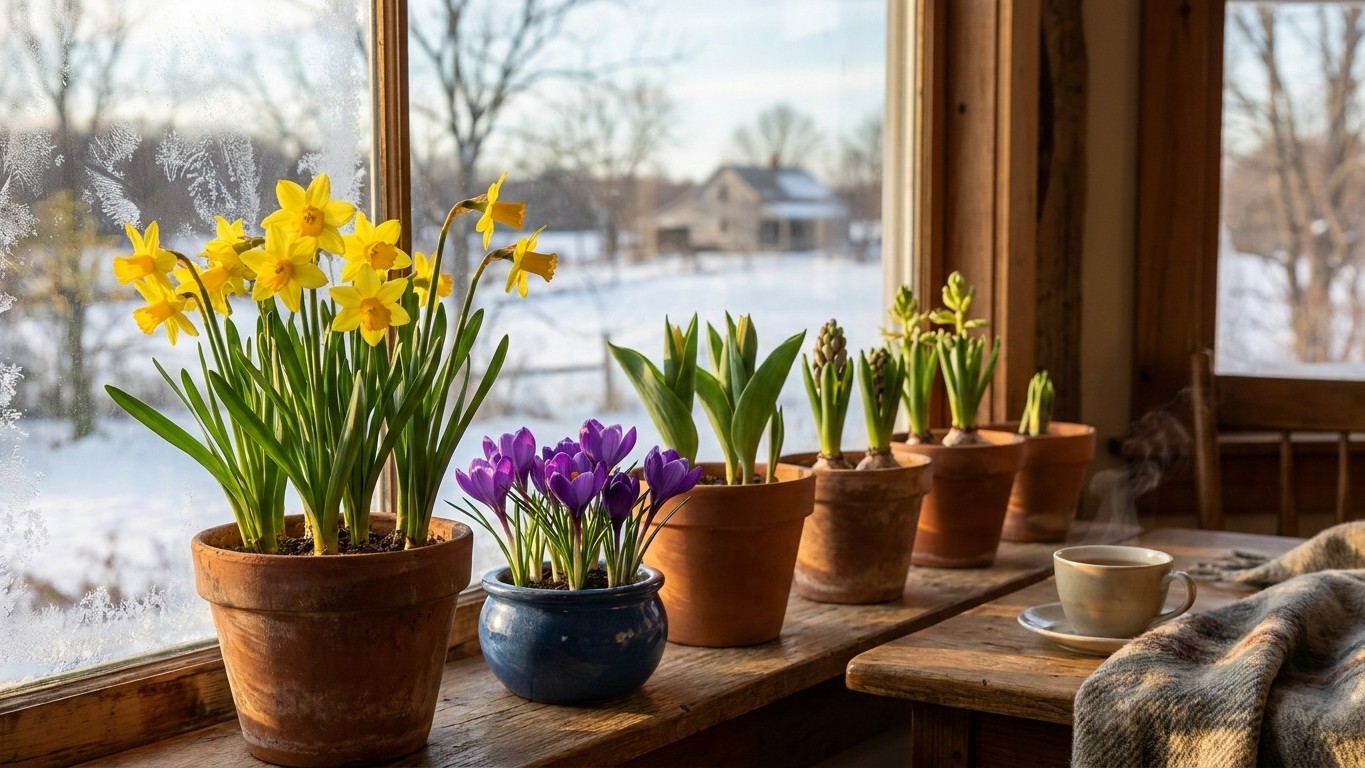

Forcing works here because West Virginia’s own cold doesn’t line up with a gardener’s calendar, not because the state lacks winter. Charleston’s coldest month averages a minimum of 26.1°F, plenty cold for chilling bulbs outdoors. The trouble is timing and containers: forcing lets you bloom bulbs indoors in the dead of winter, and it lets a potted bulb survive a cold that would otherwise freeze it solid, roots and all.
Why this matters in West Virginia

Start with the number that actually decides this: 26.1°F, the average minimum for the coldest month at the Charleston reference station (NOAA NCEI Climate Normals, 1991-2020). That’s well below the 45°F threshold spring bulbs need to break dormancy properly, which means ground-planted bulbs across most of the state get their chilling requirement met naturally, without any help. So forcing isn’t filling a gap in outdoor cold here the way it might in a warm-winter state. It’s doing something else: giving you blooms weeks or months ahead of when the garden would ever produce them, on your own schedule, on a windowsill in January instead of a flower bed in April.
Containers change the math entirely. A pot sitting on a porch or a deck doesn’t behave like garden soil. Ground only freezes from the top down, and roots several inches under the surface usually stay above the killing point even in a hard winter. A pot has no such buffer. Cold reaches it from every side, and a modest freeze that the ground would shrug off can turn the entire root ball into a block of ice. That’s a real risk in a state whose USDA Plant Hardiness Zone Map listing runs from 5a to 7a (2023 map, based on 1991-2020 normals), because a bulb rated hardy for the milder end of that range, closer to zone 7a, can die in a pot in the same backyard where it would have survived just fine in the ground.
That zone spread matters more than it looks like on a map. A gardener at higher elevation, sitting closer to 5a, is working with a colder baseline than one in a sheltered valley closer to 7a, even though both are technically “West Virginia.” Any specific recommendation about outdoor container survival has to be tied to a location, not the state-wide range, which is why this guide anchors its numbers to Charleston and flags that other parts of the state run colder. The practical upshot: if you’re forcing bulbs to bloom indoors, West Virginia’s outdoor cold is not your problem. If you’re leaving a potted bulb outside all winter and hoping it survives, it is.
How to do it here
The sequence below assumes you’re forcing bulbs indoors for winter or early-spring bloom, using either a refrigerator or an unheated space to supply the chilling period artificially. Every step is something you can check yourself with a thermometer, not a guess.
- Buy and pot bulbs in early fall, at the same time you’d be planting bulbs in the ground. Use a container with drainage holes, set bulbs close together but not touching, and leave the tips just at or slightly above the soil surface.
- Water the pot once, thoroughly, so the soil is moist but not soggy, then let it drain fully before moving it to cold storage.
- Give the pot 12 to 14 weeks of steady cold, below 45°F. An unheated garage works if it reliably stays above freezing; in a Charleston-area winter, with a coldest-month average minimum of 26.1°F, an uninsulated garage can swing below that line on the hardest nights, so check it with a thermometer rather than assuming. A refrigerator crisper drawer is the more predictable option, but keep the pot away from any ripening fruit, since the ethylene gas fruit gives off can kill the flower bud inside the bulb before it ever opens.
- Check the soil every couple of weeks and keep it barely moist, never wet. Around the ten to twelve week mark, look for pale shoots or a mat of white roots at the drainage holes; that’s the sign the chilling period is doing its job.
- Once the cold period is complete and shoots are about one to two inches tall, move the pot into a bright room kept around 60 to 65°F. Bloom typically follows within two to four weeks of that move.
- If you’re wintering a potted bulb outdoors instead of forcing it indoors, the container needs to be rated at least two hardiness zones colder than the bulb itself, or it needs to be moved into an unheated shelter and buried in mulch up to the rim. Given the state’s 5a-7a range, a bulb that’s hardy in the ground where you live may still need that extra protection in a pot.
Which bulbs are worth it
Some bulbs reward the effort of forcing and some just sit there sulking, and the difference usually comes down to how long a chilling period they need and how tall they end up. A bulb with a short cold requirement forces faster and finishes bloom sooner, which matters if you’re working around a refrigerator drawer someone else in the house wants back. A bulb that grows tall on a thin stem, meanwhile, tends to flop over in a lightweight indoor pot, even if the flower itself is fine.
Bulbs that force reliably
- Paperwhite narcissus, which needs no cold period at all and blooms within weeks of potting
- Hyacinths, sturdy-stemmed and dependable indoors
- Crocus, short-stemmed and quick to finish once chilling ends
- Muscari (grape hyacinth), compact and rarely needs staking
- Small early tulip varieties, chosen specifically for their short stems
Bulbs that tend to sulk
- Large trumpet daffodils, which grow tall and top-heavy in a light pot
- Standard tall tulip varieties, prone to flopping once the flower opens
- Alliums, which need a long chilling period and grow too tall for most indoor setups
One thing worth knowing before you start: most forced bulbs, tulips especially, have spent their stored energy by the time they finish blooming indoors and rarely come back with a good flower even if you plant them outside afterward. For a bulb like that, which was never going to be a repeat performer anyway, treating it as a one-season purchase costs you nothing extra. Paperwhites are the clearest example of this, since they’re typically discarded after bloom regardless of whether they were forced or not.
What goes wrong, and when you can still fix it
Leaves but no flower
This means the bulb didn’t get enough cold before you brought it into warmth, so it grew foliage but never developed a flower bud strong enough to open. There’s no fixing it this season; the bulb has already spent the energy it had. If you want to try it again, replant and give it the full 12 to 14 weeks next time, checked against a thermometer rather than a guess about how cold the storage space actually got.
Flower on a stem too short to see
This happens when the pot was moved into warmth too early, before the shoot had time to elongate during the cool transition. The flower is there, just buried low in the foliage. Nothing to do this season except let it finish and enjoy it at a low angle. Next time, wait until shoots are the full one to two inches recommended before moving the pot to a warm room.
Rot in the pot
Soft, mushy bulbs or a smell of decay almost always trace back to a container that never drained properly, leaving the bulb sitting in water during the cold storage period. This one isn’t salvageable; a rotted bulb won’t recover. The fix belongs to the next attempt: drainage holes that actually drain, and soil kept barely moist rather than wet through the entire chilling period.