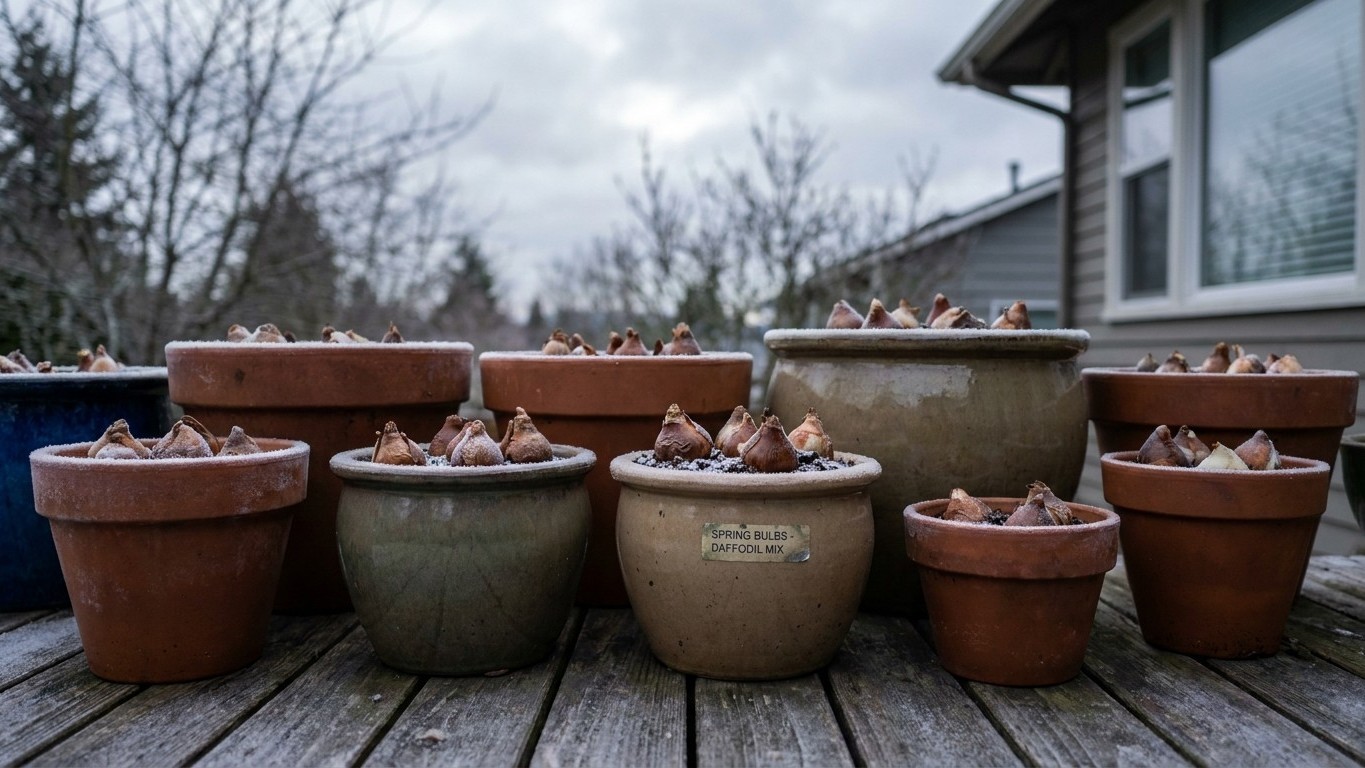

Yes, spring bulbs do well in containers in Washington, but the pot rewrites the rules that apply to a garden bed. A container has no surrounding soil mass to buffer temperature swings, so the same tulip or daffodil that shrugs off a Puget Sound winter in the ground can freeze solid, roots included, in an unprotected pot left on a porch.
Why this matters in Washington

Start with the number that actually decides this: NOAA NCEI’s 1991-2020 Climate Normals put Seattle’s coldest month at an average daily low of 37.1°F. That figure sits well below the 45°F line a spring bulb needs to cross for its twelve to fourteen weeks of chilling. Forcing exists to solve the opposite problem, a winter that never gets cold enough long enough. Seattle’s winter clears that bar on its own, month after month, so a bulb planted straight in the ground here rarely needs a gardener to manufacture cold for it.
Containers change the calculation entirely. A pot sitting above ground has air moving around all four sides and the bottom, with none of the thermal mass a garden bed has to slow a freeze down. When outdoor air drops well below freezing, a container can freeze straight through, roots and bulb together, at temperatures the same bulb would survive without trouble if it were planted in the ground three feet away.
That gap matters more in Washington than in most states, because the USDA Plant Hardiness Zone Map (2023 edition, built on the same 1991-2020 normals) spans zone 4a to zone 9a across the state. That’s the difference between a mountain valley in the Cascades or northeastern counties, where winter can hit truly severe extremes, and the mild, marine-buffered zone around Seattle. A hardiness zone number is built for plants rooted in open ground. Cite the reference station rather than the statewide range when deciding what a container can handle, because a bulb rated hardy for the Seattle area’s zone is not automatically hardy for a pot sitting on a deck in a colder inland county.
The practical upshot: gardeners in and around Seattle are mostly fighting the container’s exposure to freeze, not a shortage of natural chill. Gardeners further inland or at elevation are fighting both, and need to treat their pots as if they were gardening at least two zones colder than the map states for their area.
How to do it here
The steps below apply whether the goal is an indoor bloom out of season or simply healthy container plants that come back through a Washington winter outdoors.
- Check the bulb’s tag for its hardiness zone rating, then compare it to where the pot will actually sit through winter, not to the zone your county falls into on a map.
- Pick a container rated at least two USDA zones hardier than the bulb requires, or accept that you’ll need to move the pot to shelter once temperatures drop hard.
- Use a pot with real drainage holes and a loose, well-draining potting mix. Standing water around a bulb in a container does more damage over a wet Washington winter than cold ever will.
- Plant at the depth given on the bulb’s packaging, pointed end up, and water once to settle the soil.
- If the goal is forcing a bloom ahead of the natural season, supply twelve to fourteen weeks below 45°F yourself: an unheated garage that stays above freezing works, as does a refrigerator crisper drawer kept away from ripening fruit, since the ethylene gas fruit gives off will kill the flower bud inside the bulb before it ever opens.
- If you’re not forcing, leave the pot outdoors through winter but move it against a house wall or into an unheated garage during hard freezes, and mulch the surface of the soil to slow how fast cold reaches the bulb.
- Bring a chilled pot into warmth gradually, a few days in indirect light before full sun or a warm room, rather than straight from cold storage into heat.
- Check soil moisture by feel rather than by schedule. Water only once the top inch has dried out, and never let the pot sit in a saucer of standing water.
Which bulbs are worth it
Not every bulb pays back the effort of a container. A short chilling requirement forces faster and more reliably, while a tall flower stalk on a lightweight pot is an invitation to topple in the first stiff breeze off the water. A few bulbs are worth planting in a pot precisely because they were never coming back for a second year regardless, so pushing them hard costs nothing long term.
- Paperwhite narcissus, which need no cold period at all and bloom reliably indoors on a schedule
- Hyacinth, short chill requirement and a sturdy, low stem that stands up in a pot
- Crocus, a short chilling window and a low profile that never risks tipping
- Miniature daffodils such as Tete-a-tete, short stems that stay upright where full-size trumpet daffodils fall over
- Muscari (grape hyacinth), low growing and forgiving of an imperfect chilling period
The bulbs that sulk in containers tend to be either too tall for the pot’s weight or too demanding on timing to forgive a mistake.
- Tall trumpet daffodils (King Alfred type), whose height and top-heavy flower routinely tip a lightweight pot
- Alliums, where the flower head’s weight outpaces most container’s stability
- Standard tulips, which need a long, precise chill and rarely rebloom well after container forcing, making them a one-season purchase either way
- Fritillaria, notorious for uneven results when the chilling period isn’t exact
What goes wrong, and when you can still fix it
Leaves but no flower
Foliage that comes up green and healthy while the flower never forms almost always means the chilling period ran short of the twelve to fourteen weeks a bulb needs below 45°F. Once that window is missed, the flower bud inside the bulb simply never finished developing, and there’s no way to coax it into blooming this season. The bulb itself is usually fine. Replant it and give it the full chilling period next time.
A flower on a stem too short to see
A bloom that opens low, almost buried in the foliage, usually means the pot was moved from cold storage into full warmth too fast, before the stem had time to elongate normally. This season’s flower will still open, just stunted. The fix for next time is moving a chilled pot into bright, cool light for several days before exposing it to full indoor heat.
Rot in the pot
Bulbs that turn soft, yellow, or mushy almost always trace back to a pot that never drained. Once a bulb has gone soft, it will not recover this season and should be discarded rather than replanted. The container’s drainage, on the other hand, is a one-time fix. Add holes or a gravel layer before the next planting, and the same pot will serve every bulb that goes into it afterward.