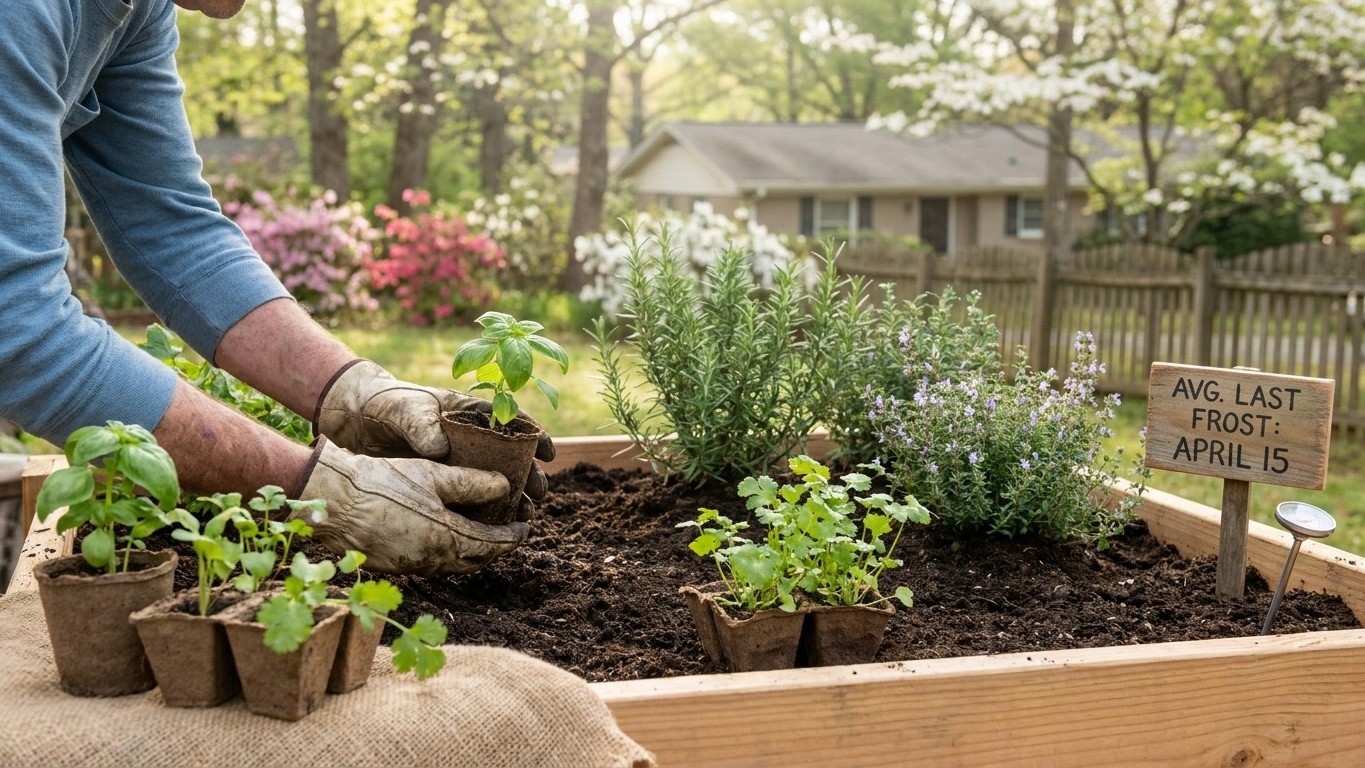

Western Washington’s frost-free window runs from roughly February 27 to March 18 on the early end, and closes between November 13 and November 30 in fall. But herb planting here doesn’t follow that window literally, cold, saturated soil and short daylight hours keep the ground too sluggish for seed germination weeks after the freeze risk has passed.
The short answer for Washington
The NOAA frost dates for the Seattle-area station (USW00024233) mark a 30-70% probability band for a 32°F freeze, not a planting deadline. That distinction matters more here than almost anywhere else in the country, because western Washington’s spring soil temperature lags the air temperature by weeks. A soil thermometer stuck in raised-bed dirt in early March often reads in the low 40s, even on a day when the air feels mild. Basil, cilantro seed, and most tender annual herbs need soil in the mid-50s or warmer to germinate reliably, so the practical herb-planting window opens well after the last-frost band closes, typically once soil has had a few weeks of longer daylight to warm through.
Cold-hardy herbs work differently. Chives, parsley, and cilantro (again, but for a fall crop) tolerate soil in the 40s and can go in the ground close to the tail end of the frost-probability window, sometimes even a little before it, since a light frost rarely kills an established seedling of these species. The mean daily minimum of the coldest month at the Seattle reference station is 37.1°F, a number that describes typical winter cold, not the rare hard freeze, and it explains why perennial herbs like thyme, sage, and oregano overwinter outdoors across most of the lowland Puget Sound area without protection.
A rough split by herb type
| Herb type | When relative to the frost window | Why |
|---|---|---|
| Chives, parsley, cilantro (spring sowing) | Near the start of the frost-probability band | Tolerates cool, damp soil; frost rarely kills seedlings |
| Basil, tender annual herbs | Weeks after the frost band closes | Needs warm soil to germinate; cold soil rots seed |
| Thyme, sage, oregano (perennials) | Planted anytime in the growing season | Overwinters outdoors given the 37.1°F coldest-month minimum |
| Cilantro, parsley (fall sowing) | Roughly two months before the fall frost band | Needs time to establish before daylight drops |
This page has no verified data for what a first-frost or last-frost date looks like east of the Cascades. That’s a real gap, not an oversight to smooth over, the region beyond the mountains is high desert with a shorter, hotter, drier season, and a Seattle-based frost window would mislead a gardener there.
What will not work here

Basil sown directly in the ground on the theoretical last-frost date is one of the most common herb failures in this region. Air temperature might clear 50°F, but soil that’s been sitting under weeks of Pacific Northwest drizzle stays cold and wet at root depth, and basil seed simply rots before it germinates. The fix isn’t a different variety, it’s a later date, or starting seed indoors and transplanting once soil has caught up.
Rosemary planted in an exposed, low-lying spot is another repeat failure. The 37.1°F coldest-month minimum describes an average, gentle winter, but cold air pools in low spots and against north-facing walls, and a rosemary plant that would otherwise handle a typical Puget Sound winter can be knocked back hard by one of those pockets. Raised beds, south-facing walls, and anywhere air drains rather than collects make the difference between a rosemary that limps through February and one that doesn’t come back at all.
Herbs planted at tight, humidity-friendly spacing struggle for a different reason. Western Washington’s growing season pairs mild temperatures with persistent moisture and often gray, low-light stretches, especially in spring and again in fall. Basil, dill, and cilantro packed close together in that kind of air don’t dry off between waterings or rain events, and powdery mildew or downy mildew moves through a bed fast. Wider spacing than a seed packet recommends, and airflow between plants, matters more here than in a drier climate where the same spacing would be fine.
Heat-loving herbs pushed too early meet the opposite problem. Basil and other warmth-dependent herbs set out while nights are still cool don’t die outright, but they sit and sulk instead of growing, and a stalled plant is more vulnerable to slugs, which are abundant in the damp lowland soil here for most of the growing season. A herb that isn’t actively growing is an easy meal.
None of this points to a single “worst” herb for the region. It points to a mismatch between herb and moment: cold-tender seed meeting cold wet soil, cold-tender plants meeting cold air pockets, and tightly spaced foliage meeting a humid microclimate that punishes crowding. Each failure traces back to the same regional trait, a mild, wet, slow-to-warm climate rather than a harsh one.
What changes across Washington
The USDA hardiness zone range for the state runs from 4a to 9a, which is one of the widest spreads a single state can show on the Plant Hardiness Zone Map. That’s not a small variation, a plant that overwinters without trouble in a 9a garden can die outright in a 4a one, and the difference has nothing to do with the frost dates cited above, since those figures come from a single western Washington station and don’t describe the whole state.
The general pattern follows geography rather than a straight north-south line. Low-elevation areas near Puget Sound and the coast sit toward the milder end of the range, buffered by the ocean and by the marine air that keeps winter lows from dropping too far too often. Move east across the Cascades, and the climate shifts to a continental, high-desert pattern with colder winters and hotter, drier summers, a different growing season entirely, not just a colder version of the same one. Gain elevation anywhere in the state, whether in the foothills or the mountains themselves, and the zone number drops further, sometimes sharply within a short distance.
A reader gardening at higher elevation or east of the mountains should expect to shift a perennial herb’s outdoor planting later, treat borderline-hardy herbs like rosemary as needing winter protection or annual replacement, and plan the season around a shorter frost-free stretch than the western Washington dates on this page describe. A reader in a low, mild coastal pocket can often push borderline perennials with less worry and start warm-season herbs a little sooner, once soil catches up.
This page can’t tell an individual reader which zone applies to their own yard, that’s what the USDA Plant Hardiness Zone Map is for, and it’s worth checking by ZIP code before betting a perennial herb bed on an assumption drawn from a statewide range this wide.
Where to check this for your own county
Washington State University’s Extension service, at extension.wsu.edu, is the right next stop for county-level answers. The frost dates and coldest-month figure cited above come from one weather station in the Seattle area, and a state this varied in elevation and climate needs local numbers, not a statewide average, before a planting date turns into a real decision.
Two things are worth looking for once there. First, a county-level planting calendar, if the local extension office publishes one, these typically translate frost-date probabilities into actual sowing windows for the specific soil and elevation of that county, which does the work this page’s statewide frost data can’t do alone. Second, any list of herb or vegetable varieties trialled by WSU’s local research stations or master gardener programs for that county’s conditions. Varieties tested and recommended for a specific county’s soil, rainfall pattern, and season length carry more weight than a general herb-growing guide, because they’ve already been checked against the local climate rather than a generic one.
A county recommendation beats a state one every time, and that’s worth saying plainly: this page describes Washington in general terms, built from a single reference station and a statewide hardiness range spanning five zones. It’s a starting point for understanding how the state’s climate works, not a substitute for what the local extension office knows about a specific county’s soil and season. Anyone gardening seriously, especially with perennial herbs meant to survive multiple winters, gets more accurate guidance from that county-level source than from any statewide frost-date table, including this one.
Checking this against your own garden
Frost dates and hardiness zones describe averages built from decades of weather records, but a single yard rarely matches the average exactly, and the most reliable signals come from the garden itself rather than a chart.
Soil warmth by feel is the first check. Pushing a bare hand into the top few inches of a bed and comparing it to how it felt a week or two earlier gives a rough but honest read on whether the ground has actually warmed enough for tender herb seed, regardless of what the calendar says the date should be. Cold, sticky, resistant soil means basil seed will most likely rot if it goes in now; loose, slightly warm soil that crumbles easily is a much better sign.
The first true leaves on any herb seedling started indoors or bought as a start are the second signal worth watching. Seed leaves (the first, simple pair that emerge at germination) don’t tell much, but the first true leaves, the ones that actually look like the mature plant’s foliage, signal that the seedling has enough root and leaf development to handle transplant shock, and that timing matters more than a date on a calendar.
Established perennial herbs like sage, thyme, or oregano putting out new growth after winter is the third. New leaf growth at the base or tips means the plant has come out of dormancy and the coldest stretch, in that specific yard, has likely passed, regardless of what a regional frost date suggests. A plant reading its own microclimate is, in the end, a more current instrument than any historical average, it’s responding to this year’s actual weather, in this actual spot, rather than a thirty-year mean drawn from a station somewhere else in the state.
If you follow the almanac, here is when to plant herbs by the moon. It is a tradition, not a proven method.