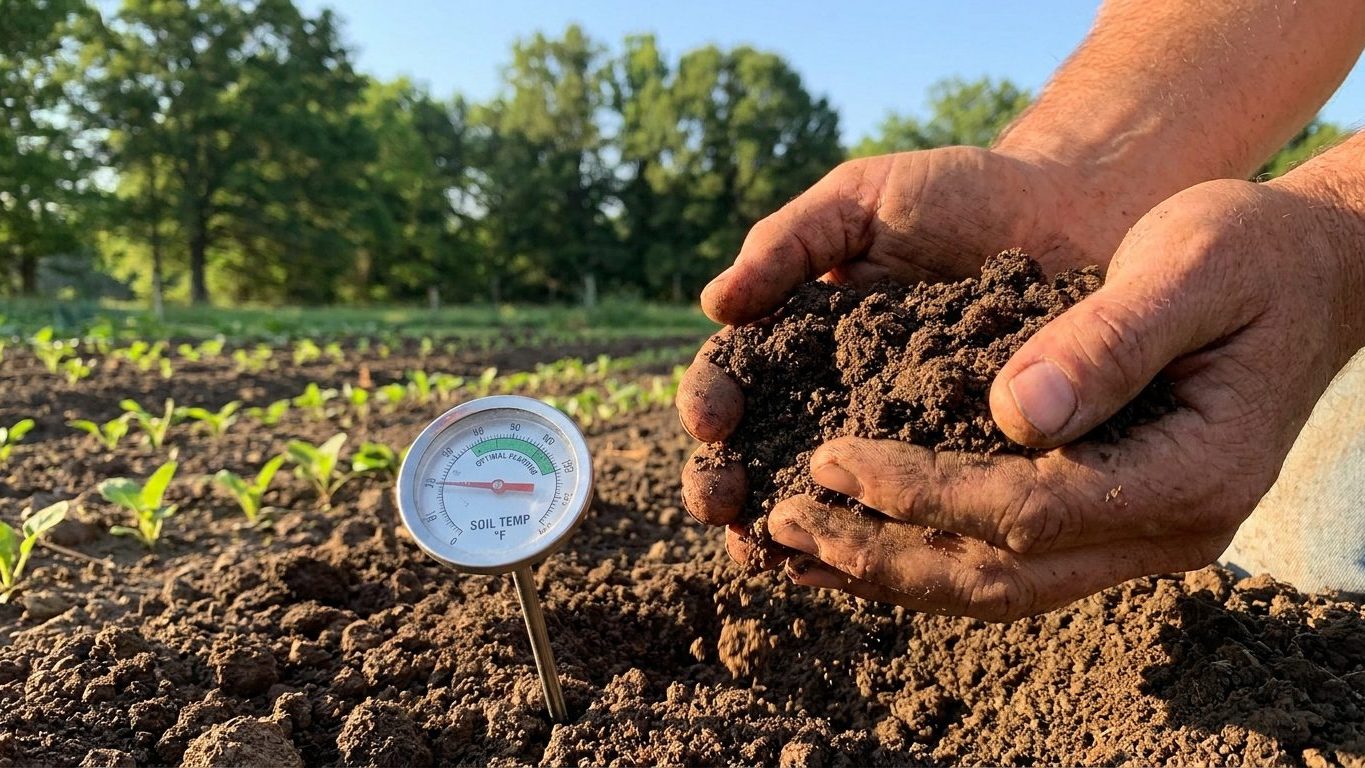

Winter Squash in Washington splits into two very different growing realities: a long, cool, damp season west of the Cascades and a shorter, hotter, drier one east of them. The safe answer for most home gardeners near the Puget Sound corridor is to wait until late spring, once soil has actually warmed, and to pick a type suited to slow-ripening, humid summers rather than blazing heat.
When the soil is warm enough in Washington

The last spring frost at the Seattle-area reference station (USW00024233) falls somewhere between February 27 and March 18, based on NOAA’s 1991-2020 Climate Normals and their 30-70% freeze-probability band. That’s a genuinely mild window by national standards, and it’s tempting to read it as a green light for early planting. It isn’t.
A frost date only tells you when the air stopped reliably dropping to 32°F. It says nothing about the soil, and winter squash germinates and grows on soil temperature, not calendar dates. In western Washington’s maritime climate, soil stays cold and waterlogged well past that last freeze because spring here brings persistent cloud cover and slow-draining rain rather than a quick warm-up. Low light levels through April and into May also slow root development even when the thermometer looks encouraging. The practical result: gardeners who direct-seed squash right after the “last frost” window often watch seed sit and rot rather than sprout.
The frost date itself is also a probability, not a guarantee. The 30-70% band from NOAA means there’s meaningful frost risk on either side of it in a given year, so treat it as a planning range rather than a fixed line on the calendar.
There’s a second, larger caveat that matters more here than in most states. That February 27 to March 18 window comes from a station representing the mild, maritime side of the Cascades. Eastern Washington is high desert, with a shorter frost-free season and a completely different rhythm. Applying the Seattle-area window to a garden in the Columbia Basin or the Palouse would be a mistake; those growers are working with a narrower, later-opening season shaped by continental extremes rather than Pacific moisture.
For most western Washington gardens, the practical move is to start squash indoors or in a protected spot several weeks before the ground would ever support direct seeding, then transplant once soil has genuinely warmed and dried out enough to work. Waiting for warm soil, not just frost-free air, is the real trigger here.
How long the season lasts here
Pair the spring numbers with the fall side of the same NOAA dataset. The first fall frost at that same reference station arrives between November 13 and November 30. Put both ranges together and the frost-free window in western Washington runs somewhere between roughly 238 days, if spring frost lingers to March 18 and fall frost arrives early on November 13, and roughly 277 days, if spring frost breaks early on February 27 and fall frost holds off until November 30.
Either end of that range describes a long growing season by squash standards. Winter squash is a crop that takes most of a summer to fill out and mature, so a season stretching close to eight or nine months gives real breathing room, even if soil-warming delays push the actual planting date into late spring rather than the theoretical frost-free start.
That length matters for a specific decision: whether transplanting is worth the trouble. In a short-season territory, every week saved by starting indoors counts directly toward getting fruit to full maturity before frost. In western Washington’s long window, the calculus shifts slightly, transplanting is still useful because it sidesteps the cold, slow-draining spring soil, but the season itself isn’t the tight constraint it would be in a place with a compressed frost-free period.
A long window like this also opens the door to succession sowing for other, faster-maturing crops planted around the squash bed, even though winter squash itself typically only gets one sowing per year given how long each plant needs on the vine. Anyone looking to stack additional plantings into that space through the season should check the succession sowing guide on this site for how to sequence it.
Eastern Washington’s high desert climate isn’t covered by this station’s numbers, but its season runs shorter and opens later than the maritime side, which changes both of these calculations for gardeners on that side of the mountains.
Heat and water in Washington

This is where the Seattle-area climate diverges sharply from the stereotype of a Western summer. The reference station logs an average of just 3.0 days a year at or above 90°F. That’s not a typo, and it’s not a description of the whole state, it’s a count at one specific maritime station, but it captures something real about western Washington summers: they’re mild, not hot.
Summer rainfall backs that up in a different way. The region gets about 3.0 inches of rain across June, July and August combined, out of 39.3 inches for the full year, with July running driest at just 0.6 inches (June comes in at 1.45 inches, August at 0.97). So summers here are dry relative to the rest of the year, but they aren’t hot and dry the way a desert climate is. That combination, low heat load plus a dry-but-mild summer, changes what actually threatens a squash crop.
Winter squash is the crop where season length decides everything: each fruit has to mature fully on the vine before frost, because an immature squash won’t cure properly and won’t store. In a hot, dry territory, irrigation is what carries fruit through its filling stage. Western Washington isn’t that territory. With only three days a year reaching 90°F, heat stress on the plants is rarely the issue. The bigger risks are slow ripening, because there simply isn’t a lot of heat accumulation to push fruit toward maturity, and disease pressure from the lingering dampness that shows up outside the driest summer months, particularly powdery mildew on leaves and vines when air circulation is poor.
None of this means irrigation is irrelevant. Even with modest summer rainfall, that water arrives unevenly, and how much of it actually reaches squash roots depends on the garden’s own soil. A sandy plot lets 3 inches of summer rain drain through almost immediately and needs supplemental watering regularly through the dry months. A clay-heavy plot holds that same rain for a week or more and needs far less intervention. A rain gauge on the actual site, not a regional average, is what settles that question for any individual garden.
Which winter squash suit Washington
Given a cool, low-heat, moisture-prone maritime summer on one side of the state and a hot, dry, shorter high-desert season on the other, the type of winter squash that makes sense in Washington depends heavily on which side of the Cascades a garden sits on.
West of the mountains, with only about three days a year above 90°F and a season that’s long but light on heat units, the earliest-maturing types in the winter squash family have the best odds of fully ripening and curing before that mid-to-late November frost arrives. Because summer dampness (even in a comparatively dry season) raises disease pressure, types bred or selected for resistance to powdery mildew are worth prioritizing over types chosen purely for size or storage length. Spacing vines for airflow, rather than letting them sprawl into a dense mat, does more for disease control here than any spray program would.
East of the mountains, in the high desert climate this page’s sourced data doesn’t cover, the priorities flip: heat tolerance and consistent irrigation through a hot, dry stretch matter more than disease resistance, and the shorter frost-free season there rewards the same early-maturing instinct for a different reason, less total season to work with rather than too little heat.
What this page won’t do is name a specific variety. Squash cultivars are trialled year after year by land-grant universities specifically because performance shifts with local soil, elevation and microclimate, and a name that performs well at a coastal trial garden can underperform completely on the dry side of the state, or the reverse. Washington State University Extension (extension.wsu.edu) publishes exactly that kind of regionally tested variety information, broken out by the state’s very different growing zones, which the USDA Plant Hardiness Zone Map (2023, based on 1991-2020 normals) reflects with a range spanning zone 4a to 9a across the state. That’s too wide a range for one page to responsibly narrow down to a single recommendation, so the honest next step is checking that local trial data before choosing seed.